


The Department of Health (DOH) designated infections of the H7N9 avian influenza strain as a notifiable disease yesterday, one day after four more cases of the bird-flu virus new to humans were reported in China.
Meanwhile, Chinese authorities later yesterday reported that two more people had contracted the new bird flu, one of whom has died, bringing the total number of known cases to nine and the number of deaths to three.
“We have decided to list H7N9 infection as a category five notifiable disease,” Department of Health Minister Chiu Wen-ta (邱文達) said after hosting a meeting with disease control experts.

Photo: Yao Chieh-hsiu, Taipei Times
The department has also decided to raise the quarantine alert for the H7N9 flu strain from Grade 2 to Grade 3, Chiu said.
A national-level H7N9 epidemic prevention and control center was also activated at 6pm yesterday, with Premier Jiang Yi-huah (江宜樺) presiding over the center’s opening.
Centers for Disease Control Director-General Chang Feng-yee (張峰義) will serve as the new control center’s chief, Chiu said.
Chinese health authorities said on Tuesday that three women and a man, from various cities in Jiangsu Province, have fallen critically ill from the H7N9 virus. The cases were the second batch to be confirmed in China after three in Shanghai and in Anhui Province on Sunday.
Chinese authorities reported yesterday that a 38-year-old cook became ill early last month while working in Jiangsu Province. He died in hospital in Hangzhou on Wednesday last week, the Xinhua news agency reported.
Samples taken from him tested positive yesterday for the new H7N9 strain.
The second patient, also in Hangzhou, is a 67-year old who is under treatment. Xinhua said no connection between the two cases had been discovered and no one in close contact with either patient had developed any flu-like symptoms.
The Chinese news Web site Chinanews.com said the four patients in Jiangsu all reported varying symptoms of dizziness, fever, coughing and breathlessness.
The Chinese Ministry of Agriculture said it had yet to find any animals infected with the H7N9 virus, but added it was possible that H7N9 had been brought to China by migratory birds.
In Taipei yesterday, Council of Agriculture Deputy Minister Wang Cheng-teng (王政騰) said tourists from China have been barred from visiting poultry farms nationwide over concerns about avian influenza.
Huang Kuo-ching (黃國青), deputy head of the Bureau of Animal and Plant Health Inspection and Quarantine, said the bureau has advised poultry farm operators to reject visits by Chinese tourists.
On Tuesday, when commenting on Taiwan’s ability to cope with a possible threat from the disease, Steve Chan (詹啟賢), chairman of the Taichung-based Adimmune Corp (國光生技), said that although there is no specific vaccine for H7N9 — a new variant — it is a “sibling” of the more commonly seen H5N1 virus, for which a vaccine already exists.
Should there be a major outbreak of H7N9, he said, it would take Adimmune just two months to produce between 5 million and 10 million doses of the vaccine.

A signaling system malfunction disrupted high-speed rail (HSR) services beginning at 8am today, with trains temporarily reduced to three northbound and three southbound trains per hour as authorities conduct inspections. The malfunction occurred on a section of track in Miaoli County during pre-operation checks early this morning, forcing northbound and southbound trains to use a single track, the HSR operator said. The regular schedule has been replaced with three hourly trains offering only nonreserved seating in each direction, stopping at every station, it said, adding that business class cars would still have reserved seating. Departures from terminal stations are scheduled at the top

DRONE CENTRAL: Taiwan aims to become Asia’s democratic hub for drones, with most exports focused on high-quality military-grade models, an official said Taiwan’s drone industry is expected to expand significantly by 2030, producing 100,000 units per month and exporting half of them, the Ministry of Economic Affairs said yesterday. Current drone production capacity is about 15,000 units per month, but the industry can quickly scale up as demand increases, Industrial Development Administration Director-General Chiou Chyou-huey (邱求慧) told a news conference in Taipei. Taiwan’s drone output grew 2.5-fold last year to NT$12.9 billion (US$408.3 million) under a government program to develop the uncrewed vehicle sector, he said. The Executive Yuan in October last year approved plans to invest NT$44.2 billion into domestic production of uncrewed aerial

VERBOSE VESSELS: A CGA cutter and a China Coast Guard exchanged verbal barbs for more than a day in Taiwanese-controlled waters before the Chinese vessel left The Taiwanese and Chinese coast guards had a standoff near the strategically located Pratas Islands (Dongsha Islands, 東沙群島) in the north of the South China Sea, the Coast Guard Administration (CGA) said yesterday. The two sides engaged in intense radio exchanges over sovereignty claims during the 33-hour standoff. China Coast Guard vessel 3501 eventually left the restricted waters, 26.6 nautical miles (49.2km) west of the Pratas Islands, at 5pm yesterday, the CGA said. Lying approximately between southern Taiwan and Hong Kong, the Taiwan-controlled Pratas are seen by some security experts as vulnerable to Chinese attack due to their distance — more than
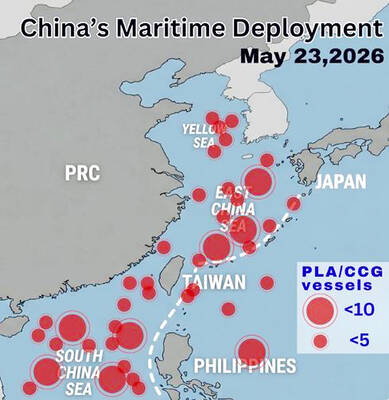
WARNING: China should stop engaging in actions that undermine regional peace and stability, as it would only build resentment among people across the Strait, the CGA said China has deployed more than 100 navy, coast guard and other vessels in waters from the Yellow Sea to the South China Sea and the western Pacific since US President Donald Trump and Chinese President Xi Jinping (習近平) met in Beijing, National Security Council Secretary-General Joseph Wu (吳釗燮) said yesterday. “In this part of the world, #China is the one & only PROBLEM wrecking the #StatusQuo & threatening regional peace & stability,” Wu wrote on X. In a separate post, he said Beijing was coercing Taiwan’s maritime domain, calling it illegal and provocative, after the Coast Guard Administration (CGA) expelled a


 RSS
RSS