


Thousands of mourners marched yesterday in the Egyptian city of Port Said at the funeral of people killed in clashes triggered by death sentences on supporters of a local soccer team.
Bodies wrapped in white shrouds were carried in open coffins by a sea of mourners along the city’s main avenue.
A brief burst of gunfire sent mourners running in several directions amid chaotic scenes before calm was restored.
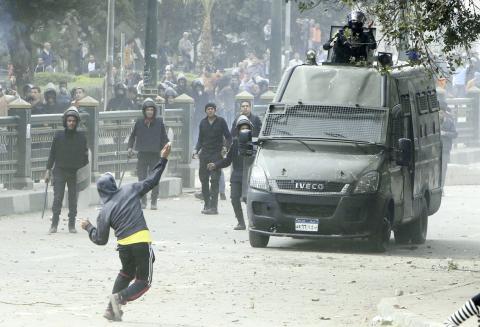
Photo: Reuters
“Our city is being hit by the interior ministry!” and “Down with Brotherhood rule!” the crowd chanted.
On Saturday, 31 people were killed in the city in clashes with police after a Cairo court handed down death sentences on 21 supporters of Port Said’s Al-Masry soccer club.
There was no police presence securing yesterday’s funeral, and shops and businesses remained closed for a second day, witnesses said.
The burials came after a day of rioting in Port Said and Suez and deadly protests in Cairo against Egyptian President Mohamed Morsi, highlighting deep political divisions and long-standing tensions between police and protesters.
In Cairo, overnight clashes on the outskirts of Tahrir Square — the symbolic heart of the uprising that ousted former Egyptian president Hosni Mubarak in 2011 — continued into yesterday, with one bridge blocked off and the heavy smell of tear gas hanging in the air.
Overnight, demonstrators blocked the 6 October bridge, a vital flyover linking east and west Cairo, and burned cars as police clashed with masked protesters on the Nile corniche.
Trouble flared on Saturday just minutes after the verdict in the trial of last year’s soccer riots that left 74 people dead. The violence followed a clash between Al-Masry and Cairo’s Al-Ahly.
Many Egyptians believe the deadly stadium violence was orchestrated either by police or by Mubarak supporters, and any verdict was likely to trigger a highly charged response.
Cairo soccer fans had threatened widespread chaos if justice was not served, and Port Said residents said the ruling was politically motivated.
“The government delivered a political ruling that sacrificed our children to avoid chaos,” said Ashraf Sayyed, a resident of the canal city.
“Our children are the scapegoats used to restore calm in the rest of the country,” Sayyed said.
On Saturday, protesters in Port Said attacked police stations and set tires alight and relatives of those who were sentenced clashed with security forces as they tried to storm the prison in Port Said where the defendants are being held.
Medics said all the fatalities were from gunfire.
Crowds stormed two police stations as heavy shooting crackled through the city, where shops and businesses had closed, a correspondent said.
Ambulances ferried the injured to hospitals and mosques urged worshipers to donate blood.
The army deployed troops to restore calm and protect vital public buildings, military sources and witnesses said.
Clashes also erupted in the nearby canal city of Suez, where at least eight people were killed in fighting on Friday.
Protesters stormed four police stations, freed 25 detainees and seized weapons, security sources said.

‘NO SECURITY RISK’: The Railway Bureau reassured the public that the technicians’ activities were limited to technical guidance and did not involve sensitive systems The Railway Bureau yesterday said it had invited eight Chinese technicians to assist with an airport MRT construction project. The bureau issued the confirmation after an Internet user said Chinese nationals had entered the construction zone of Taiwan Taoyuan International Airport’s Terminal 3 project. They asked why “individuals from an enemy state” were allowed access to such a major national infrastructure project, which raised serious concerns over Taiwan’s industrial safety, sensitive systems and information security. The bureau’s Northern Region Engineering Branch Office said subcontractor Taiwan Handle Industrial Co (台灣手把工業) of the Taoyuan airport MRT’s “Contract No. CU05 Project A14 Station Civil, MEP &

The National Chungshan Institute of Science and Technology yesterday showcased its locally developed variants of the Vision 60 robotic patrol dog, which it plans to deploy on the nation’s outlying territories in the South China Sea. The variants were produced under the Joint Lab project — created by the institute and domestic companies — and assembled with domestically produced motors, lenses and artificial intelligence (AI) systems alongside licensed tech from the US, Missile and Rocket Systems Research Division deputy director Jen Kuo-kang (任國光) told the media event at a military base in Taipei’s Dazhi (大直) area. Taiwan has built up its strengths
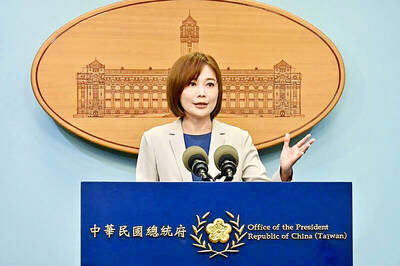
TIT-FOR-TAT: The US allegedly revoked the visa of a Chinese national working at Xinhua News Agency in the US in response to Beijing’s expulsion of Vivian Wang The Presidential Office yesterday condemned China for expelling a New York Times correspondent from Beijing following the newspaper’s interview with President William Lai (賴清德), saying the move highlighted Beijing’s suppression of press freedom and its threat to international news media. Taiwan has noted a series of recent incidents in which Beijing used similar tactics to “threaten and pressure international media outlets and journalists,” Presidential Office spokeswoman Karen Kuo (郭雅慧) said in a statement. “This concerns not only press freedom and freedom of expression, but also the safety of journalists, and Taiwan and relevant partners are paying close attention to the situation,” she

NOT IMMEDIATE: Taiwan has a chance to appeal the proposed 10 percent tariff before it starts, while other countries face a 12.5 percent tariff from the trade office Taiwan is among 60 economies determined by the US to have failed to impose or enforce a ban on the importation of goods produced with forced labor, according to a notice released on Tuesday by the Office of the US Trade Representative (USTR), which proposed imposing an additional 10 percent or more tariff on them. The USTR in a statement said that following an investigation, it had determined under Section 301 of the Trade Act of 1974 that the failure of the 60 economies to impose and effectively enforce a prohibition on the importation of goods produced with forced labor is


 RSS
RSS