


The Democratic Progressive Party (DPP) appears to be hoping that a conflict between Chinese Nationalist Party (KMT) candidate Yen Kuan-hen (顏寬恆) and President Ma Ying-jeou (馬英九) could help it win tomorrow’s legislative by-election in Greater Taichung’s second electoral district.
“Ma, who is the KMT’s chairman, has not campaigned for Yen, and Yen has not used the KMT’s logo during his campaign, nor has he emphasized that he represents the KMT,” DPP Chairman Su Tseng-chang (蘇貞昌) said at a campaign stop in Greater Taichung.
Su said he believes the president lacked confidence because of his low approval ratings and that Yen was attempting to distance his candidacy from the KMT.
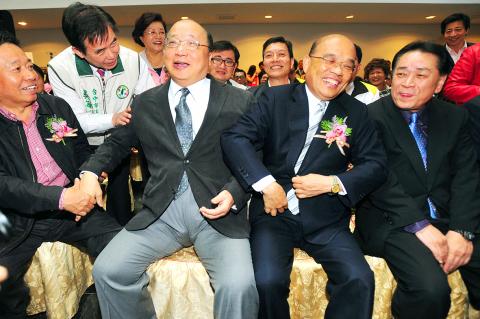
Photo: Liao Yau-tung, Taipei Times
Yen’s father, Yen Ching-piao (顏清標), was a former Non-Partisan Solidarity Union legislator whose status was revoked after he was found guilty of corruption. The younger Yen is aiming to fill the post left vacant by his father after his conviction.
The DPP has promoted the by-election as a vote of no confidence in Ma’s governance in an apparent effort to neutralize the Yen family’s strong political presence in the electoral district, a traditional KMT stronghold which includes the districts of Shalu (沙鹿), Longjing (龍井), Wurih (烏日), Dadu (大肚), Wufeng (霧峰) and part of Dali (大里).
Chen Shih-kai (陳世楷), the 36-year-old DPP candidate, has reminded the 220,000 voters in the constituency that local politics should not be dominated by one family, the DPP said.
Chen’s campaign managers and DPP headquarters both said they were cautiously optimistic about Chen’s chances of becoming the DPP’s 41st legislator.
However, they said they were concerned about vote-buying and the turnout rate, which is usually lower than 50 percent in local elections.
The DPP has continously urged judicial authorities to crack down on potential vote-buying and encouraged its supporters to vote for Chen.
DPP Secretary-General Lin Hsi-yao (林錫耀) said the DPP is confident it can beat any candidate in the by-election, but that “because the Yen family has such strong political connections” it would be hard to win against Yen Kuan-hen.
Chen’s deputy campaign manager, Li Chin-hsiang (利錦祥), said that a low turnout rate could benefit the KMT, adding that “in local elections, the outcome is usually decided by whether your supporters come out to vote.”
Unlike the KMT, which only sent Legislative Speaker Wang Jin-pyng (王金平) and Taichung Mayor Jason Hu (胡志強) to campaign for Yen Kuan-hen, DPP heavyweights, including former chairperson Tsai Ing-wen (蔡英文) and former premiers Frank Hsieh (謝長廷) and Yu Shyi-kun , have all campaigned for the party’s candidate in the region.
DPP legislative caucus convener Ker Chien-ming (柯建銘) described the by-election as a “critical battle” which could impact the nation’s democratic development and party competition in the coming years, saying that Chen’s victory could have the same impact as DPP Legislator Liu Chien-kuo’s (劉建國) win in Yunlin County in 2009, which propelled the party up from a low point after it lost the presidential election in 2008.
Su and Tsai are scheduled to campaign for Chen in Greater Taichung tonight.
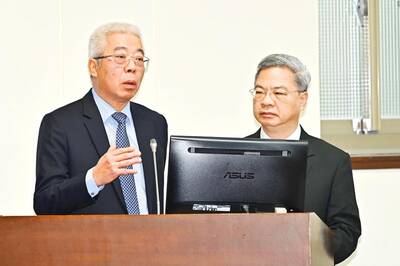
Taiwan has arranged for about 8 million barrels of crude oil, or about one-third of its monthly needs, to be shipped from the Red Sea this month to bypass the Strait of Hormuz and ease domestic supply pressures, CPC Corp, Taiwan (CPC, 台灣中油) said yesterday. The state-run oil company has worked with Middle Eastern suppliers to secure routes other than the Strait of Hormuz, through which about 20 percent of the world’s oil and liquefied natural gas typically passes, CPC chairman Fang Jeng-zen (方振仁) said at a meeting of the legislature’s Economics Committee in Taipei. Suppliers in Saudi Arabia have indicated they

South Korea has adjusted its electronic arrival card system to no longer list Taiwan as a part of China, a move that the Ministry of Foreign Affairs said would help facilitate exchanges between the two sides. South Korea previously listed “Taiwan” as “Taiwan (China)” in the drop-down menus of its online arrival card system, where people had to fill out where they came from and their next destination. The ministry had requested South Korea make a revision and said it would change South Korea’s name on Taiwan’s online immigration system from “Republic of Korea” to “Korea (South),” should the issue not be
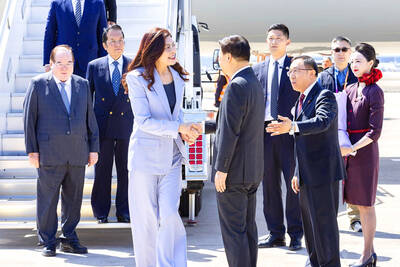
CCP ‘PAWN’? Beijing could use the KMT chairwoman’s visit to signal to the world that many people in Taiwan support the ‘one China’ principle, an academic said Chinese Nationalist Party (KMT) Chairwoman Cheng Li-wun (鄭麗文) yesterday arrived in China for a “peace” mission and potential meeting with Chinese President Xi Jinping (習近平), while a Taiwanese minister detailed the number of Chinese warships currently deployed around the nation. Cheng is visiting at a time of increased Chinese military pressure on Taiwan, as the opposition-dominated Legislative Yuan stalls a government plan for US$40 billion in extra defense spending. Speaking to reporters before going to the airport, Cheng said she was going on a “historic journey for peace,” but added that some people felt uneasy about her trip. “If you truly love Taiwan,

Tainan, Taipei and New Taipei City recorded the highest fines nationwide for illegal accommodations in the first quarter of this year, with fines issued in the three cities each exceeding NT$7 million (US$220,639), Tourism Administration data showed. Among them, Taipei had the highest number of illegal short-term rental units, with 410. There were 3,280 legally registered hotels nationwide in the first quarter, down by 14 properties, or 0.43 percent, from a year earlier, likely indicating operators exiting the market, the agency said. However, the number of unregistered properties rose to 1,174, including 314 illegal hotels and 860 illegal short-term rental


 RSS
RSS