


North Korea’s recent rocket launch amounted to the test of a ballistic missile capable of carrying a half-tonne payload as far as the US west coast, the South Korean defense ministry said yesterday.
North Korea launched its three-stage Unha-3 rocket on Dec. 12, insisting it was a purely scientific mission aimed at putting a polar-orbiting satellite in space.
Yesterday’s estimate was based on analysis of an oxidizer container — recovered from the rocket’s first-stage splashdown site — which stored red fuming nitric acid to fuel the first-stage propellant.
“Based on our analysis and simulation, the missile is capable of flying more than 10,000km with a warhead of 500kg to 600kg,” a South Korean defense ministry official told reporters.
The estimated range of 10,000km covers the whole of Asia, eastern Europe and western Africa, as well as Alaska and a large part of the US west coast, including San Francisco.
Without any debris from the second and third stages to analyze, the official said it could not be determined if the rocket had re-entry capability — a key element of inter-continental ballistic missile (ICBM) technology.
Most of the world saw the North’s rocket launch as a disguised ballistic missile test that violates UN resolutions imposed after Pyongyang conducted nuclear tests in 2006 and 2009.
The success of the launch was seen as a major strategic step forward for the North, although missile experts differed on the level of ballistic capability demonstrated by the rocket.
The debris collected by the South Koreans was made of an alloy of aluminum and magnesium, with eight panels welded manually.
“Welding was crude, done manually,” the ministry official said, adding that oxidizer containers for storing toxic chemicals are rarely used by countries with advanced space technology.
The South’s navy later recovered three more pieces of the rocket — a fuel tank, a combustion chamber and an engine connection rod — from the Yellow Sea and has been analyzing them since Friday, Yonhap news agency said yesterday.
“As additional pieces have been salvaged, we will be able to look deeper into the function and structure of North Korea’s long-range rocket,” a South Korean defense ministry official quoted by Yonhap said.
The North apparently timed the widely condemned launch to mark the first anniversary of the death of longtime North Korean leader Kim Jong-il and drum up more support for his son and successor, Kim Jong-un.
Since the launch, Pyongyang’s propaganda machine has gone into overdrive to heap praise on the ruling Kim dynasty for leading the successful mission and to urge support for the young ruler who took over a year ago. The nuclear-armed nation has awarded medals to 101 rocket scientists and technicians who worked on the launch, its official Korean Central News Agency said yesterday.
“By successfully launching satellite Kwangmyongsong 3-2, they instilled great national self-esteem ... and dealt a sledge-hammer blow to the hostile forces’ desperate moves to check the advance of [North Korea],” it said.
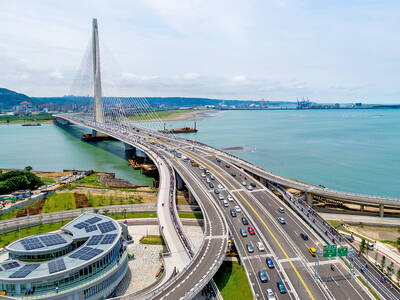
The Ministry of Transportation and Communications yesterday inaugurated the Danjiang Bridge across the Tamsui River in New Taipei City, saying that the structure would be an architectural icon and traffic artery for Taiwan. Feted as a major engineering achievement, the Danjiang Bridge is 920m long, 211m tall at the top of its pylon, and is the longest single-pylon asymmetric cable-stayed bridge in the world, the government’s Web site for the structure said. It was designed by late Iraqi-British architect Zaha Hadid. The structure, with a maximum deck of 70m, accommodates road and light rail traffic, and affords a 200m navigation channel for boats,
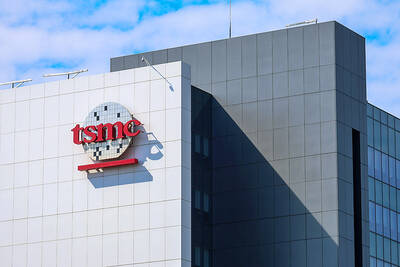
Taiwan Semiconductor Manufacturing Co (TSMC, 台積電), the world’s largest foundry service provider, yesterday said that global semiconductor revenue is projected to hit US$1.5 trillion in 2030, after the figure exceeds US$1 trillion this year, as artificial intelligence (AI) demand boosts consumption of token and compute power. “We are still at the beginning of the AI revolution, but we already see a significant impact across the whole semiconductor ecosystem,” TSMC deputy cochief operating officer Kevin Zhang (張曉強) said at the company’s annual technology symposium in Hsinchu City. “It is fair to say that in the past decade, smartphones and other mobile devices were
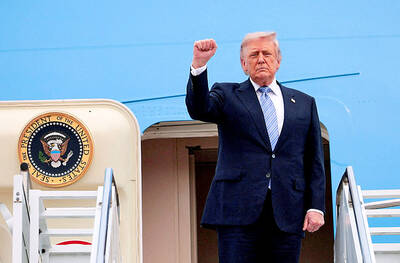
US-CHINA SUMMIT: MOFA welcomed US reassurance of no change in its Taiwan policy; Trump said he did not comment when Xi talked of opposing independence US President Donald Trump yesterday said he has not made a decision on whether to move forward with a major arms package for Taiwan after hearing concerns about it from Chinese President Xi Jinping (習近平). Trump’s comments on Taiwan came as he flew back to Washington after wrapping up critical talks in which both leaders said important progress was made in stabilizing US-China relations even as deep differences persist between the world’s two biggest powers on Iran and Taiwan. “I will make a determination,” Trump said, adding: “I’ll be making decisions. But, you know, I think the last thing we need right
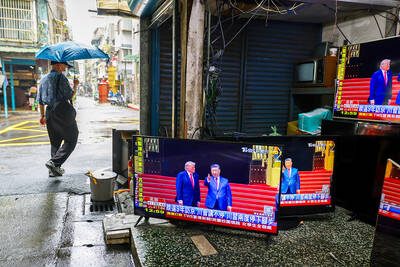
TAIWAN ISSUE: US treasury secretary Scott Bessent said on the first day of meetings that ‘it wouldn’t be a US-China summit without the Taiwan issue coming up’ There were no surprises on the first day of the summit between US President Donald Trump and Chinese President Xi Jinping (習近平), the Mainland Affairs Council (MAC) said yesterday, as the government reiterated that cross-strait stability is crucial to the Asia-Pacific region, as well as the world. As the two presidents met for a highly anticipated summit yesterday, Chinese state media reported that Xi warned Trump that missteps regarding Taiwan could push their two countries into “conflict.” Trump arrived in China with accolades for his host, calling Xi a “great leader” and “friend,” and extending an invitation to visit the White House


 RSS
RSS