


Applications by Aboriginal tribes to have the ownership of original Aboriginal naming rights, intellectual property and other items returned to the tribes, in accordance with the Indigenous Peoples Intellectual Property Act (原住民族傳統智慧創作保護條例), are to be reviewed by March next year.
According to Huang Chu-cheng (黃居正), Institute of Law for Science and Technology assistant professor at Tsing Hua University — the facility commissioned to review the applications — the nation’s 14 officially recognized Aboriginal tribes have from earlier this year gradually started to apply for protection of their respective tribal intellectual property.
The 14 Aboriginal tribes are the Amis, Atayal, Paiwan, Bunun, Puyuma, Rukai, Tsou, Saisiyat, Tao, Thao, Kavalan, Truku, Sakizaya and Sediq. Each of the recognized tribes has their own distinct language, culture, customs, traditions and social structures.
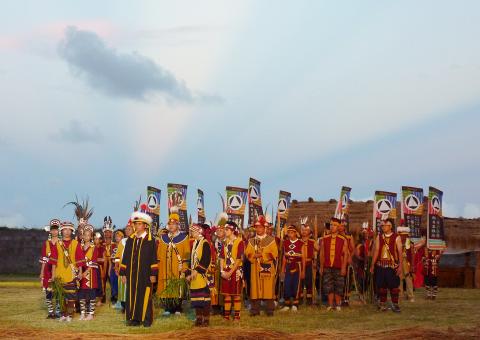
Photo provided courtesy of the Sakizaya Association for Cultural and Educational Promotion
Huang said that the applications for protection range from the rights to the name Kavalan, rights to the symbols on glass beads reserved for use by the Paiwan chieftains and the clothing worn by the Tsou, to the Sediq’s witchdoctors and their traditional ways.
All ownership rights connected with the items, names, symbols and other intellectual property that pass the review next year would be returned to the applicable Aboriginal tribes, he added.
The act is retrospective, in accordance with the concept of transitional justice — reparations made by a democratic government to people it had previously wronged — meaning any trademarks formerly granted would be revoked, unless the former trademark applicant agreed terms with the new holder of the registration rights and agreed to compensate the owner, in return for authorization to use trademarked items, Huang said.
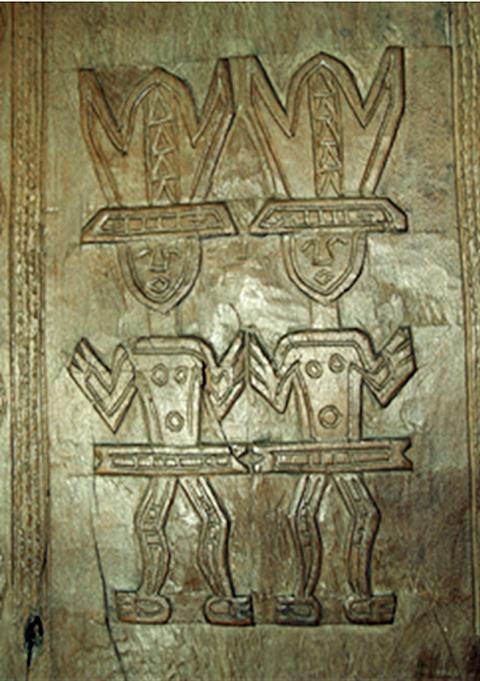
Photo provided courtesy of the Kavalan Development Association
Companies or people that use names or items that originally belonged to Aboriginal tribes could potentially be restricted from using that item, product or name, should the tribe’s application pass the review, he said.
Huang said that the Council of Indigenous Peoples (CIP) has recently refused nearly every request to use names or any item of Aboriginal intellectual property forwarded to the agency by the Ministry of Economic Affairs.
He added that corporations and companies should avoid using any pictures, objects of art, music or names that could be subject to Aboriginal intellectual property claims.
Netizens should also avoid posting pictures and symbols of particular Aboriginal signs online. If such signs have to be posted on the Internet for a particular reason, permission from the relevant tribes should be obtained to prevent future problems, Huang said.
According to the act, if a business owner does not cease current usage of Aboriginal names or objects, the rights owner may ask for governmental action to exclude or prevent the business from using the copyright.
Purposeful or accidental infringement of exclusive rights to intellectual property are obliged to be compensated, and the owner of the rights may demand an amount after calculating damages according to regulations under the act.
If damages cannot be easily calculated, the rights owner can ask the court to fine the copyright violator with a fine ranging from NT$50,000 (US$1,709) to NT$3 million. If the court finds that an infringement of copyright was intentional and the form of infringement is great, the fine may be raised to NT$6 million.
However, Huang also noted difficulties in policy implementation because of difficulties getting into contact with the tribes in question.
Citing popular singer A-mei (張惠妹) as an example, Huang said that A-mei — a member of the Puyuma (卑南) tribe — had incorporated parts of the tribe’s music into an album she released three years ago, but when the company asked whom it should ask for authorization of the music’s use, nobody knew who should be contacted.
The Daba Lioujiou Community (大巴六九部落) in which A-mei grew up offered a temporary solution by giving authorization to the record company in the community’s name, but pointed out that proper channels were hard to follow because no one knew what the channels were, Huang said.
Commenting on the issue, CIP Minister Sun Ta-chuan (孫大川) said the act is still in its trial-run phase and there were indeed some difficulties in the implementation of the policy.
A balance between the protection and promotion of Aboriginal culture must be struck to ensure a win-win situation, Sun said, adding: “This is a double-edged sword and we must proceed extremely cautiously precisely because it is difficult.”
Lee Chun-jun (李俊仁), CEO of Kamalan (葛瑪蘭) Bus Inc, whose Chinese characters are homophonous to that of the Kavalan tribe’s, said his company is willing to recompense the Kavalan tribe for the use of its name and would be negotiating with the tribe over the details.
The company would receive the necessary authorization and do the necessary paperwork, he added.
However, the Taiwan Railway Administration (TRA) was not so understanding. TRA spokesperson Lu Chieh-shen (鹿潔身) said the retrospective application of the act would not only impact heavily on the TRA, but also make the whole of Taiwan more chaotic.
Singling out the TRA’s Taroko and Puyuma trains, as well as Taimali (太麻里), Jhihben (知本) and other stations that have Aboriginal names, Lu said that as these were either given local area names or were named after certain events, they should not be penalized by the act.
The TRA would continue to study the Act and acquaint itself with its particulars before making any decisions, he said.
Formosan Naruwan Hotel & Resort Taitung assistant general manager Chen Hsiu-chieh (陳修頡) said that the word “Naruwan” means “welcome” and “hello” in the Puyuma language and is similar to the Hawaiian word “Aloha.”
It is widely used in many song titles and official video clips, Chen said, adding that although the resort would further study the Act to determine how to react, the hotel currently does not feel that it has violated the law.
Meanwhile, the director of the blockbuster film Warriors of the Rainbow: Seediq Bale, Wei Te-sheng (魏德聖), praised the Act, saying: “I feel it is good to have such a law. Now movies, TV shows and other cultural and creative industries that need to use Aboriginal intellectual properties can find the proper people to go to and obtain legal authorization to use them.”
Additional reporting by Tseng Hung-ju and Tsai Po-chieh

‘NO SECURITY RISK’: The Railway Bureau reassured the public that the technicians’ activities were limited to technical guidance and did not involve sensitive systems The Railway Bureau yesterday said it had invited eight Chinese technicians to assist with an airport MRT construction project. The bureau issued the confirmation after an Internet user said Chinese nationals had entered the construction zone of Taiwan Taoyuan International Airport’s Terminal 3 project. They asked why “individuals from an enemy state” were allowed access to such a major national infrastructure project, which raised serious concerns over Taiwan’s industrial safety, sensitive systems and information security. The bureau’s Northern Region Engineering Branch Office said subcontractor Taiwan Handle Industrial Co (台灣手把工業) of the Taoyuan airport MRT’s “Contract No. CU05 Project A14 Station Civil, MEP &

The National Chungshan Institute of Science and Technology yesterday showcased its locally developed variants of the Vision 60 robotic patrol dog, which it plans to deploy on the nation’s outlying territories in the South China Sea. The variants were produced under the Joint Lab project — created by the institute and domestic companies — and assembled with domestically produced motors, lenses and artificial intelligence (AI) systems alongside licensed tech from the US, Missile and Rocket Systems Research Division deputy director Jen Kuo-kang (任國光) told the media event at a military base in Taipei’s Dazhi (大直) area. Taiwan has built up its strengths

TIT-FOR-TAT: The US allegedly revoked the visa of a Chinese national working at Xinhua News Agency in the US in response to Beijing’s expulsion of Vivian Wang The Presidential Office yesterday condemned China for expelling a New York Times correspondent from Beijing following the newspaper’s interview with President William Lai (賴清德), saying the move highlighted Beijing’s suppression of press freedom and its threat to international news media. Taiwan has noted a series of recent incidents in which Beijing used similar tactics to “threaten and pressure international media outlets and journalists,” Presidential Office spokeswoman Karen Kuo (郭雅慧) said in a statement. “This concerns not only press freedom and freedom of expression, but also the safety of journalists, and Taiwan and relevant partners are paying close attention to the situation,” she

NOT IMMEDIATE: Taiwan has a chance to appeal the proposed 10 percent tariff before it starts, while other countries face a 12.5 percent tariff from the trade office Taiwan is among 60 economies determined by the US to have failed to impose or enforce a ban on the importation of goods produced with forced labor, according to a notice released on Tuesday by the Office of the US Trade Representative (USTR), which proposed imposing an additional 10 percent or more tariff on them. The USTR in a statement said that following an investigation, it had determined under Section 301 of the Trade Act of 1974 that the failure of the 60 economies to impose and effectively enforce a prohibition on the importation of goods produced with forced labor is


 RSS
RSS