


The “Hsichih Trio,” three former death row inmates in a long-running murder case that drew the attention of Amnesty International and other international human rights groups, were again found not guilty yesterday after the latest — and final — retrial by the Taiwan High Court.
Calling the 21-year-old case closed, the court said there was insufficient evidence to prove the trio committed the double murders they were charged with, adding that the verdict was final and no appeals would be allowed, in accordance with the Fair and Speedy Criminal Trials Act (刑事妥速審判法).
This was the third time Su Chien-ho (蘇建和), Liu Bin-lang (劉秉郎) and Chuang Lin-hsun (莊林勳) were acquitted by the High Court since their case was reopened in 2000.
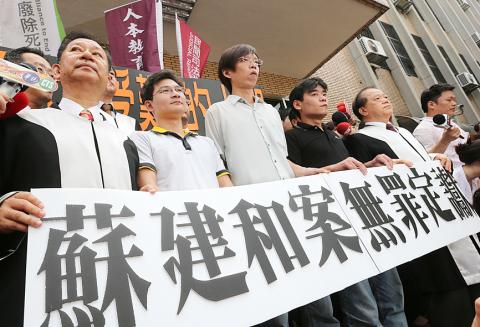
Photo: CNA
The trio, along with Wang Wen-hsiao (王文孝), were accused of robbing and murdering Wu Min-han (吳銘漢) and his wife, Yeh Ying-lan (葉盈蘭), in then-Taipei County’s Sijhih (汐止) on March 24, 1991. The couple were found dead in their apartment. They had been stabbed 79 times.
Wang, an army conscript, was arrested on Aug. 13, 1991. He was convicted and sentenced under military law and executed on Jan. 11, 1992. His brother, Wang Wen-chung (王文忠), whom he had implicated, was also arrested and named three classmates — Su, Liu and Chuang — as accomplices.
Wang Wen-chung served two years in jail after being convicted of being an accomplice, but the trio were convicted of robbery and murder and sentenced to death in February 1992.
By 1995, they had exhausted all their legal appeals, but justice ministers repeatedly refused to sign their execution orders. In May 2000, the High Court decided to reopen the case for a retrial after state public prosecutor-general Chen Han (陳涵) made three extraordinary appeals to the Supreme Court.
In January 2003, the High Court acquitted the trio and released them on their own recognizance.
In the 11th retrial, the High Court again sentenced them to death in June 2007, but left them free while they continued their appeals.
The death sentences were reversed again in November 2010 after the 13th retrial, when the High Court again found them not guilty.
In their defense, the trio said they were tortured by police and the statements they made in interviews were against their free will.
The ruling said statements of Wang Wen-hsiao and Wang Wen-chung conflicted in several details with the statements made by Su, Lin and Liu.
The trio’s statements in police interviews on how the couple were stabbed contradicted the results of examinations by US forensic scientist Henry Lee (李昌鈺), the ruling added.
Lee had appeared in court in 2009 as an expert witness and said the victims suffered a total of 79 stab wounds, 56 of them on their heads, which was at odds with the trio’s statements that they had stabbed the couple all over their bodies. The ruling cited Lee as saying that the bloodstains and weapons marks were also not in accordance with the trio’s statements.
Lee said it was very likely a single killer carried out the murders.
Yesterday’s ruling said fingerprints at the site of the murders were Wang Wen-hsiao’s and hairs found there were Wu’s and his wife’s and that there was no evidence to prove the trio were there.
According to legal experts, the trio, who were incarcerated for 12 years before being released in January 2003, are eligible for compensation for a miscarriage of justice.
After the Taiwan High Court announced the verdict yesterday, Su said he had not been so happy since he was 19 years old.
“The trial started when I was 19 and now I am 41. All those years I was wrongfully accused and felt sad, hopeless and helpless. Our youth is already gone, but we appreciate that our attorneys and society supported us in all these years,” Su said.
However, not everyone was happy with yesterday’s verdict.
Outside the court, Wu’s brother, Wu Tan (吳唐), said the ruling failed to uphold justice for the victims.
“Justice has been overridden by human rights,” he said.
Shih Yi-lin (石宜琳), a lawyer representing the Wu family, said the judiciary was “the bigger loser” in the case because it had lost the trust of the people.
Additional reporting by Staff writer

LEVERAGE: China did not ‘need to fire a shot’ to deny Taiwan airspace over Africa when it owns ‘half the continent’s debt,’ a US official said, calling it economic warfare The EU has raised concerns about overflight rights following the delay of President William Lai’s (賴清德) planned state visit to the Kingdom of Eswatini after three African nations denied overflight clearance for his charter at the last minute. Taiwanese allies Paraguay and Saint Kitts and Nevis, as well as several US lawmakers and the Inter-Parliamentary Alliance on China (IPAC) condemned China for allegedly pressuring the countries. Lai was scheduled to fly directly to Taiwan’s only African ally from yesterday to Sunday to celebrate the 40th anniversary of King Mswati III’s accession and his 58th birthday, but Seychelles, Mauritius and Madagascar suddenly revoked
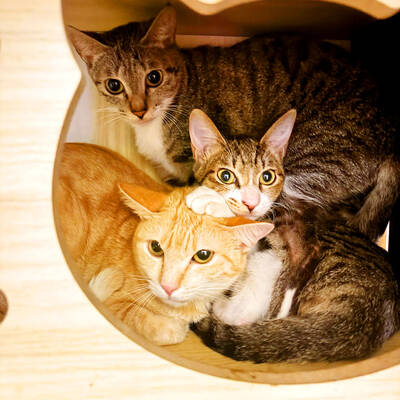
The number of pet cats in Taiwan surpassed that of pet dogs for the first time last year, reaching 1,742,033, a 32.8 percent increase from 2023, the Ministry of Agriculture said yesterday, citing a survey. By contrast, the number of pet dogs declined slightly by 1.2 percent over the same period to 1,462,528, the ministry said. Despite the shift, households with dogs still slightly outnumber those with cats by 1.2 percent. However, while the number of households with multiple dogs has remained relatively stable, households keeping more than two cats have increased, contributing to the overall rise in the feline population. The trend
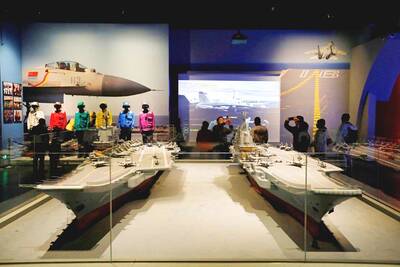
China on Wednesday teased in a video an aircraft carrier that could be its fourth, and the first using nuclear power, while making an allusion to Taiwan and vowing to further build up its islands, as it looks to boost maritime power, secure resources and bolster territorial claims. The video, issued on the eve of the 77th founding anniversary of the Chinese People’s Liberation Army Navy, featured fictional officers with names that are homophones of three commissioned aircraft carriers, the Liaoning (遼寧), Shandong (山東) and Fujian (福建). Titled Into the Deep, it showed a 19-year-old named “Hejian” (何劍) joining the group, sparking
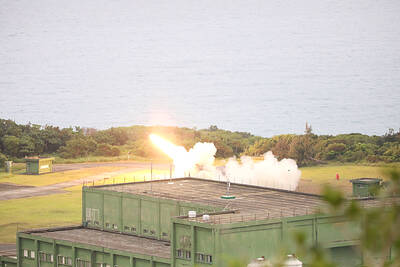
Taiwan has signed six arms procurement offers from the US totaling more than NT$208 billion (US$6.59 billion) covering long-range precision strike systems, missile stockpile replenishment and joint production of large-caliber ammunition, the Ministry of National Defense said yesterday. The government’s proposed NT$1.25 trillion special defense budget has been stalled in the Legislative Yuan as opposition lawmakers question the amount and procurement items, while the Presidential Office and defense ministry say that the full amount is necessary to safeguard Taiwan. Minister of National Defense Wellington Koo (顧立雄) on Monday briefed the legislature’s Foreign Affairs and National Defense Committee on the defense budget for


 RSS
RSS