


Former US attorney-general Ramsey Clark, a longtime advocate for Taiwanese democracy, yesterday visited former president Chen Shui-bian (陳水扁) in Taipei Prison and said that the government should release Chen immediately.
Clark visited Chen in the afternoon, accompanied by former Democratic Progressive Party (DPP) legislator Chai Trong-rong (蔡同榮) and Chen’s son, Chen Chih-chung (陳致中).
After the 80-minute visit, Clark left the prison and told hundreds of Chen Shui-bian supporters that the former president’s health was deteriorating and that he needed be freed immediately.
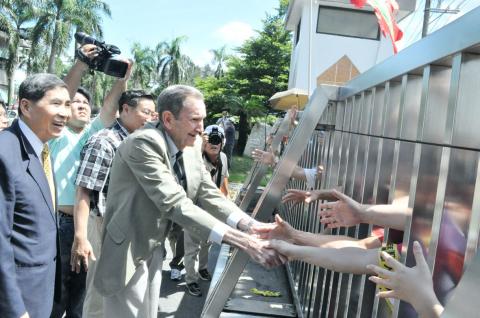
Photo: Yu Juei-jen, Taipei Times
Taiwanese should stand up to support the release of Chen Shui-bian, he said.
Clark said Chen Shui-bian should receive appropriate medical treatment, as well as his human rights. All people in Taiwan should call for Chen Shui-bian’s release and only people power could make it happen, he said.
Hundreds of supporters cheered Clark’s remarks.
Clark also told reporters that the former president was clearly suffering and very ill.
“I respect his courage. He has a strong will. He is upheld by people’s support and I believe he will regain his strength after he is released,” Clark said.
He said Chen Shui-bian’s release would be good for Taiwanese and for all political parties.
He added that a report on Chen Shui-bian’s situation would be submitted to concerned US governmental departments and said he hoped President Ma Ying-jeou (馬英九) would consider freeing the former leader.
Chen Shui-bian is serving a 17-and-a-half-year prison term on corruption charges. During his incarceration, he has complained about several physical ailments, including chest pains.
An internationally renowned defender of human rights, Clark flew to Taiwan in 1980 to express concerns over what came to be known as the Formosa Incident, also known as the Kaohsiung Incident, during which riot police cracked down on protesters calling for political rights.

‘NO SECURITY RISK’: The Railway Bureau reassured the public that the technicians’ activities were limited to technical guidance and did not involve sensitive systems The Railway Bureau yesterday said it had invited eight Chinese technicians to assist with an airport MRT construction project. The bureau issued the confirmation after an Internet user said Chinese nationals had entered the construction zone of Taiwan Taoyuan International Airport’s Terminal 3 project. They asked why “individuals from an enemy state” were allowed access to such a major national infrastructure project, which raised serious concerns over Taiwan’s industrial safety, sensitive systems and information security. The bureau’s Northern Region Engineering Branch Office said subcontractor Taiwan Handle Industrial Co (台灣手把工業) of the Taoyuan airport MRT’s “Contract No. CU05 Project A14 Station Civil, MEP &

A US uncrewed surface vessel (USV) encountered multiple Chinese warships during an autonomous transit of the Taiwan Strait, US defense company Seasats said in a statement on Wednesday. Seasats announced that a Lightfish USV had completed the first autonomous transit of the Taiwan Strait. Over five days, the USV traversed the entire length of the Strait while constantly monitoring surface vessel traffic, the company said. The Lightfish encountered multiple Chinese warships, one of which was a Chinese People’s Liberation Army Navy (PLAN) Type 056 corvette, it said. The Chinese vessels were operating “well within Taiwan’s exclusive economic zone without transmitting their identity via the

Taiwan is still in the process of assessing the possibility of recruiting workers from Eswatini, the Ministry of Foreign Affairs said yesterday, adding that its goal is to help Eswatini upgrade its vocational training centers. If there are plans to recruit workers from Eswatini, safeguarding national security, protecting public health and ensuring the employment rights of Taiwanese would be prerequisites, Department of West Asian and African Affairs Director-General Yen Chia-liang (顏嘉良) told a news conference. Key considerations would also include filling labor shortages in specific industries, and fostering bilateral professional and technical exchanges, he said. Yen was asked about the progress of labor
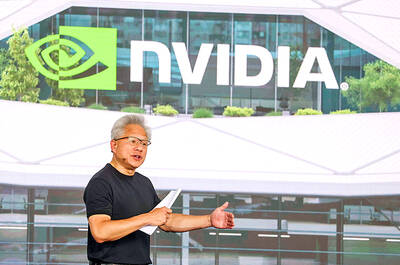
‘BOOMING’: ’ The number of partners we have here is incredible. You can see from their stock prices. They’re doing so well, they’re so happy,’ Jensen Huang said Nvidia Corp’s spending in Taiwan has ballooned to about US$150 billion a year, 10 times the US$10 billion to US$15 billion the company spent five years ago, Nvidia chief executive officer Jensen Huang (黃仁勳) said yesterday, suggesting Taiwan’s strategic importance in the global artificial intelligence (AI) supply chain. “Taiwan is the epicenter of the AI revolution. This is where the chips come, packaging comes. This is where the systems are made. This is where AI supercomputers were created,” Huang said at a meeting for the company’s employees in Beitou-Shilin Technology Park (北投士林科技園區) in Taipei, the planned site of Nvidia’s Taipei headquarters. “Taiwan


 RSS
RSS