


Former Democratic Progressive Party (DPP) chairperson Tsai Ing-wen (蔡英文) yesterday filed a lawsuit against Vice President Wu Den-yih (吳敦義) and former Council of Economic Planning and Development minister Christina Liu (劉憶如) over the pair’s allegations during the presidential election campaign that Tsai had played an improper role in the formation of a biotechnology company.
Tsai filed the lawsuit with the Supreme Prosecutors’ Office Special Investigation Division (SID) against Wu, who is currently visiting Central America, and Liu for violations of the Presidential and Vice Presidential Election and Recall Act (總統副總統選舉罷免法), accusing them of spreading rumors or false statements for the purpose of impeding a candidate’s election chances, Tsai’s lawyers Wellington Koo (顧立雄) and Lien Yuan-long (連元龍) told a press conference.
“With the lawsuit, Tsai intends to highlight the issue of the state apparatus’ illegal involvement in a campaign and its impact on a major election result, rather than proving her innocence,” Koo said.
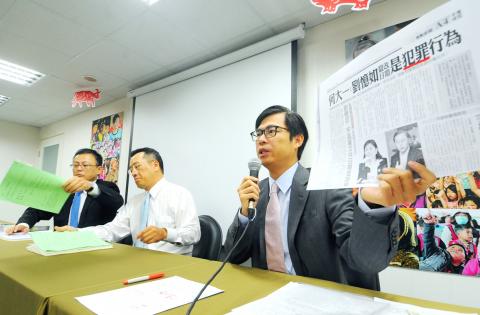
Photo: Wang Min-wei, Taipei Times
“If the fairness of elections is sabotaged over and over again, democracy will be only an illusion,” Koo quoted Tsai as saying.
Tsai did not attend the press conference because of previous engagements.
Initiated by Liu’s declassification of government documents in December last year, the Chinese Nationalist Party (KMT) accused Tsai of corruption in the “Yu Chang [Biologics Co (宇昌生技股份有限公司)] case” during her time as vice premier in 2007, when she approved separate government investments of NT$875 million (US$28.8 million) and US$20 million — about NT$1.4 billion in total — for the biotechnology start-up before leaving office and later serving as Yu Chang chairperson.
The SID on Tuesday last week closed its probe into the case, which was seen by many as one of the reasons behind Tsai’s loss to President Ma Ying-jeou (馬英九) in January, clearing Tsai of any wrongdoing.
The division had previously dismissed all lawsuits related to the case, including the DPP lawyers’ lawsuit against Wu, Wu’s wife Tsai Ling-yi (蔡令怡) and Liu, who allegedly altered documents to discredit Tsai Ing-wen and benefit Ma’s campaign, as well as Tsai Ing-wen’s lawsuit against Liu for alleged document forgery.
Liu said the document was not forged, but misplaced.
Tsai Ing-wen’s integrity in the case had held up to the utmost scrutiny, which is understandable in any democratic election, Koo said, adding: “Tsai Ing-wen wants to know whether Wu should be scrutinized by the same standard.”
The core issues of the lawsuit were the use of state apparatus as a campaign tool, whether the judicial investigation has been fair and whether the legal procedure has been carried out completely, Lien said.
Tsai Ing-wen’s legal team recommended she file a new lawsuit after Liu reportedly told the SID last month that she launched the administrative investigation into her involvement in the case after receiving an order from Wu, who was premier at the time, Lien said.
The case was obviously a mud-slinging tactic and would have been a scandal in other democracies, said DPP Legislator Chen Chi-mai (陳其邁), who served as the moderator of the press conference.
“The hurried dismissal of the case by the Taipei Prosecutors’ Office was an obvious attempt to cover up the political motives of the defendants, as well as an encouragement of future abuse of the administrative branch as a tool to influence election results,” Chen said.
The DPP described the SID’s dismissal of the case as “ridiculous” because spokesperson Lin Chun-hsien (林俊憲) said the SID made the ruling without subpoenaing Liu, Wu and Tsai Ling-yi.
In response, Chinese Nationalist Party (KMT) Secretary-General Lin Join-sane (林中森) said Tsai Ing-wen should not attempt to shift the focus of the issue by suing Wu and Liu.
Lin Join-sane said that during the entire time of the Yu Chang case, Tsai Ing-wen remained vague or dodged questions.
Lin Join-sane said the KMT respected the judiciary, but as a political figure, Tsai Ing-wen should know that while obeying the law is the minimum required of a politician, she should also shoulder moral responsibility.
He said he suspected Tsai Ing-wen had not avoided a conflict of interest in the Yu Chang case, adding that in comparison, even though Ma had faced many false accusations, he did not sidestep the accusations and has proved of his innocence.
He asked whether Taiwanese could accept the evasive attitude that he said Tsai Ing-wen has taken toward the case.
Meanwhile, he said Tsai Ing-wen’s allegation that the KMT had used government resources to intervene in the election and manipulate the judiciary was unacceptable.
“We cannot accept such accusations,” Lin said, adding that he hoped the DPP would stop demeaning the authority and trust citizens should have in the judicial system.
The KMT’s Culture and Communication Committee director, Hsiao Hsu-tsen (蕭旭岑), also said he hoped that Tsai Ing-wen would clearly explain her role in the Yu Chang case, while the committee’s deputy director, Lai Su-ju (賴素如), also accused her of being evasive.
We hope that Tsai Ing-wen does not waste the resources of the judiciary, Lai said.
Meanwhile, the Control Yuan said it would continue to monitor civil servants for administrative abnormalities in the case, Control Yuan member Yeh Yao-peng (葉耀鵬) said.
One of the Control Yuan members looking into the Yu Chang case aside from Ma Yi-kung (馬以工) and Ma Hsiu-ru (馬秀如), Yeh said that criminal responsibility and administrative responsibility were different matters.
The Control Yuan will continue to monitor the Yu Chang case to ascertain whether civil servants acted in accordance with administrative procedures, Yeh said, adding that the Control Yuan would also question former premier Su Tseng-chang (蘇貞昌).
Whether the Control Yuan would call on Tsai Ing-wen remains to be seen, Yeh said, adding that the peripheries of the case should be understood clearly before the person involved makes her statement on the issue.
Commenting on the pan-green legislators’ criticism of the Control Yuan’s motives for looking into the case, Yeh said that if Control Yuan members did not investigate the case in accordance with the law, then it would be the Control Yuan members who have committed dereliction of duty.

‘NO SECURITY RISK’: The Railway Bureau reassured the public that the technicians’ activities were limited to technical guidance and did not involve sensitive systems The Railway Bureau yesterday said it had invited eight Chinese technicians to assist with an airport MRT construction project. The bureau issued the confirmation after an Internet user said Chinese nationals had entered the construction zone of Taiwan Taoyuan International Airport’s Terminal 3 project. They asked why “individuals from an enemy state” were allowed access to such a major national infrastructure project, which raised serious concerns over Taiwan’s industrial safety, sensitive systems and information security. The bureau’s Northern Region Engineering Branch Office said subcontractor Taiwan Handle Industrial Co (台灣手把工業) of the Taoyuan airport MRT’s “Contract No. CU05 Project A14 Station Civil, MEP &
A signaling system malfunction disrupted high-speed rail (HSR) services beginning at 8am today, with trains temporarily reduced to three northbound and three southbound trains per hour as authorities conduct inspections. The malfunction occurred on a section of track in Miaoli County during pre-operation checks early this morning, forcing northbound and southbound trains to use a single track, the HSR operator said. The regular schedule has been replaced with three hourly trains offering only nonreserved seating in each direction, stopping at every station, it said, adding that business class cars would still have reserved seating. Departures from terminal stations are scheduled at the top

Taiwan is still in the process of assessing the possibility of recruiting workers from Eswatini, the Ministry of Foreign Affairs said yesterday, adding that its goal is to help Eswatini upgrade its vocational training centers. If there are plans to recruit workers from Eswatini, safeguarding national security, protecting public health and ensuring the employment rights of Taiwanese would be prerequisites, Department of West Asian and African Affairs Director-General Yen Chia-liang (顏嘉良) told a news conference. Key considerations would also include filling labor shortages in specific industries, and fostering bilateral professional and technical exchanges, he said. Yen was asked about the progress of labor

A US uncrewed surface vessel (USV) encountered multiple Chinese warships during an autonomous transit of the Taiwan Strait, US defense company Seasats said in a statement on Wednesday. Seasats announced that a Lightfish USV had completed the first autonomous transit of the Taiwan Strait. Over five days, the USV traversed the entire length of the Strait while constantly monitoring surface vessel traffic, the company said. The Lightfish encountered multiple Chinese warships, one of which was a Chinese People’s Liberation Army Navy (PLAN) Type 056 corvette, it said. The Chinese vessels were operating “well within Taiwan’s exclusive economic zone without transmitting their identity via the


 RSS
RSS