


China demanded yesterday that Japan cease actions “harming” its territorial sovereignty amid an escalating row over disputed islands as a Japanese group prepared to sail to the Diaoyutais (釣魚台).
The foreign ministry statement was in response to plans by a group of Japanese lawmakers and nationalists to visit the East China Sea islands after Tokyo deported pro-China activists who had sailed there from Hong Kong.
“China has made solemn representations to Japan, demanding that it immediately cease actions harming China’s territorial sovereignty,” said the statement, which was in response to a media query on the planned Japanese trip.
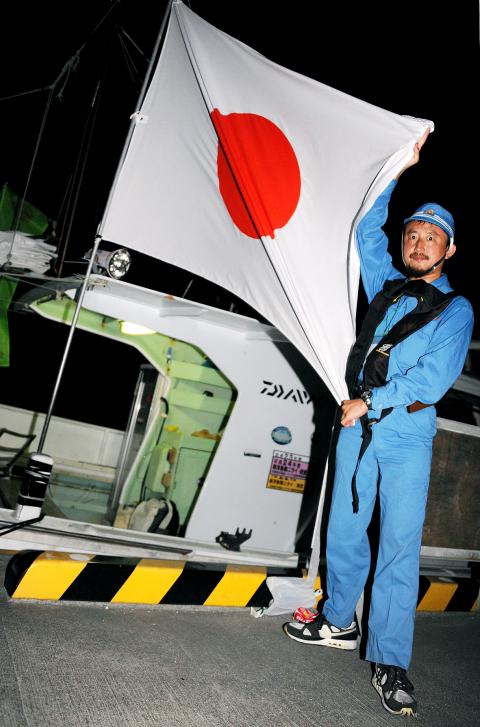
Photo: AFP
“China reiterates that any unilateral action taken by Japan regarding” the islands “are illegal and invalid,” the statement said, adding that any such actions would not undermine its claim over the territory.
It follows another statement late on Friday that called on Japan to pursue “dialogue and negotiation” to resolve the dispute.
Japan, which controls the uninhabited islands, on Friday deported 14 activists who had sailed there, moving swiftly to put an end to a potentially damaging row with Beijing.
Some of them became the first non-Japanese to set foot on any part of the archipelago — known as the Diaoyutais in Taiwan and China and Senkaku in Japan — since 2004.
However, Japanese Prime Minister Yoshihiko Noda has come under fire from conservative lawmakers — including members of the main opposition Liberal Democratic Party and nationalist Tokyo Governor Shintaro Ishihara — for not allowing the activists to be held for prosecution.
The long-running dispute flares up from time to time and has proven a stumbling block — along with issues related to Japan’s military occupation of parts of China during World War II — to smooth relations between Asia’s two biggest economies.
The renewed dispute comes as tensions also spiked between Tokyo and Seoul after South Korean President Lee Myung-bak on Aug. 10 visited a separate group of islands, known as Takeshima in Japan and Dokdo in South Korea. The islets are controlled by Seoul, but claimed by Tokyo.
Japan also has a separate territorial dispute with Russia over northern islands seized by the Soviet Union in the waning days of World War II.
The ruling party policy chief said yesterday that Japan should strengthen its coast guard to defend disputed islands.
“Coast guard officials are doing their best, and so the government and the ruling parties will discuss how to strengthen our backup to them,” Democratic Party of Japan policy chief Seiji Maehara told reporters.
“We should discuss not only [increasing] the number of staff and ships, but also possibilities of various other supports” to the coast guard, he said.
Members of his ruling party also complained that the coast guard failed to block the activists’ landing, the Yomiuri Shimbun reported yesterday.
With the hasty deportation, Noda’s government sought a swift end to the potentially damaging row with China because Japan cannot afford squabbles with China and South Korea at the same time, the Yomiuri and Mainichi newspapers said, without disclosing sources.
In a statement issued late on Friday, China called on Japan to pursue “dialogue and negotiation” to resolve the two countries’ territorial dispute over the islands, which are also claimed by Taiwan.
In response to Lee’s visit to Takeshima, Japan recalled its ambassador from Seoul and canceled its finance minister’s planned trip to Seoul.
Japan also called on South Korea to resolve the dispute in the International Court of Justice.

NATIONAL SECURITY THREAT: An official said that Guan Guan’s comments had gone beyond the threshold of free speech, as she advocated for the destruction of the ROC China-born media influencer Guan Guan’s (關關) residency permit has been revoked for repeatedly posting pro-China content that threatens national security, the National Immigration Agency said yesterday. Guan Guan has said many controversial things in her videos posted to Douyin (抖音), including “the red flag will soon be painted all over Taiwan” and “Taiwan is an inseparable part of China,” while expressing hope for expedited “reunification.” The agency received multiple reports alleging that Guan Guan had advocated for armed reunification last year. After investigating, the agency last month issued a notice requiring her to appear and account for her actions. Guan Guan appeared as required,
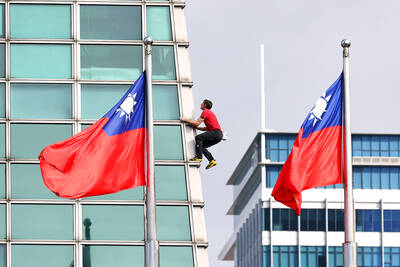
DAREDEVIL: Honnold said it had always been a dream of his to climb Taipei 101, while a Netflix producer said the skyscraper was ‘a real icon of this country’ US climber Alex Honnold yesterday took on Taiwan’s tallest building, becoming the first person to scale Taipei 101 without a rope, harness or safety net. Hundreds of spectators gathered at the base of the 101-story skyscraper to watch Honnold, 40, embark on his daredevil feat, which was also broadcast live on Netflix. Dressed in a red T-shirt and yellow custom-made climbing shoes, Honnold swiftly moved up the southeast face of the glass and steel building. At one point, he stepped onto a platform midway up to wave down at fans and onlookers who were taking photos. People watching from inside

A Vietnamese migrant worker yesterday won NT$12 million (US$379,627) on a Lunar New Year scratch card in Kaohsiung as part of Taiwan Lottery Co’s (台灣彩券) “NT$12 Million Grand Fortune” (1200萬大吉利) game. The man was the first top-prize winner of the new game launched on Jan. 6 to mark the Lunar New Year. Three Vietnamese migrant workers visited a Taiwan Lottery shop on Xinyue Street in Kaohsiung’s Gangshan District (崗山), a store representative said. The player bought multiple tickets and, after winning nothing, held the final lottery ticket in one hand and rubbed the store’s statue of the Maitreya Buddha’s belly with the other,

‘NATO-PLUS’: ‘Our strategic partners in the Indo-Pacific are facing increasing aggression by the Chinese Communist Party,’ US Representative Rob Wittman said The US House of Representatives on Monday released its version of the Consolidated Appropriations Act, which includes US$1.15 billion to support security cooperation with Taiwan. The omnibus act, covering US$1.2 trillion of spending, allocates US$1 billion for the Taiwan Security Cooperation Initiative, as well as US$150 million for the replacement of defense articles and reimbursement of defense services provided to Taiwan. The fund allocations were based on the US National Defense Authorization Act for fiscal 2026 that was passed by the US Congress last month and authorized up to US$1 billion to the US Defense Security Cooperation Agency in support of the


 RSS
RSS