

Vietnam is in no position to question the Republic of China’s (ROC) plan to extend the runway on Taiping Island (太平島) in the contested South China Sea because the country has sovereignty over the area, the Ministry of Foreign Affairs said.
In response to its Vietnamese counterpart, the ministry said in a statement on Friday that there was no basis for questioning Taiwan’s administrative measures on Taiping Island because sovereignty over the South China Sea region belongs to the ROC.
Taiping Island, the largest of the Spratly Islands (Nansha Islands, 南沙群島), is one of the two islands in the region controlled by Taiwan, along with the Pratas Islands (Dongsha Islands, 東沙群島), but the nation also claims sovereignty over the Paracel Islands (Xisha Islands, 西沙群島), Macclesfield Bank (Zhongsha Islands, 中沙群島) and their surrounding waters.
“The ROC enjoys all rights over the islands and their surrounding waters and it does not accept any claims to sovereignty over, or occupation of, these areas by other countries,” the statement said.
The National Border Committee under the Vietnamese Foreign Ministry earlier last week urged Taiwan to stop any activities or projects in the South China Sea unless they have Vietnam’s permission.
Hanoi, like Taiwan and China, claims sovereignty over all of the islands in the region, which is also partially claimed by the Philippines, Malaysia and Brunei.
It said the moves by Taiwan violate Vietnamese sovereignty and international laws, especially the 1982 UN Convention on the Law of the Sea, and go against the spirit of the Declaration on the Conduct of Parties in the East Sea while also causing tension in the region.
An official at the ministry, who preferred to remain anonymous, confirmed a report printed in the Chinese-language Liberty Times (the Taipei Times’ sister paper) that a plan to extend the current landing strip on Taiping Island has been under deliberation.
Dismissing speculation that the extension was to pave the way for redeploying marines to the island, which is currently guarded by coast guard units, the official said the 500m elongation was meant to improve the safety of aircraft during takeoff and landing.
The runway was completed in 2008 and was constructed from a central road on the island after it was extended to 1,150m in length and 30m in width, enough to be used by C-130 transport planes, while the new project was reportedly to make the runway suitable for P-3C marine patrol aircraft.
The plan to extend the runway has drawn environmental concerns, an issue that was also disputed when construction of the runway began in 2006.
Allen Chen (陳昭倫), an associate researcher with the Biodiversity Research Center at Academia Sinica and a member at the Council of the International Society for Reef Studies, published an op-ed article in the Liberty Times on Tuesday calling on the government to take into account the potential ecological effects of the project, including its impact on the reef around the island and the green turtles inhabiting it.

‘GLOBAL WARNING’: The infiltration is not just a local problem, as Beijing has been deploying the same tactics worldwide against Western democracies, a report said Between 50,000 and 100,000 Chinese spies are operating in Taiwan, far more than the National Security Bureau’s previous estimate of 5,000, German journalist and author Jurgen Kremb said on Monday. Kremb presented his research, titled “The War of Spies: How China’s Intelligence Services Are Infiltrating Taiwan — and What Europe Must Learn from It,” at a joint event held by the Taiwan offices of the Friedrich Naumann Foundation and the European Values Center for Security Policy. The report was published in June in the Ministry of Justice Investigation Bureau’s Prospect & Exploration Monthly (展望與探索月刊). By spies, he said he was referring to informants,

PRICE STABILIZATION: The Ministry of Economic Affairs has urged the legislature to support the Cabinet’s supplementary budget for state-owned energy companies State-owned oil supplier CPC Corp, Taiwan (CPC, 台灣中油) on Saturday announced that it would raise domestic gasoline prices by NT$0.7 (US$0.02) per liter and diesel prices by NT$0.6 per liter this week after international crude oil prices rose above US$100 per barrel last week. Formosa Petrochemical Corp (台塑石化) yesterday said that it matched CPC’s price adjustments for this week. The decisions end a six-week period during which CPC and Formosa kept fuel prices in Taiwan unchanged. Retail gasoline prices this week would rise to NT$31.2, NT$32.7 and NT$34.7 per liter for 92, 95 and 98-octane unleaded gasoline respectively at CPC
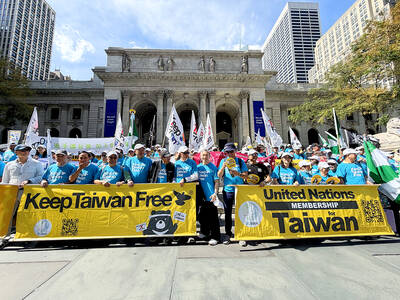
More than 100 Taiwanese-Americans, Taiwanese lawmakers and members of civic groups on Saturday marched through New York City to call for Taiwan’s participation in the UN, with Marshall Island Permanent Representative to the UN John Silk joining the event to show support. Participants chanted: “UN for Taiwan” and “Keep Taiwan Free” as they marched through central Manhattan, passing Times Square and Bryant Park before ending near the New York Public Library. The annual march brought together Taiwanese community groups from across the US East Coast. Silk expressed hope that Taiwan would one day be able to participate in UN meetings

Two aides at independent Legislator May Chin’s (高金素梅) office were ordered detained incommunicado yesterday in a broadening probe into alleged Chinese espionage by Chin’s former chief of staff, Chang Chun-chieh (張俊傑). The move to hold Lin I-chun (林怡君) and current chief of staff Chen Chih-huang (陳智葟) in custody came four days after Chang, indicted on corruption charges, cut off his electronic monitoring wristband and jumped bail. The High Prosecutors’ Office said that it believes Chang had developed a Chinese spy ring, which might have operated for more than a decade, with funding from China, and that Lin and Chen were suspected of


 RSS
RSS