


Vice Minister of Foreign Affairs Vanessa Shih (史亞平) yesterday dismissed rumors that she was too close to one of former Singaporean prime minister Lee Kuan Yew’s (李光耀) sons as “groundless.”
“It is not true. Like all the other rumors, they are all off base,” Shih said.
Former Chinese Nationalist Party (KMT) legislator Chang Sho-wen (張碩文) said sources within the Ministry of Foreign Affairs had told him that Lee once pointed his finger at Shih and it seemed that he was “enraged” at Shih or that he “blamed” her for something.
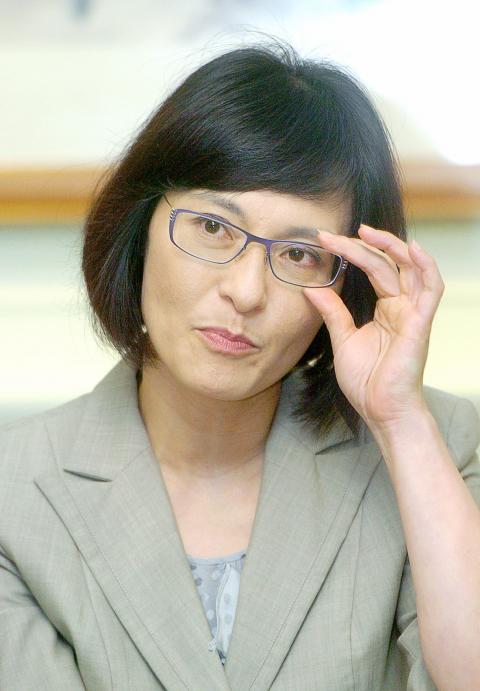
Photo: Wang Min-wei, Taipei Times
Lee was unhappy with Shih because she was too close to his youngest son, Lee Hsien Yang (李顯揚), Chang said.
Lee Hsien Yang, 55, is married with three children.
Asked to elaborate on the nature of the alleged relationship, Chang said he would like to think that the reason why Shih approached Lee Hsien Yang was for help negotiating a bilateral trade deal — the Agreement between Singapore and the Separate Customs Territory of Taiwan, Penghu, Kinmen and Matsu on Economic Partnership (ASTEP).
Chang said he viewed the matter from a positive standpoint: that it was for the sake of the ASTEP negotiations “rather than the other way around, as rumored within the ministry.”
In response to Chang’s comments, Shih called for an end to all the rumors.
“The spread of baseless rumors not only causes harm to the parties concerned, it is also impolite to [Lee Hsien Yang],” Shih said.
“I did not have any official dealings with Mr Lee [Hsien Yang] and we had no personal friendship. You could say that I am not acquainted with him. I have made it crystal clear. There is no gray area in the matter,” Shih said.
The rumor surfaced when Chang made it public on a TV political talk show on Wednesday afternoon, at a time when the Control Yuan was struggling to convince the public about its investigation, led by Chou Yang-shan (周陽山), who said he found that Shih “damaged” Taiwan-Singapore relations because of a “dereliction of duty” when she was posted to the country.
The Control Yuan on Wednesday decided to uphold an earlier decision that the results of Chou’s investigation should remain classified to protect relations between Taiwan and Singapore, leaving questions regarding Shih’s performance in the city-state to linger.
Asked if the relationship between Shih and Lee Hsien Yang was part of his findings, Chou said he learned a lot of information during his investigation, but he did not include it all in his report.
“Unless I have evidence beyond a shadow of a doubt, I can’t include it in my report. On that [the alleged relationship], I can only say I have no comment,” Chou said.
Chou said the decision not to declassify the report was made by 16 or 17 of the 20 members of a meeting of the Committee on Foreign and Overseas Chinese Affairs on Wednesday.
Under fire for not being able to substantiate the charges he brought against Shih, Chou said the central part of his report was based on the daily work record kept by the representative office in Singapore and that was classified information.
Chou has also denied accusations by some KMT lawmakers that he took revenge on Shih because the representative office reportedly did not treat him very well when he was in Singapore.
People First Party Legislator Thomas Lee (李桐豪) yesterday said Chou should consider stepping down if he failed to prove that his investigation was evidence-based.
The way Chou handled the case has dragged Shih’s name through the mud and it has “deeply impaired the credibility of the Control Yuan,” Thomas Lee said.
KMT Legislator Lin Yu-fang (林郁方) said the Control Yuan decided to keep the report classified because it did not dare to publish it because “the truth is there is no secret. The Control Yuan would only make itself a laughing stock if the report was made public.”
The Democratic Progressive Party (DPP) called for full disclosure of the truth behind Shih’s controversial tenure in Singapore, adding that President Ma Ying-jeou (馬英九) should review his personnel policy.
Full disclosure of the Control Yuan’s report on Shih would end the rumors and conspiracy theories about the case, DPP spokesperson Lin Chun-hsien (林俊憲) said.
Shih should be recognized for her efforts if she did everything she could to protect Taiwan’s national interest in Singapore, he said, adding that on the other hand, Shih should be reprimanded if there was any inappropriate conduct.
From disgraced former Executive Yuan secretary-general Lin Yi-shih (林益世), who has been detained for alleged corruption, to Shih, Ma’s personnel decisions have jeopardized the nation’s internal affairs as well as its diplomatic relations, he added.
Additional reporting by Chris Wang

‘NO SECURITY RISK’: The Railway Bureau reassured the public that the technicians’ activities were limited to technical guidance and did not involve sensitive systems The Railway Bureau yesterday said it had invited eight Chinese technicians to assist with an airport MRT construction project. The bureau issued the confirmation after an Internet user said Chinese nationals had entered the construction zone of Taiwan Taoyuan International Airport’s Terminal 3 project. They asked why “individuals from an enemy state” were allowed access to such a major national infrastructure project, which raised serious concerns over Taiwan’s industrial safety, sensitive systems and information security. The bureau’s Northern Region Engineering Branch Office said subcontractor Taiwan Handle Industrial Co (台灣手把工業) of the Taoyuan airport MRT’s “Contract No. CU05 Project A14 Station Civil, MEP &

A US uncrewed surface vessel (USV) encountered multiple Chinese warships during an autonomous transit of the Taiwan Strait, US defense company Seasats said in a statement on Wednesday. Seasats announced that a Lightfish USV had completed the first autonomous transit of the Taiwan Strait. Over five days, the USV traversed the entire length of the Strait while constantly monitoring surface vessel traffic, the company said. The Lightfish encountered multiple Chinese warships, one of which was a Chinese People’s Liberation Army Navy (PLAN) Type 056 corvette, it said. The Chinese vessels were operating “well within Taiwan’s exclusive economic zone without transmitting their identity via the
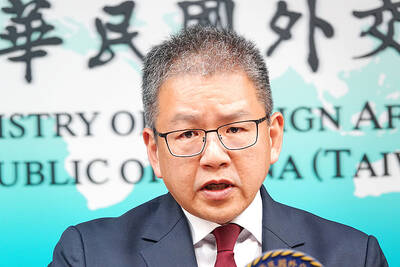
Taiwan is still in the process of assessing the possibility of recruiting workers from Eswatini, the Ministry of Foreign Affairs said yesterday, adding that its goal is to help Eswatini upgrade its vocational training centers. If there are plans to recruit workers from Eswatini, safeguarding national security, protecting public health and ensuring the employment rights of Taiwanese would be prerequisites, Department of West Asian and African Affairs Director-General Yen Chia-liang (顏嘉良) told a news conference. Key considerations would also include filling labor shortages in specific industries, and fostering bilateral professional and technical exchanges, he said. Yen was asked about the progress of labor
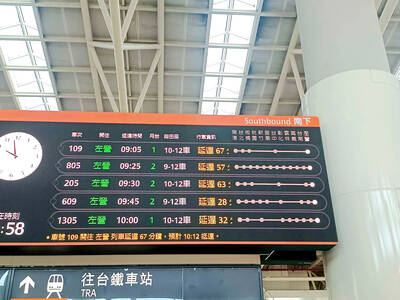
The nation’s usually punctual high-speed rail system yesterday was hit by major disruptions after all scheduled services were canceled and replaced with three hourly trains offering only non-reserved seating, affecting more than 200,000 passengers. Preliminary findings indicate the disruption was caused by a faulty power module in a track switch control cabinet, Taiwan High-Speed Rail Corp (THSRC) said, adding that as a full system inspection could only be conducted after operations end for the day, a decision on whether normal service would resume today would be announced before the first train departs. During a routine inspection early yesterday, a switch signal abnormality


 RSS
RSS