


The Control Yuan is said to have secretly concluded an investigation into an alleged incident involving Deputy Minister of Foreign Affairs Vanessa Shih (史亞平) during her tenure as representative to Singapore, in a report that allegedly concludes the representative office in Singapore was responsible for “a major violation of law and dereliction of duty.”
The Chinese-language China Times reported yesterday that the Control Yuan-led investigation launched following Shih’s recall as representative to Singapore — a move widely believed to be the result of souring bilateral relations — concluded on June 20 that “a significant violation of law and serious dereliction of duty had been committed by the representative office.”
However, as a result of the -“delicate nature of Taiwan-Singapore relations” and concern that the report could damage the national interest, the Presidential Office and the Ministry of Foreign Affairs allegedly convinced the Control Yuan to conclude the probe in secret, the report said.
Those involved have been neither impeached nor disciplined, the report said.
The Singaporean government reportedly voiced dissatisfaction with Shih’s behavior after the former representative allegedly displayed the Republic of China (ROC) flag and sang the national anthem without official consent during the city-state’s national day last year.
A purported meeting between Shih and Chen Show Mao (陳碩茂), a member of Singapore’s opposition Workers’ Party, was also said to have infuriated former Singaporean prime minister Lee Kuan Yew (李光耀).
In November last year, the representative office was not invited to a centennial commemoration of the Hsinhai Revolution, which was jointly organized by Taiwan’s National Sun Yet-sen Memorial Hall and its counterpart in Singapore.
The event not only galvanized public concern over the state of diplomatic ties between Taiwan and Singapore, but also prompted Control Yuan member Chou Yang-shan (周陽山), who was invited to the memorial, to initiate the probe into exchanges between the two countries.
According to sources familiar with the matter, the “series dereliction of duty” referred to in the report was Shih’s “inappropriate conduct” in her exchanges with Singaporean government officials that were said to have had a negative impact on the bilateral relations.
The “major violation of law” referred to the refusal by former representative office division chief Chang Shih-jui (張詩瑞) to answer questions when called to a meeting with Control Yuan members dealing with the case, the source said, an act that constituted a violation of the Control Act (監察法).
Sources said that given the major changes in Taiwan-Singapore relations, bilateral ties could be damaged “irreparably” if key parts of the report were made public.
Confirming receipt of the report late last month, Minister of Foreign Affairs Timothy Yang (楊進添) said the ministry would review the content and take action on the proposals made by Control Yuan members where necessary, and would seek to clarify any misunderstandings with the agency before a specified deadline.
The ministry believes Shih performed well during her term as representative to Singapore and did not commit any breach of duty, Yang said.
Quoting a ministry official, the Chinese-language United Evening News wrote yesterday that the Control Yuan report did not accuse Shih of committing major breaches of duty, but rather instructed her to “engage in introspection and actively deal with the matter.”
On the controversy over the commemoration event, the official said that Shih was absent because of a request from the embassy of the People’s Republic of China, which did not participate in the organization of the event, to send delegates.
Although the Singapore officials declined the request, saying the activity was purely academic in nature, Shih was still asked not to attend the memorial to avoid any complications, the official said.
In a press conference held to explain the situation, Shih, who was appointed to her position at the ministry on July 6, said she took the report very seriously and that it was for the members of the Control Yuan to determine whether she had committed any misconduct while in Singapore.
“The ministry will take the findings of the report very seriously,” she said, adding that she would be happy to provide explanations if there were any misunderstandings.

‘NO SECURITY RISK’: The Railway Bureau reassured the public that the technicians’ activities were limited to technical guidance and did not involve sensitive systems The Railway Bureau yesterday said it had invited eight Chinese technicians to assist with an airport MRT construction project. The bureau issued the confirmation after an Internet user said Chinese nationals had entered the construction zone of Taiwan Taoyuan International Airport’s Terminal 3 project. They asked why “individuals from an enemy state” were allowed access to such a major national infrastructure project, which raised serious concerns over Taiwan’s industrial safety, sensitive systems and information security. The bureau’s Northern Region Engineering Branch Office said subcontractor Taiwan Handle Industrial Co (台灣手把工業) of the Taoyuan airport MRT’s “Contract No. CU05 Project A14 Station Civil, MEP &

A US uncrewed surface vessel (USV) encountered multiple Chinese warships during an autonomous transit of the Taiwan Strait, US defense company Seasats said in a statement on Wednesday. Seasats announced that a Lightfish USV had completed the first autonomous transit of the Taiwan Strait. Over five days, the USV traversed the entire length of the Strait while constantly monitoring surface vessel traffic, the company said. The Lightfish encountered multiple Chinese warships, one of which was a Chinese People’s Liberation Army Navy (PLAN) Type 056 corvette, it said. The Chinese vessels were operating “well within Taiwan’s exclusive economic zone without transmitting their identity via the

Taiwan is still in the process of assessing the possibility of recruiting workers from Eswatini, the Ministry of Foreign Affairs said yesterday, adding that its goal is to help Eswatini upgrade its vocational training centers. If there are plans to recruit workers from Eswatini, safeguarding national security, protecting public health and ensuring the employment rights of Taiwanese would be prerequisites, Department of West Asian and African Affairs Director-General Yen Chia-liang (顏嘉良) told a news conference. Key considerations would also include filling labor shortages in specific industries, and fostering bilateral professional and technical exchanges, he said. Yen was asked about the progress of labor
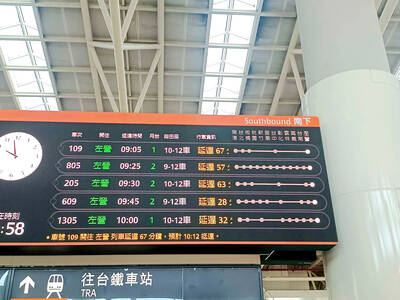
The nation’s usually punctual high-speed rail system yesterday was hit by major disruptions after all scheduled services were canceled and replaced with three hourly trains offering only non-reserved seating, affecting more than 200,000 passengers. Preliminary findings indicate the disruption was caused by a faulty power module in a track switch control cabinet, Taiwan High-Speed Rail Corp (THSRC) said, adding that as a full system inspection could only be conducted after operations end for the day, a decision on whether normal service would resume today would be announced before the first train departs. During a routine inspection early yesterday, a switch signal abnormality


 RSS
RSS