


Representative Robert Andrews has introduced a new bill to establish a special commission to advise the US Congress on how to implement the Taiwan Relations Act (TRA).
Andrews, a Democrat, lists the proposed commission’s number one job as assessing arms sales and reporting whether sufficient “defense articles” had been made available to Taiwan by the US. It would also assess whether Taiwan’s air and air defense forces retain the ability to effectively defend Taiwan against threats posed by China.
The idea is to appoint a five-member commission with a permanent staff and an annual budget of US$500,000.
A mini-survey by the Taipei Times showed that while the bill had widespread bipartisan support in the House, there could be difficulty providing financing during this fiscally tight election year.
The commissioners would be appointed by the president and by leaders of the House and Senate, and would write an annual report.
Other areas that commissioners would review include current and potential threats to the security, social or economic system of Taiwan and the extent to which the US retains the capability to resist any resource to force; measures taken by the US government toward the preservation and enhancement of human rights in Taiwan and policy options for the US to advance normalization of relations with Taiwan.
According to the Formosan Association for Public Affairs (FAPA), the concept of a Congressional Taiwan commission sprang from testimony given last year by Project 2049 Institute president Randall Schriver. He told the House Foreign Affairs Committee there had been a tendency among US administrations to relegate relations with Taiwan to a sub-issue in US-China bilateral ties.
“Objective analysis is important because it remains the legal obligation of this administration to make weapons for self-defense available to our democratic friend Taiwan,” he said.
FAPA president Mark Kao (高龍榮) said that although the TRA had been in force for 33 years, Congress had yet to undertake a comprehensive review of its implementation.
“There is increasing concern about whether the US government is faithfully executing its obligations under the TRA, which after all is the law of the land,” he said.
The establishment of an objective advisory commission, whose sole purpose would be to examine the implementation of the TRA, would “contribute greatly to addressing this gap,” Kao said.
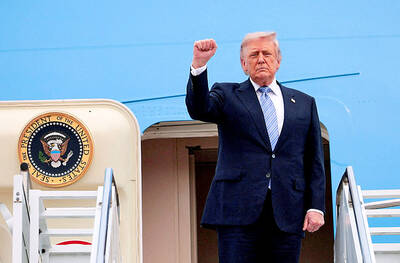
US-CHINA SUMMIT: MOFA welcomed US reassurance of no change in its Taiwan policy; Trump said he did not comment when Xi talked of opposing independence US President Donald Trump yesterday said he has not made a decision on whether to move forward with a major arms package for Taiwan after hearing concerns about it from Chinese President Xi Jinping (習近平). Trump’s comments on Taiwan came as he flew back to Washington after wrapping up critical talks in which both leaders said important progress was made in stabilizing US-China relations even as deep differences persist between the world’s two biggest powers on Iran and Taiwan. “I will make a determination,” Trump said, adding: “I’ll be making decisions. But, you know, I think the last thing we need right
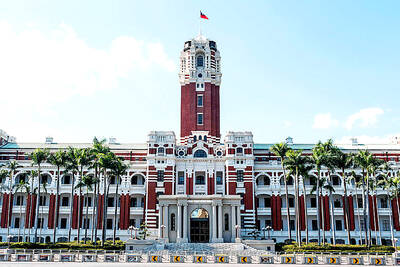
SECURITY: Taipei presses the US for arms supplies, saying the arms sales are not only a reflection of the US security commitment to Taiwan but also serve as a mutual deterrent against regional threats Taiwan is committed to preserving the cross-strait “status quo” and contributing to regional peace and stability, the Presidential Office said yesterday. “It is an undeniable fact that the Republic of China is a sovereign and independent democratic nation,” Presidential Office spokeswoman Karen Kuo (郭雅慧) reiterated, adding that Beijing has no right to claim sovereignty over Taiwan. The statements came after US President Donald Trump warned against Taiwanese independence. Trump wrapped up a state visit to Beijing on Friday, during which Chinese President Xi Jinping (習近平) had pressed him not to support Taiwan. Taiwan depends heavily on US security backing to deter China from carrying
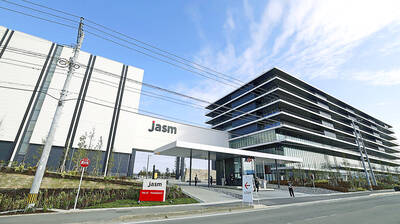
The subsidiary of Taiwan Semiconductor Manufacturing Co (TSMC, 台積電) in Kumamoto, Japan, turned a profit in the first quarter of this year, marking the first time the first fab of the unit has become profitable since mass production started at the end of 2024. According to the contract chipmaker’s financial statement released on Friday, Japan Advanced Semiconductor Manufacturing Inc (JASM), a joint venture running the fab in Kumamoto, posted NT$951 million (US$30.19 million) in profit in the January-to-March period, compared with a loss of NT$1.39 billion in the previous quarter, and a loss of NT$3.25 billion in the first quarter of
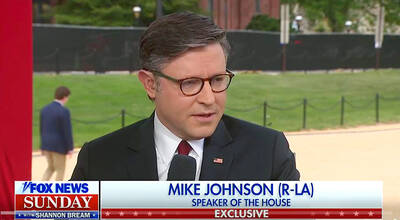
RESOLUTE BACKING: Two Republican senators are planning to introduce legislation that would impose immediate sanctions on China if it attempts to invade Taiwan US House of Representatives Speaker Mike Johnson on Sunday reaffirmed US congressional support for Taiwan, saying the US and “all freedom-loving people” have a stake in preventing China from seizing Taiwan by force. Johnson made the remarks in an interview with Fox News Sunday on US President Donald Trump’s summit with Chinese President Xi Jinping (習近平) last week. In an interview that aired on Friday on Fox News, just as Trump wrapped up a high-stakes visit to China, he said he has yet to green-light a new US$14 billion arms package to Taiwan and that it “depends on China.” “It’s a very good


 RSS
RSS