


Two buses collided in the 12.9km Hsuehshan Tunnel in northeastern Taiwan yesterday, causing two deaths and injuring more than 20 people, two of them seriously.
The collision, which occurred at 1:27pm, caused a passenger bus to catch fire after it was rear-ended by another bus at the 26km marker on the southbound side of Freeway No. 5 in the Hsuehshan Tunnel, which links New Taipei City (新北市) and Yilan County, police said.
The Directorate-General of Highways confirmed that the collision occurred after a tire blew out on a car in front of the first bus, forcing the bus driver, employed by Kamalan Bus (葛瑪蘭客運), to stomp on the brakes, catching the driver of the following bus by surprise.
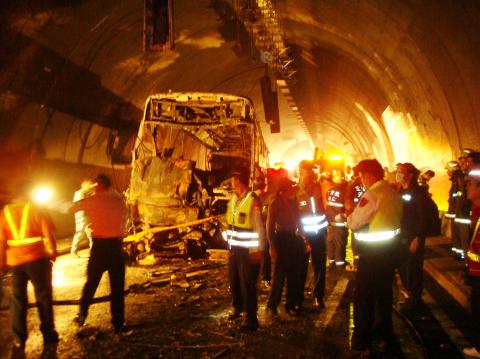
Photo courtesy of the New Taipei City Fire Department
The second bus, owned by Capital Bus (首都客運), burst into flames after the collision, and the driver was killed in the fire, the agency said.
Firefighters extinguished the flames at 2:08pm, saying the injured, who mostly suffered from smoke inhalation, had been rushed to nearby hospitals.
The tunnel has been closed to traffic to facilitate rescue work, police said.
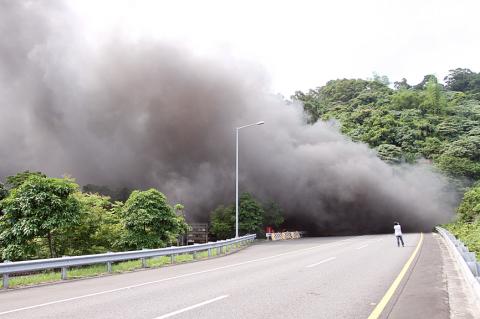
Photo: CNA
It was the most serious accident to occur in the tunnel since its opening in June 2006.
Considered a marvel of civil engineering and human perseverance, the tunnel took 15 years to complete.
National Freeway Bureau -Director-General Tseng Dar-jen (曾大仁) said one fire drill is held in the tunnel every season, with the most recent taking place on March 31 and April 1.
The drills focus on smoke and fume ventilation, and extinguishing flames, Tseng said.
Eight vehicle fires have -occurred in the tunnel. In all fires, the fire fighting team outsourced by the bureau — Shang Hung Gardening (尚宏園藝有限公司) — was able to put out the flames, Tseng said.
However, the fire from yesterday’s accident was too much for the gardening company to handle, and the bureau had to ask for help from fire stations in Yilan County and New Taipei City, Tseng said.
The Financial Supervisory Commission has directed insurance companies to help the victims and the family members of the deceased.
Miaoli-based Shang Hung -Gardening, which began -operations with less than NT$5 million (US$170,500) in paid-in capital, won a contract in 2010 to provide first-line firefighting services in the tunnel for three years.
Although the nearest the company had previously come to working on the national freeway system was the placement and maintenance of shrubs, hedges and flowers, its manager said at the time that his company was experienced enough to ensure the safety of the more than 40,000 vehicles that pass through the tunnel per day, adding that its firefighters were “very highly trained.”
Translation by Jake Chung, Staff Writer
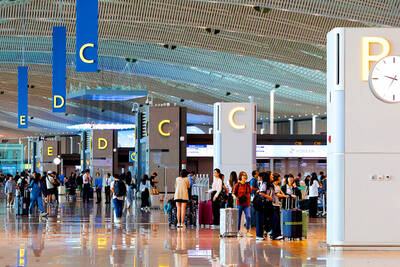
South Korea has adjusted its electronic arrival card system to no longer list Taiwan as a part of China, a move that the Ministry of Foreign Affairs said would help facilitate exchanges between the two sides. South Korea previously listed “Taiwan” as “Taiwan (China)” in the drop-down menus of its online arrival card system, where people had to fill out where they came from and their next destination. The ministry had requested South Korea make a revision and said it would change South Korea’s name on Taiwan’s online immigration system from “Republic of Korea” to “Korea (South),” should the issue not be

Tainan, Taipei and New Taipei City recorded the highest fines nationwide for illegal accommodations in the first quarter of this year, with fines issued in the three cities each exceeding NT$7 million (US$220,639), Tourism Administration data showed. Among them, Taipei had the highest number of illegal short-term rental units, with 410. There were 3,280 legally registered hotels nationwide in the first quarter, down by 14 properties, or 0.43 percent, from a year earlier, likely indicating operators exiting the market, the agency said. However, the number of unregistered properties rose to 1,174, including 314 illegal hotels and 860 illegal short-term rental
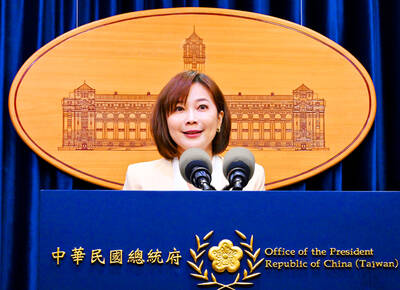
ECONOMIC COERCION: Such actions are often inconsistently applied, sometimes resumed, and sometimes just halted, the Presidential Office spokeswoman said The government backs healthy and orderly cross-strait exchanges, but such arrangements should not be made with political conditions attached and never be used as leverage for political maneuvering or partisan agendas, Presidential Office spokeswoman Karen Kuo (郭雅慧) said yesterday. Kuo made the remarks after China earlier in the day announced 10 new “incentive measures” for Taiwan, following a landmark meeting between Chinese President Xi Jinping (習近平) and Chinese Nationalist Party (KMT) Chairwoman Cheng Li-wun (鄭麗文) in Beijing on Friday. The measures, unveiled by China’s Xinhua news agency, include plans to resume individual travel by residents of Shanghai and China’s Fujian

Chinese President Xi Jinping (習近平) and Chinese Nationalist Party (KMT) Chairwoman Cheng Li-wun (鄭麗文) met in Beijing yesterday, where they vowed to bring people on both sides of the Taiwan Strait closer to facilitate the “great rejuvenation of the Chinese nation.” The meeting was held in the East Hall of the Great Hall of the People, a venue typically reserved for meetings between Xi and foreign heads of state. In public remarks prior to a closed-door meeting, Xi, in his role as head of the Chinese Communist Party (CCP), said that Taiwan is historically part of China, and remains an “inalienable” and


 RSS
RSS