


Rejecting Minister of Justice Tseng Yung-fu’s (曾勇夫) claim that psychiatric medication was administered to former president Chen Shui-bian (陳水扁) with Chen’s consent, Chen’s family and his office yesterday demanded an explanation of why he was given the medication without his knowledge.
Chen Chih-chung (陳致中), Chen Shui-bian’s son, said on Friday that the medical team at the state-run Taoyuan General Hospital discovered the drug Ativan, which is usually used to treat anxiety, was on the former president’s list of prescribed medications.
Later that same day Tseng told the legislature that the former president had told prison doctors in January last year that he often had slight headaches and trouble sleeping and that Chen Shui-bian had agreed to doctors’ suggestion that he take the minor tranquilizer Ativan.
Chen Shui-bian’s daughter, Chen Hsin-yu (陳幸妤), found Ativan on her father’s list of prescribed medications on Thursday and asked why it was there, Tseng added.
She then agreed her father should continue to take the medication after staff from Taoyuan General Hospital explained to her what had happened, Tseng said.
Dismissing Tseng’s account, the former president’s office said in a statement yesterday that Chen Shui-bian never agreed to take psychiatric medication while in Taipei Prison and that Chen Hsin-yu did not agree to continued use of the drug after she found out about it on Thursday.
The former president has never seen a psychiatrist in his life and he never told prison doctors he had trouble sleeping or any psychiatric problem, the statement said, adding that Chen Shui-bian mistakenly took the drug because he thought it was a medicine for colds.
Now knowing it to be Ativan, he refuses to take it, the statement said, adding that Chen Hsin-yu had not agreed to her father’s continued usage of the drug.
The office demanded that the prison explain what diagnosis it had made for it to prescribe Chen Shui-bian such a drug, and why he had been taking it for the past 14 months.
It added that according to medical research, taking Ativan for long periods might damage the brain or the central nervous system, and cause depression, amnesia, hallucinations or other serious side-effects.
Taipei Prison spokesperson Su Kun-ming (蘇坤銘) said yesterday that in January last year the former president said he was having problems with his heart and that prison doctors, on secondment from Taoyuan General Hospital, prescribed the medicine.
The prison respected the professionalism of the doctors and did not question the content of the medication, he added.
Chen, who is serving a 17-and-a-half-year prison sentence for corruption, was scheduled to stay at the Taoyuan General Hospital for a week to undergo a cardiac catheterization procedure on Thursday.
Doctors subsequently said Chen’s acute cardiac syndrome could be cured by medication rather than by inserting stents.
Wang Wei-chieh (王偉杰), spokesperson of the Taoyuan General Hospital, described Ativan as a commonly prescribed drug used to regulate the autonomic nervous system and assist with relieving symptoms such as anxiety, disturbance and insomia, adding that doctors prescribe the drug to patients who display any of the symptoms mentioned above.
According to Wang, Chen Shui-bian initially took half of a 0.5mg Ativan pill twice a day, then the dose was diminished to half a pill once a day.
After consulting with Chen Chih-chung and Chen Hsin-yu on Thursday over Ativan, the doctor had respected family members’ wishes and no longer administer Ativan to the former president, Wang said.
Additional reporting by Lin Shu-hui and Hsieh Wu-hsiung

‘NO SECURITY RISK’: The Railway Bureau reassured the public that the technicians’ activities were limited to technical guidance and did not involve sensitive systems The Railway Bureau yesterday said it had invited eight Chinese technicians to assist with an airport MRT construction project. The bureau issued the confirmation after an Internet user said Chinese nationals had entered the construction zone of Taiwan Taoyuan International Airport’s Terminal 3 project. They asked why “individuals from an enemy state” were allowed access to such a major national infrastructure project, which raised serious concerns over Taiwan’s industrial safety, sensitive systems and information security. The bureau’s Northern Region Engineering Branch Office said subcontractor Taiwan Handle Industrial Co (台灣手把工業) of the Taoyuan airport MRT’s “Contract No. CU05 Project A14 Station Civil, MEP &

A US uncrewed surface vessel (USV) encountered multiple Chinese warships during an autonomous transit of the Taiwan Strait, US defense company Seasats said in a statement on Wednesday. Seasats announced that a Lightfish USV had completed the first autonomous transit of the Taiwan Strait. Over five days, the USV traversed the entire length of the Strait while constantly monitoring surface vessel traffic, the company said. The Lightfish encountered multiple Chinese warships, one of which was a Chinese People’s Liberation Army Navy (PLAN) Type 056 corvette, it said. The Chinese vessels were operating “well within Taiwan’s exclusive economic zone without transmitting their identity via the
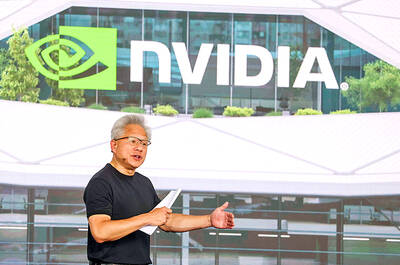
‘BOOMING’: ’ The number of partners we have here is incredible. You can see from their stock prices. They’re doing so well, they’re so happy,’ Jensen Huang said Nvidia Corp’s spending in Taiwan has ballooned to about US$150 billion a year, 10 times the US$10 billion to US$15 billion the company spent five years ago, Nvidia chief executive officer Jensen Huang (黃仁勳) said yesterday, suggesting Taiwan’s strategic importance in the global artificial intelligence (AI) supply chain. “Taiwan is the epicenter of the AI revolution. This is where the chips come, packaging comes. This is where the systems are made. This is where AI supercomputers were created,” Huang said at a meeting for the company’s employees in Beitou-Shilin Technology Park (北投士林科技園區) in Taipei, the planned site of Nvidia’s Taipei headquarters. “Taiwan
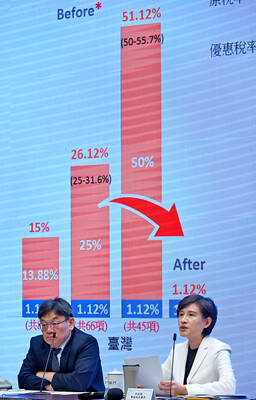
GREATER REACH? Auto parts and wood products would face tariffs of up to 15%, matching those targeting the EU, Japan and South Korea, Vice Premier said The US has announced that preferential tariff treatment for Taiwan’s non-semiconductor Section 232 goods would take effect retroactively from May 1, the Executive Yuan said yesterday. The US government yesterday posted a notice on the Federal Register’s public inspection Web site previewing tariff concessions for Taiwan under a memorandum of understanding (MOU) on Taiwan-US investment after two months of negotiations. The MOU signed on Jan. 15 stipulated three major preferential tariff arrangements: a 15 percent “reciprocal” tariff rate for Taiwan without stacking most-favored nation (MFN) rates; preferential Section 232 treatment for semiconductors and related products; and preferential Section 232 treatment for non-semiconductor


 RSS
RSS