


After more than a decade of delays and reversals, the navy has confirmed that it will embark on a domestic submarine program next year, with a prototype to be delivered within three to four years.
Taiwanese and US sources told the Taipei Times earlier this month that officials from the Taiwanese Navy had briefed a small group of legislators from the Foreign Affairs and Defense Committee during a classified meeting late last month or early this month. Legislators from the Democratic Progressive Party are also said to have attended the meeting.
While not mentioning the initial meeting with legislators, the Chinese-language United Daily News reported yesterday that the navy would brief senior government officials and legislators on the issue and seek budgets for the program within two months.
One US source, who has been actively involved in efforts to procure submarines for Taiwan over the years, told the Taipei Times in a meeting on Feb. 11 that an unspecified budget for the 2013 financial year has been set aside for a domestic diesel-electric submarine program, which would involve a unique design and assistance from one or a number of foreign countries.
The navy is reportedly aiming for a design with a relatively light displacement of between 1,000 tonnes and 1,500 tonnes.
A navy official told the Taipei Times earlier this month that the acquisition of submarines from the US remains the preferred option and that the door — at least on Taipei’s side — has not been closed on such a course of action.
However, after more than a decade of aborted efforts following the offer by the administration of former US president George W. Bush in 2001 to provide eight diesel-electric submarines to Taiwan for the sum of about US$12 billion, Taipei has since resigned itself to the reality that it will likely have to build them itself or acquire them from a third party, analysts say.
Local media have reported that three countries have expressed an interest in either assisting Taiwan develop its own submarine prototype or selling it ships recently decommissioned from their own fleets.
Although it did not exclude such a possibility, the Ministry of National Defense yesterday would not provide confirmation on the matter.
One country, Germany, has often been rumored to be a possible candidate for the program. However, an official at the German Institute, Taipei denied yesterday any knowledge of such efforts as being underway.
Greece has been another country that has been rumored as a possible candidate, although the economic crisis that has beset the country could make it difficult to realize such efforts.
Chinese Nationalist Party (KMT) Legislator Lin Yu-fang (林郁方), who sits on the Foreign Affairs and Defense Committee, said yesterday that acquiring submarines from abroad would be difficult, as most countries that manufacture them enjoy good relations with Beijing and were reluctant to risk compromising those ties over the sale of submarines to Taiwan.
Lin said a more feasible alternative would be for Taiwan to consult with international naval experts to develop its own subs.
The Taipei Times reported in December last year that naval authorities were readying to send personnel abroad to study production technology or to negotiate technology transfers to develop pressure-resistant hulls, which are said to be among the most challenging aspects in building submarines.
Additional difficulties for domestic shipbuilders could also arise from an alleged decision by the US Navy to bar top US defense firms, such as Lockheed Martin Corp and Raytheon Corp, among others, from participating in Taiwan’s submarine program,both under a Foreign Military Sale (FMS) program or Direct Commercial Sale (DCS), which requires approval from the State Department.
The US-based source with good knowledge of the matter confirmed as much during the discussion earlier this month, and if true, the directive could have a significant impact on the ability of the Taiwanese navy to integrate torpedo and ballistic missile systems, along with the electronic suites, into the submarines.
Ahead of the notification for the US$5.8 billion arms package to Taiwan announced in September last year, Taiwanese negotiators reportedly told Washington that a compromise for not obtaining the 66 F-16C/D aircraft Taipei was seeking could be the resumption of Phase 1 efforts on a submarine design.
Although the F-16 aircraft were not included in the notification, the US Department of State and the US National Security Council are said to have smacked down the proposed compromise, forcing Taiwan to go it alone.
In addition to expected pressure from Beijing on Washington not to assist Taiwan on the program, the US Navy is reportedly wary of seeing additional undersea vessels in the narrow Taiwan Strait and the South China Sea, fearing that the increased traffic could lead to accidents.
Regional navies are also said to be failing to abide by customary navigation rules for undersea forces by ignoring the pre-established depths and “corridors” — similar to the air corridors used for civilian aviation — to avoid collisions.

‘NO SECURITY RISK’: The Railway Bureau reassured the public that the technicians’ activities were limited to technical guidance and did not involve sensitive systems The Railway Bureau yesterday said it had invited eight Chinese technicians to assist with an airport MRT construction project. The bureau issued the confirmation after an Internet user said Chinese nationals had entered the construction zone of Taiwan Taoyuan International Airport’s Terminal 3 project. They asked why “individuals from an enemy state” were allowed access to such a major national infrastructure project, which raised serious concerns over Taiwan’s industrial safety, sensitive systems and information security. The bureau’s Northern Region Engineering Branch Office said subcontractor Taiwan Handle Industrial Co (台灣手把工業) of the Taoyuan airport MRT’s “Contract No. CU05 Project A14 Station Civil, MEP &

A US uncrewed surface vessel (USV) encountered multiple Chinese warships during an autonomous transit of the Taiwan Strait, US defense company Seasats said in a statement on Wednesday. Seasats announced that a Lightfish USV had completed the first autonomous transit of the Taiwan Strait. Over five days, the USV traversed the entire length of the Strait while constantly monitoring surface vessel traffic, the company said. The Lightfish encountered multiple Chinese warships, one of which was a Chinese People’s Liberation Army Navy (PLAN) Type 056 corvette, it said. The Chinese vessels were operating “well within Taiwan’s exclusive economic zone without transmitting their identity via the
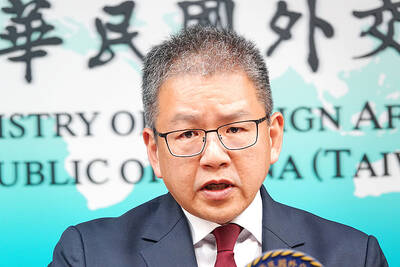
Taiwan is still in the process of assessing the possibility of recruiting workers from Eswatini, the Ministry of Foreign Affairs said yesterday, adding that its goal is to help Eswatini upgrade its vocational training centers. If there are plans to recruit workers from Eswatini, safeguarding national security, protecting public health and ensuring the employment rights of Taiwanese would be prerequisites, Department of West Asian and African Affairs Director-General Yen Chia-liang (顏嘉良) told a news conference. Key considerations would also include filling labor shortages in specific industries, and fostering bilateral professional and technical exchanges, he said. Yen was asked about the progress of labor
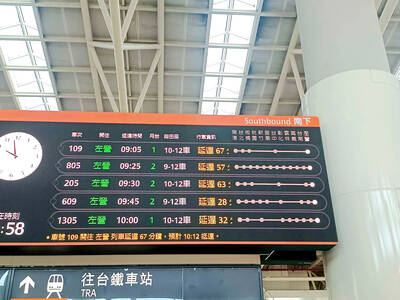
The nation’s usually punctual high-speed rail system yesterday was hit by major disruptions after all scheduled services were canceled and replaced with three hourly trains offering only non-reserved seating, affecting more than 200,000 passengers. Preliminary findings indicate the disruption was caused by a faulty power module in a track switch control cabinet, Taiwan High-Speed Rail Corp (THSRC) said, adding that as a full system inspection could only be conducted after operations end for the day, a decision on whether normal service would resume today would be announced before the first train departs. During a routine inspection early yesterday, a switch signal abnormality


 RSS
RSS