

Falun Gong practitioners filed a lawsuit against Beijing Mayor Guo Jinlong (郭金龍), who arrived in Taiwan yesterday afternoon, saying he had committed crimes against humanity, including his alleged involvement in the torture and abuse of Falun Gong practitioners and Tibetans.
A group of Falun Gong practitioners in Taiwan, accompanied by attorney Theresa Chu (朱婉琪), filed a lawsuit against Guo yesterday morning with the Taiwan High Prosecutors’ Office, asking it to launch a probe into Guo’s alleged crimes against humanity.
Guo arrived in Taiwan hours after the lawsuit was filed to take part in Beijing Culture Week, hosted by the Taipei City Government.
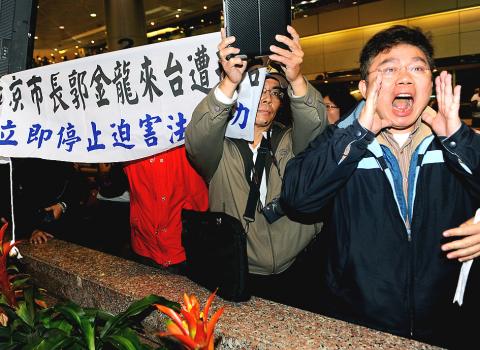
Photo: Chu Pei-hsiung, Taipei Times
“Guo’s record of human rights violations started with the repression of Tibetans in Tibet, who struggled for their freedom when he served as the Chinese Communist Party [CCP] chief in the Tibetan Autonomous Region,” Chu told the media outside the prosecutors’ office in Taipei. “Then, when Guo was party chief in Anhui Province, he prepared reports and a strategic handbook for the repression of Falun Gong activities in the province, leading to the illegal arrest of at least 37 Falun Gong practitioners.”
A member of the Beijing Olympics Organizing Committee, Guo was involved in the arrests of 586 Falun Gong practitioners in a six-month period, and more than 100 have been arrested in Beijing since he was sworn in as mayor of China’s capital, Chu said.
Guo became mayor of Beijing in January 2008.
“Guo’s role in the repression of Falun Gong practitioners and Tibetan activists constitutes crimes against humanity, as well as violations of the International Covenant on Civil and Political Rights and the International Covenant on Economic, Social and Cultural Rights,” Chu said. “As those human rights covenants have been adopted by the Legislative Yuan as domestic laws, the judiciary should take action if someone accused of such crimes is in the country, as many other countries that have prosecuted Chinese officials have done.”
Chu also panned the government for permitting Guo to visit Taiwan.
“We’ve delivered evidence of human rights abuses for which Guo was responsible to the National Immigration Agency, but he was still granted a permit to enter the country,” Chu said. “Most shockingly, Guo submitted his application [for a permit to visit Taiwan] on Feb. 4, and it was approved on Feb. 8 — even though there was a two-day weekend at that time.”
Guo, who was invited by the Chinese Nationalist Party (KMT), is the ninth Chinese official to be sued for alleged crimes against humanity since 2009.
Upon arriving in Taipei yesterday, he visited former KMT chairman Lien Chan (連戰) at Lien’s office before attending a dinner banquet hosted by former KMT chairman Wu Poh-hsiung (吳伯雄) at the Grand Hotel.
The six-day trip is Guo’s first visit to Taiwan and he is expected to discuss cross-strait issues and exchanges with various politicians during his stay.
The KMT insists Guo is in Taiwan to promote cross-strait cultural exchanges and his itinerary will focus on activities surrounding Beijing Culture Week.
Guo will visit the National Palace Museum and Songshan Cultural and Creative Park today, and head to Eslite Bookstore’s Xinyi flagship store before attending a cultural night at the Taipei Arena tomorrow.
Taipei City’s Department of Cultural Affairs, co-organizer of the Beijing Culture Week, said Taipei Mayor Hau Lung-bin (郝龍斌) would accompany Guo to the exhibitions at Songshan Cultural and Creative Park, and would introduce art and design work by Taiwanese artists.
Beijing Culture Week is a large-scale cultural event co-organized by Taipei and Beijing, launched seven years ago. Taipei and Beijing take turns hosting the event every six months.
Guo is also looking to use his visit to meet local politicians.
Information provided by the KMT shows he will visit also Greater Taichung, Changhua County and Nantou County and meet local KMT government leaders in those cities.
Hau and New Taipei City (新北市) Mayor Eric Chu (朱立倫) will meet with Guo and discuss the possibility of more city-to-city exchanges.
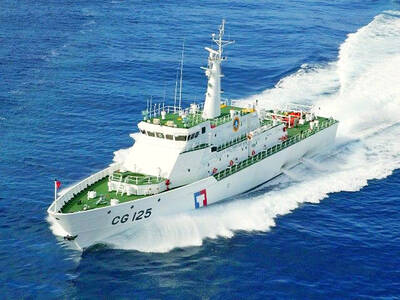
GEOPOLITICAL SIGNIFICANCE: The CGA’s nonmilitary role makes it a tool to avert diplomatic issues, an official said, while confirming the donation of a ship to Manila Coast Guard Administration (CGA) ships are scheduled to sail to the Philippines bearing the words “Taiwan Coast Guard” in a high-profile visit in October next year, the first such visit by a Taiwanese maritime law enforcement vessel to the Southeast Asian nation, the agency said yesterday. The CGA also confirmed that it had donated one of its decommissioned patrol vessels to the Philippines in a rare transfer of a retired ship to a nondiplomatic ally. The Republic of China (ROC) Navy last made such a visit in 1974, shortly before the Philippines switched diplomatic recognition to the People’s Republic of China in

‘GLOBAL WARNING’: The infiltration is not just a local problem, as Beijing has been deploying the same tactics worldwide against Western democracies, a report said Between 50,000 and 100,000 Chinese spies are operating in Taiwan, far more than the National Security Bureau’s previous estimate of 5,000, German journalist and author Jurgen Kremb said on Monday. Kremb presented his research, titled “The War of Spies: How China’s Intelligence Services Are Infiltrating Taiwan — and What Europe Must Learn from It,” at a joint event held by the Taiwan offices of the Friedrich Naumann Foundation and the European Values Center for Security Policy. The report was published in June in the Ministry of Justice Investigation Bureau’s Prospect & Exploration Monthly (展望與探索月刊). By spies, he said he was referring to informants,
CALL FOR CHANGE: They urged the UN to facilitate Taiwan’s involvement in the body, recognize its peace efforts and to work with members in preventing military conflict Representatives to the UN from five of Taiwan’s diplomatic allies sent a joint letter to UN Secretary-General Antonio Guterres on Friday, calling for the country’s inclusion in the body. Allies in the letter sent ahead of the 81st session of the UN General Assembly General Debate made three demands in support of Taiwan: inclusion, recognition and camaraderie. They implored the UN to seek an appropriate way to facilitate Taiwan’s meaningful involvement in the world governing body, saying that UN Resolution 2758, which accepted the People’s Republic of China (PRC) as a member of the UN, does not exclude Taiwan. Beijing claims that the
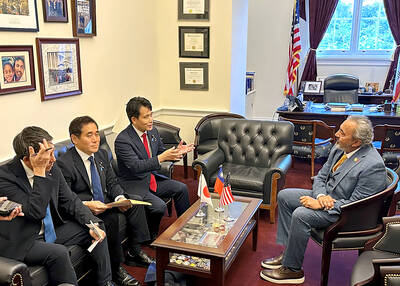
WASHINGTON MEETING: Japan’s Hirofumi Takinami said participants rejected the idea that the US should limit its defensive perimeter to the Second Island Chain US and Japanese lawmakers agree that the US must defend the First Island Chain, including Taiwan, and should not fall back to the Second Island Chain, while “a Taiwan contingency is a Japan contingency and therefore a US-Japan alliance contingency,” media reported after a meeting between officials of the two nations in Washington on Tuesday. A delegation of Japanese lawmakers from the Liberal Democratic Party met with US Senator Thom Tillis, co-chair of the Senate Taiwan Caucus, and US Representative Ami Bera, co-chair of the US Congressional Taiwan caucus, to discuss issues concerning East Asia and the Taiwan Strait. The Japanese and


 RSS
RSS