


A Chinese court yesterday sentenced a veteran dissident to seven years in jail, his son said, in the latest blow to challengers of the Chinese Communist Party’s (CCP) rule.
This came just a day after US Vice President Joe Biden called for China to address a “deterioration” of its human rights record as he met activists ahead of a key visit by his Chinese counterpart.
Biden — the host for next week’s visit by Chinese Vice President Xi Jinping (習近平), who is widely tipped to be China’s next president — met on Wednesday with four advocates for human rights.
In the meeting, Biden and the activists “discussed the deterioration of China’s human rights situation, prospects for reform and recommendations for US policy,” a White House statement said.
“The vice president underscored the administration’s belief in the universality of human rights and its commitment to human rights as a fundamental part of our foreign policy,” it said.
“He reiterated his view that greater openness and protection of universal rights is the best way to promote innovation, prosperity and stability in all countries, including China,” it said.
The White House said Biden met Li Xiaorong (李曉蓉), a founding member of the group Human Rights in China; Benjamin Liebman, a Columbia University expert on China’s legal system; Zha Jianying, an expert on Chinese media and pop culture, and Kenneth Roth, executive director of Human Rights Watch.
In China, Zhu Yufu (朱虞夫) was jailed for “inciting subversion of state power” by a court in Hangzhou, a city in eastern China, after a trial hearing on Jan. 31 when prosecutors cited a poem and messages he sent on the Internet, his son Zhu Ang (朱昂) said by telephone.
“The court verdict said this was a serious crime that deserved stern punishment,” said Zhu Ang, 31, who was allowed to attend the hearing with his mother.
“Now my mother is terribly upset, even if we saw this coming,” Zhu Ang said.
He said the verdict cited his father’s online calls for mobilization in the name of democracy.
“Basically, the only chance that my father had to say anything was when he was being taken out after the hearing, and he stopped and said: ‘I want to appeal.’”
Xi, who is nearly certain to succeed Chinese President Hu Jintao (胡錦濤) as CCP leader later this year and as state president early next year, leaves for Washington on Monday.
Xi is likely to face US criticism over China’s clampdown in restive Tibetan areas after a series of self-immolation protests.
At a briefing about Xi’s trip, Chinese Vice Deputy Foreign Minister Cui Tiankai (崔天凱) indicated his government would not welcome being publicly criticized by the administration of US President Barack Obama over rights.
“The problem now is that internationally there are some people who always grab hold of the human-rights banner when they want to speak ill of China,” Cui said. “I think that this is abusing the notion of human rights.”
The sentencing of Zhu, who turns 59 this month, followed the jailing of two other Chinese dissidents in December on subversion charges.
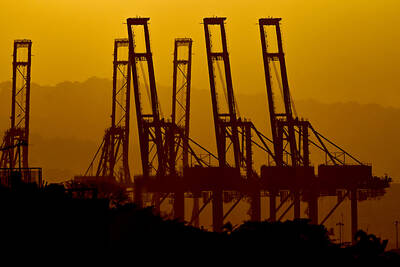
A subsidiary of a Hong Kong-based company that has lost control of two critical ports on the Panama Canal said it is seeking US$2 billion of compensation in damages from Panama over its “illegal” takeover of the ports. Panama Ports Co, a unit of Hong Kong’s CK Hutchison Holdings (長江和記實業), on Friday said in a statement that it is demanding the sum under international arbitration proceedings that it had already started. The Panamanian government last week seized control of the Balboa and Cristobal ports on each end of the Panama Canal, after the country’s Supreme Court declared earlier that a concession allowing
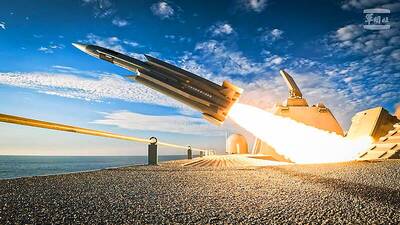
DETERRENCE: With 1,000 indigenous Hsiung Feng II and III missiles and 400 Harpoon missiles, the nation would boast the highest anti-ship missile density in the world With Taiwan wrapping up mass production of Hsiung Feng II and III missiles by December and an influx of Harpoon missiles from the US, Taiwan would have the highest density of anti-ship missiles in the world, a source said yesterday. Taiwan is to wrap up mass production of the indigenous anti-ship missiles by the end of year, as the Chungshan Institute of Science and Technology has been meeting production targets ahead of schedule, a defense official with knowledge of the matter said. Combined with the 400 Harpoon anti-ship missiles Taiwan expects to receive from the US by 2028, the nation would have

POSSIBILITIES EMERGE: With Taiwan’s victory and Japan’s narrow win over Australia, Taiwan now have a chance to advance if South Korea also beat the Aussies Taiwan has high hopes that the national baseball team would advance to the World Baseball Classic (WBC) quarter-finals after clinching a crucial 5-4 victory over South Korea in a nail-biting extra-inning game at the Tokyo Dome yesterday. Boosted by three home runs — two solo shots by Yu Chang (張育成) and Cheng Tsung-che (鄭宗哲) and a two-run homer by Stuart Fairchild — the triumph gave Taiwan a much-needed second victory in the five-team Pool C, where only the top two finishers would advance to the knockout stage in Miami, Florida. Entering extra innings with the game tied at four apiece, Taiwan scored
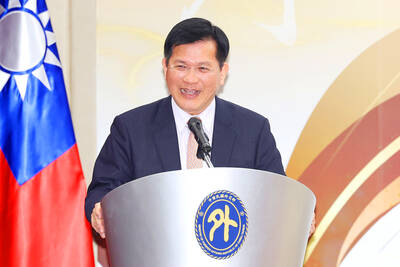
MISSION OF PEACE: The foreign minister urged Beijing to respect Taiwan’s existence as an independent nation, and work together to ensure peace and stability in the region Minister of Foreign Affairs Lin Chia-lung (林佳龍) yesterday rejected Chinese Minister of Foreign Affairs Wang Yi’s (王毅) comments about Taiwan, criticizing China as a “troublemaker” in the international community and a disruptor of cross-strait peace. Speaking at a news conference on the sidelines of the Chinese National People’s Congress, Wang said that Taiwan has always been a territory of China and that it would be impossible for it to become its own country. The “return” of Taiwan to China was the natural outcome of the Chinese people’s resistance against Japan in World War II, and that any pursuit of independence was “doomed


 RSS
RSS