


The Taipei District Prosecutors’ Office yesterday wrapped up its investigation into a case involving singer-actress Makiyo and her friend Takateru Tomoyori, charging both with assault and asking for four and six years imprisonment respectively over the alleged beating of a taxi driver last week.
The prosecution said it decided to charge Makiyo for assault after reviewing footage from a dashboard camera provided by another taxi driver, which prosecutors said showed that the actress kicking the driver, surnamed Lin (林).
Actresses A-tzu (ㄚ子) and Hsiang Ying (湘瑩), who were in the car, have been charged with providing false testimony.
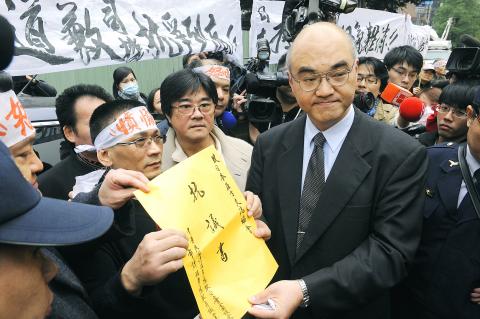
Photo: George Tsorng, Taipei Times
The incident is believed to have followed the refusal by Tomoyori to fasten his seatbelt, whereupon Lin was allegedly kicked several times by Tomoyori. Lin sustained severe injuries and was hospitalized.
Earlier in the day, a group of about 20 members of the National Taxi Drivers Union submitted a protest letter to the Interchange Association, Japan, in Taipei, asking the association, which serves as the de facto embassy in the absence of official diplomatic ties, to apologize to the nation “for the tensions” caused by the dispute.
Union chief of staff Kuo Ya-hsiung (郭雅雄) said the incident had dragged on for so long and that none of the alleged perpetrators were telling the truth.
“We want dignity! We want the truth!” the protesters shouted, holding banners that said: “Find the truth” and “Violent Japanese drinkers not welcome in Taiwan.”
Although Lin’s case was an isolated incident, Japan’s representative association should say something about a Japanese national beating up a Taiwanese in his own country, said Cheng Chuan-yi (鄭釧義), an executive committee member of the taxi drivers’ association.
“They [the association] should apologize to Taiwanese and Mr Lin to help ease tensions between the two countries [caused by the incident],” Kuo said.
The association sent a representative to accept the protest letter.
In an interview with the Taipei Times, Kuo thanked the media for speaking for the victim and for allowing justice to prevail.
“The media have helped highlight the plight facing the nation’s taxi drivers,” he said.
Lawyer Yu Chun-ru (余俊儒), who was retained by the union to help Lin in the case, said the driver had indicated he would forgive the young people if they truly repented for what they did and told the truth.
People make mistakes and it is one’s attitude after making a mistake that counts, he said.
Since the controversy emerged, Kuo said several taxi drivers had come forward and said they had had Makiyo as a passenger before, adding that they had complained about her behavior. So far, none of the alleged perpetrators have offered compensation to the victim.
“Some things, like dignity, simply cannot be bought with money,” Kuo said.
Several well-known people, including former leader of the Bamboo Union gang “White Wolf” Chang An-lo (張安樂) — who has made public statements about the affair — and Yulon Motor (裕隆汽車) chairman Kenneth Yen (嚴凱泰), have indicated their intent to donate money to Lin.
Chang, a wanted fugitive who has fled to China, is the founder of the China Unification Promotion Party. One taxi association, the Grand Chinese Taxi Association, is affiliated with the party.
His involvement in the matter in Taipei appears to have been made to please China and spark anti-Japanese sentiment.
Meanwhile, the Taipei City Police Department removed two police officials from their posts over the local divisions’ “poor handling” of the evidence in the case.
The department acknowledged its failure to include a video clip in the evidence package given to prosecutors on Friday last week.
The video clip, taken by a taxi driver using his car camcorder, showed clear images of Makiyo shouting at the taxi driver and kicking him several times before being stopped by Tomoyori.
The police department did not present the video clip to the prosecutors until the prosecutors saw the footage on TV on Wednesday and demanded the tape from the department.
Taipei Mayor Hau Lung-bin (郝龍斌) said the head of the Police Department, Huang Sheng-yong (黃昇勇), on Thursday afternoon presented a report on its handling of evidence and the list of personnel to be given punishments for negligence.
Hau also said he instructed the chief to re-examine the list and consider giving more severe punishments, if necessary.
Head of the department’s Sanchangli police station, Yang Kuo-chang (楊國昌), and director of Inspection Division of Xinyi precinct, Su Je-ping (蘇哲平), were removed from their posts.
Police officers who had handled the piece of evidence were also given demerits, according to the list.
“There was administrative negligence in the procedures relating to presenting evidence to the prosecutors, and I think those who are responsible for the mistakes should be punished,” Hau said.
Asked to comment on the singer-actress’ character, some sources within the Japanese community in Taipei said that Makiyo, who is half-Japanese, was not a well-behaved student when she attended the Taipei Japanese School.
Many parents were really troubled by some of her behavior, the source said, such as kissing her boyfriends in school.
The source also used the term “childish” to describe the actions taken by Makiyo and Tomoyori.
“Being drunk should not be used as an excuse,” the source said, referring to Makiyo. “We are embarrassed by Tomoyori’s chauvinistic behavior as well; he is really the shame of Japan.”
With translation by Jake Chung, Staff Writer, and additional reporting by CNA

A signaling system malfunction disrupted high-speed rail (HSR) services beginning at 8am today, with trains temporarily reduced to three northbound and three southbound trains per hour as authorities conduct inspections. The malfunction occurred on a section of track in Miaoli County during pre-operation checks early this morning, forcing northbound and southbound trains to use a single track, the HSR operator said. The regular schedule has been replaced with three hourly trains offering only nonreserved seating in each direction, stopping at every station, it said, adding that business class cars would still have reserved seating. Departures from terminal stations are scheduled at the top

Taiwan is still in the process of assessing the possibility of recruiting workers from Eswatini, the Ministry of Foreign Affairs said yesterday, adding that its goal is to help Eswatini upgrade its vocational training centers. If there are plans to recruit workers from Eswatini, safeguarding national security, protecting public health and ensuring the employment rights of Taiwanese would be prerequisites, Department of West Asian and African Affairs Director-General Yen Chia-liang (顏嘉良) told a news conference. Key considerations would also include filling labor shortages in specific industries, and fostering bilateral professional and technical exchanges, he said. Yen was asked about the progress of labor

VERBOSE VESSELS: A CGA cutter and a China Coast Guard exchanged verbal barbs for more than a day in Taiwanese-controlled waters before the Chinese vessel left The Taiwanese and Chinese coast guards had a standoff near the strategically located Pratas Islands (Dongsha Islands, 東沙群島) in the north of the South China Sea, the Coast Guard Administration (CGA) said yesterday. The two sides engaged in intense radio exchanges over sovereignty claims during the 33-hour standoff. China Coast Guard vessel 3501 eventually left the restricted waters, 26.6 nautical miles (49.2km) west of the Pratas Islands, at 5pm yesterday, the CGA said. Lying approximately between southern Taiwan and Hong Kong, the Taiwan-controlled Pratas are seen by some security experts as vulnerable to Chinese attack due to their distance — more than

WARNING: China should stop engaging in actions that undermine regional peace and stability, as it would only build resentment among people across the Strait, the CGA said China has deployed more than 100 navy, coast guard and other vessels in waters from the Yellow Sea to the South China Sea and the western Pacific since US President Donald Trump and Chinese President Xi Jinping (習近平) met in Beijing, National Security Council Secretary-General Joseph Wu (吳釗燮) said yesterday. “In this part of the world, #China is the one & only PROBLEM wrecking the #StatusQuo & threatening regional peace & stability,” Wu wrote on X. In a separate post, he said Beijing was coercing Taiwan’s maritime domain, calling it illegal and provocative, after the Coast Guard Administration (CGA) expelled a


 RSS
RSS