


More than 60 academics and members of civic groups launched a petition yesterday to boycott the Chinese-language China Times newspaper over recent controversial remarks by its owner, Tsai Eng-meng (蔡衍明), concerning the 1989 Tiananmen Square massacre.
Tsai, chairman and chief executive of the Want Want Group (旺旺集團) and owner of multiple media outlets including the China Times, said in an interview last month with the Washington Post that the 1989 crackdown on June 4 in Beijing did not constitute a massacre.
A joint petition drafted by academics and civic groups, including the Taipei Society and pro-democracy advocates, yesterday called for a “boycott of the crooked China Times.”
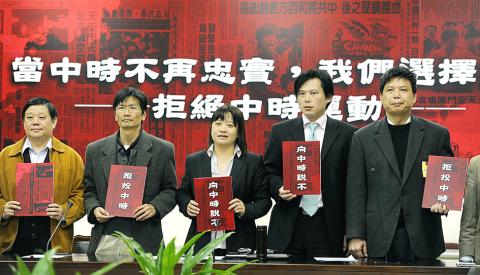
Photo: George Tsorng, Taipei Times
Petitioners called on the public to reject such an “unfaithful medium,” accusing the China Times of abandoning its responsibilities as a media outlet and allowing itself to become a tool for Tsai to ingratiate himself with a totalitarian regime.
Taipei Society director Huang Kuo-chang (黃國昌) appealed for more academics to join their efforts to blacklist the China Times, adding that they might petition government agencies in the near future.
National Chengchi University’s Department of Radio and Television associate professor Kuo Li-shin (郭力昕) said Tsai’s remarks had damaged the professionalism, autonomy and freedom of journalism.
Kuo also called on columnists perceived as pan-blue to back the boycott by “not writing or publishing” in the China Times in a bid to heal a split within society that divides people into either pan-blue or pan-green camps.
“This is just the first step,” Kuo said, adding that Tsai’s constant attempts to acquire and merge different media outlets have monopolized the supposedly diversified public voices of Taiwanese society.
Chiou Wen-tsong (邱文聰), an assistant researcher at Academia Sinica, expressed concern over how little attention the media have paid to Tsai’s remarks, describing the phenomenon as “the gradual collapse of Taiwan’s defense mechanism for its democracy.”
With the owner of a media outlet being in total control of its editorial line and monitoring what its reporters can put in their -articles, it appears as if Taiwanese are under the control of a totalitarian regime again, National Chengchi University professor Ku Chung-hwa (顧忠華) said.
Wang Dan (王丹), a student leader in Tiananmen Square in 1989 who initiated the boycott against the China Times last month via a post on his Facebook page, yesterday wrote on his Facebook page: “In my opinion, people are entitled to express their stance on historic incidents and to defend their freedom of speech in their own manner. It’s not necessary to force columnists currently working at the China Times to quit writing because of public pressure. So long as they can ensure that their articles are not altered or removed, we should respect their choices.”
Meanwhile, according to a reporter working at the China Times, employees scarcely talked about the controversy triggered by Tsai, adding that Tsai’s remarks and the China Times’ pro-China stance had caused jeering among his co-workers.
“We are only trying to make a living,” the anonymous reporter said, adding that Tsai, who last week said his remarks had been distorted and taken out of -context by the Washington Post and that he would communicate with people who misunderstood him, should keep his word and clearly explain his remarks.
Translated by Stacy Hsu, Staff Writer
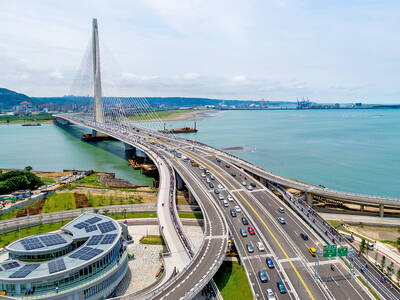
The Ministry of Transportation and Communications yesterday inaugurated the Danjiang Bridge across the Tamsui River in New Taipei City, saying that the structure would be an architectural icon and traffic artery for Taiwan. Feted as a major engineering achievement, the Danjiang Bridge is 920m long, 211m tall at the top of its pylon, and is the longest single-pylon asymmetric cable-stayed bridge in the world, the government’s Web site for the structure said. It was designed by late Iraqi-British architect Zaha Hadid. The structure, with a maximum deck of 70m, accommodates road and light rail traffic, and affords a 200m navigation channel for boats,
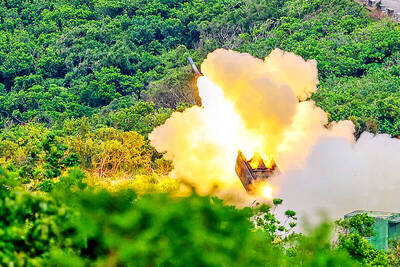
PRECISION STRIKES: The most significant reason to deploy HIMARS to outlying islands is to establish a ‘dead zone’ that the PLA would not dare enter, a source said A High Mobility Artillery Rocket System (HIMARS) would be deployed to Penghu County and Dongyin Island (東引) in Lienchiang County (Matsu) to force the Chinese military to retreat at least 100km from the coastline, a military source said yesterday. Taiwan has been procuring HIMARS and Army Tactical Missile Systems (ATACMS) from the US in batches. Once all batches have been delivered, Taiwan would possess 111 HIMARS units and 504 ATACMS, which have a range of 300km. Considering that “offense is the best defense,” the military plans to forward-deploy the systems to outlying islands such as Penghu and Dongyin so that
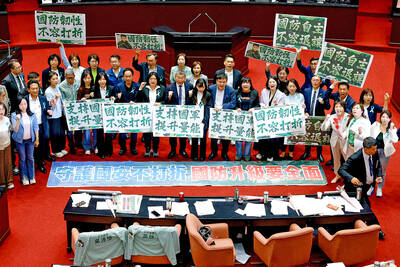
WHAT WAS ALL THAT FOR? Jaw Shaw-kong said that Cheng Li-wen had pushed for more drastic cuts and attacked him, just for the outcome to be nearly identical to his bill The legislature yesterday passed a supplementary budget bill to fund the purchase of separate packages of US military equipment, with the combined amount of spending capped at NT$780 billion (US$24.8 billion). The Chinese Nationalist Party (KMT) and Taiwan People’s Party (TPP) used their legislative majority to pass the bill, which runs until 2033 and has two main funding provisions. One was for NT$300 billion of arms sales already approved by the US for Taiwan on Dec. 17 last year, the other was for NT$480 billion for another arms package expected to be announced by Washington. The bill, which fell short of the NT$1.25
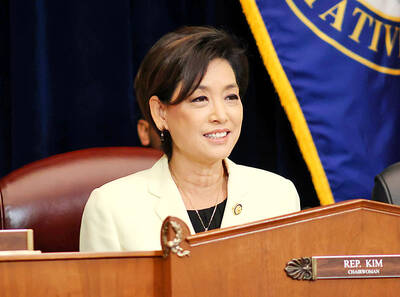
‘CLEAR MESSAGE’: The bill would set up an interagency ‘tiger team’ to review sanctions tools and other economic options to help deter any Chinese aggression toward Taiwan US Representative Young Kim has introduced a bill to deter Chinese aggression against Taiwan, calling for an interagency “tiger team” to preplan coordinated sanctions and economic measures in response to possible Chinese military or political action against Taiwan. “[Chinese President] Xi Jinping [習近平] has directed the People’s Liberation Army to be ready to invade Taiwan by 2027. China has a plan. America should have one too,” Kim said in a news release on Thursday last week. She introduced the “Deter PRC [People’s Republic of China] aggression against Taiwan act” to “ensure the US has a coordinated sanctions strategy ready should


 RSS
RSS