


Ratcheting up momentum for his campaign, President Ma Ying-jeou (馬英九) yesterday led a large campaign rally and march in Taipei that attracted tens of thousands of supporters on the final Sunday before the presidential election.
Rallies, titled “Stand up for Taiwan,” were simultaneously held in Greater Taichung as well as Hualien and Taitung counties yesterday afternoon.
In Taipei, a large crowd began gathering at Taipei City Hall at noon for a march to Ketagalan Boulevard, waving campaign flags, national flags and holding signs with slogans, such as: “Victory for Ma Ying-jeou” and: “Ma, Only U Ma, four more years!”
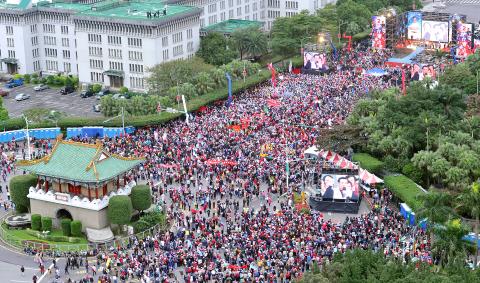
Photo: CNA
Ma appeared on stage at about 2:30pm and drew loud cheers from the crowd. He thanked supporters for their passion before leading the march and said the event highlighted his goal of continuing to lead Taiwan forward.
“The country is walking on the right path with a vigorous economy, clean government, just society and peaceful cross-strait relations. We should not change that direction and let’s continue on this path and move forward,” he said.
Accompanied by former Chinese Nationalist Party (KMT) chairman Wu Poh-hsiung (吳伯雄), Taipei Mayor Hau Lung-bin (郝龍斌) and New Taipei City Mayor Eric Chu (朱立倫), Ma then started walking toward Ketagalan Boulevard, but could barely move for a while as he was swamped by supporters.
To ensure a large turnout, the KMT mobilized members from all branches, local factions and support groups.
Waving national flags and cheering from the sidewalk with her children, a 40-year-old Taipei resident surnamed Lin (林) said Ma deserved a second term because of his efforts to improve cross-strait relations and boost the economy.
When Ma completed the march two hours later, Ketagalan Boulevard was packed as the crowd spilled into adjacent roads. The rally attracted about 250,000 people, the organizers said.
Surrounded by KMT heavyweights and legislative candidates, Ma took the stage on Ketagalan Boulevard amid cheers from the crowd as they chanted: “Standing up for Taiwan” and: “President Ma, dong suan [凍蒜, Taiwanese for getting elected].”
Ma attacked the Democratic Progressive Party (DPP) administration of former president Chen Shui-bian (陳水扁) and said that DPP presidential candidate Tsai Ing-wen (蔡英文) should apologize for what he called “mistakes in the past.”
“Chairperson Tsai and the DPP said we cannot move on from Chen’s corruption cases. The reason we keep mentioning the cases is because history happened and the mistakes may have been forgiven, but the lesson should not be forgotten,” he said.
Ma questioned Tsai’s integrity over recent allegations about her role in an investment case and accused her of being evasive when facing confrontation.
“Chairperson Tsai spent six months talking about a ‘Taiwan consensus,’ but still failed to offer a clear explanation … Rather than waiting for what she called a Taiwan consensus to be formed, why don’t you all let me continue with the current cross-strait policies?” he said.
First lady Chow Mei-ching (周美青) and Ma’s running mate, Premier Wu Den-yih (吳敦義), led a rally in Greater Taichung.
Ma later traveled to Greater Tainan and campaigned in Shao Bei Night Market as an attempt to boost support in the south.
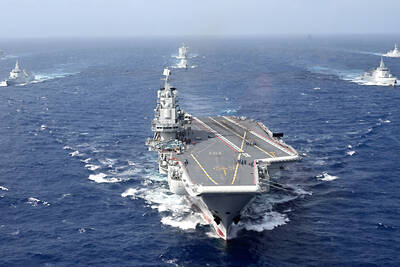
PROVOCATIVE: Chinese Deputy Ambassador to the UN Sun Lei accused Japan of sending military vessels to deliberately provoke tensions in the Taiwan Strait China denounced remarks by Japan and the EU about the South China Sea at a UN Security Council meeting on Monday, and accused Tokyo of provocative behavior in the Taiwan Strait and planning military expansion. Ayano Kunimitsu, a Japanese vice foreign minister, told the Council meeting on maritime security that Tokyo was seriously concerned about the situation in the East China and South China seas, and reiterated Japan’s opposition to any attempt to change the “status quo” by force, and obstruction of freedom of navigation and overflight. Stavros Lambrinidis, head of the EU delegation to the UN, also highlighted South China Sea
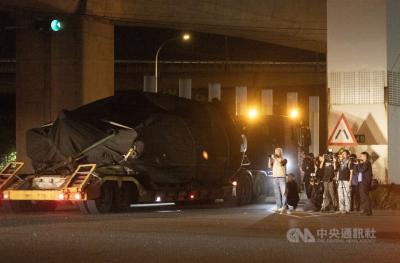
The final batch of 28 M1A2T Abrams tanks purchased from the US arrived at Taipei Port last night and were transported to the Armor Training Command in Hsinchu County’s Hukou Township (湖口), completing the military’s multi-year procurement of 108 of the tanks. Starting at 12:10am today, reporters observed more than a dozen civilian flatbed trailers departing from Taipei Port, each carrying an M1A2T tank covered with black waterproof tarps. Escorted by military vehicles, the convoy traveled via the West Coast Expressway to the Armor Training Command, with police implementing traffic control. The army operates about 1,000 tanks, including CM-11 Brave Tiger
Taiwan Semiconductor Manufacturing Co (TSMC, 台積電), the world’s largest contract chipmaker, said it expects its 2-nanometer (2nm) chip capacity to grow at a compound annual rate of 70 percent from this year to 2028. The projection comes as five fabs begin volume production of 2-nanometer chips this year — two in Hsinchu and three in Kaohsiung — TSMC senior vice president and deputy cochief operating officer Cliff Hou (侯永清) said at the company’s annual technology symposium in Silicon Valley, California, last week. Output in the first year of 2-nanometer production, which began in the fourth quarter of last year, is expected to
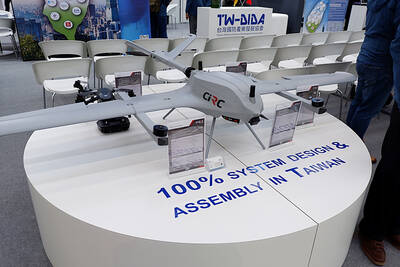
Taiwan’s drone exports surged past US$100 million in the first quarter, exceeding last year’s full-year total, with the Czech Republic emerging as the largest buyer, the Ministry of Economic Affairs said. Exports of complete drones reached US$115.85 million in the period, about 1.2 times the total recorded for all of last year, the ministry said in a report. Exports to the Czech Republic accounted for about US$100 million, far outpacing other markets. Poland, last year’s top destination, recorded about US$11.75 million in the first quarter. Taiwan’s drone exports have expanded rapidly in the past few years, with last year’s total


 RSS
RSS