


The US has sought to reassure China that its expansion of military ties with Australia is not aimed at containing China, a US defense official said yesterday, a day after holding talks with the Chinese army.
US President Barack Obama said on a trip to Asia last month the US was “here to stay” and that it had reached a deal to put a de facto US military base in northern Australia.
China’s military denounced the plan at the time, warning that it could erode trust and fan Cold War-era antagonism.
The talks on Wednesday, led by US Undersecretary of Defense for Policy Michele Flournoy and the Deputy Chief of the People’s Liberation Army General Staff, General Ma Xiaotian (馬曉天), went ahead despite those and other tensions, including US arms sales to Taiwan in September.
Flournoy told reporters that Ma had asked about US intentions behind the plan to put as many as 2,500 US Marines as well as US war planes and navy ships at a base in Darwin.
“We assured General Ma and his delegation that the US does not seek to contain China. We do not view China as an adversary. That these posture changes were first and foremost about strengthening our alliance with Australia,” she said at a briefing at the US embassy in Beijing.
Flournoy said the plan was about fostering bonds with an “incredibly steadfast ally.”
“So, this really isn’t about China. This is about Australia and ensuring that we remain present in the region in a way that is relevant to the kinds of, particularly non-traditional, challenges that we face,” she said.
Despite Washington’s efforts to ease Beijing’s worries, some in China suspect the US is seizing an opportune moment to advance its own interests at China’s expense.
China’s military modernization and the growing reach of its navy are raising regional concerns that have fed into long-standing territorial disputes and risk speeding up military expansion across Asia.
US allies such as Japan and South Korea have sought assurances from the US that it would continue to be a strong counterweight in the region.
China has repeatedly emphasized the defensive nature of its military and Chinese Ministry of Foreign Affairs spokesman Hong Lei (洪磊) reiterated that pledge on the day of the talks, saying China “has not in the past, and it will not in the future, present a danger to any country.”
In August, China made a trial launch of its first aircraft carrier, a retro-fitted Soviet vessel, and it has been building new submarines, surface ships and anti-ship ballistic missiles as part of its naval modernization.
China has had run-ins at sea with Japan, Vietnam and the Philippines in the past year. The incidents — boat crashes and charges of territorial incursions — have been minor, but the diplomatic reaction has often been heated.
In talks that she called “positive” and “very constructive,” Flournoy said she had reiterated to China’s military leaders that US surveillance patrols near China’s coast were routine.
“I assured the Chinese that we conduct these operations globally, literally in every region of the world, including near the coastlines of friends and allies,” she said.

‘NO SECURITY RISK’: The Railway Bureau reassured the public that the technicians’ activities were limited to technical guidance and did not involve sensitive systems The Railway Bureau yesterday said it had invited eight Chinese technicians to assist with an airport MRT construction project. The bureau issued the confirmation after an Internet user said Chinese nationals had entered the construction zone of Taiwan Taoyuan International Airport’s Terminal 3 project. They asked why “individuals from an enemy state” were allowed access to such a major national infrastructure project, which raised serious concerns over Taiwan’s industrial safety, sensitive systems and information security. The bureau’s Northern Region Engineering Branch Office said subcontractor Taiwan Handle Industrial Co (台灣手把工業) of the Taoyuan airport MRT’s “Contract No. CU05 Project A14 Station Civil, MEP &

The National Chungshan Institute of Science and Technology yesterday showcased its locally developed variants of the Vision 60 robotic patrol dog, which it plans to deploy on the nation’s outlying territories in the South China Sea. The variants were produced under the Joint Lab project — created by the institute and domestic companies — and assembled with domestically produced motors, lenses and artificial intelligence (AI) systems alongside licensed tech from the US, Missile and Rocket Systems Research Division deputy director Jen Kuo-kang (任國光) told the media event at a military base in Taipei’s Dazhi (大直) area. Taiwan has built up its strengths
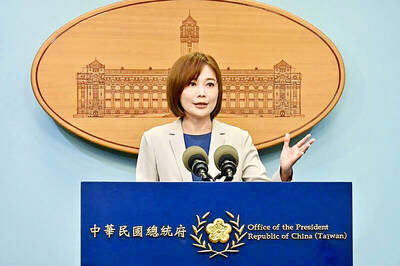
TIT-FOR-TAT: The US allegedly revoked the visa of a Chinese national working at Xinhua News Agency in the US in response to Beijing’s expulsion of Vivian Wang The Presidential Office yesterday condemned China for expelling a New York Times correspondent from Beijing following the newspaper’s interview with President William Lai (賴清德), saying the move highlighted Beijing’s suppression of press freedom and its threat to international news media. Taiwan has noted a series of recent incidents in which Beijing used similar tactics to “threaten and pressure international media outlets and journalists,” Presidential Office spokeswoman Karen Kuo (郭雅慧) said in a statement. “This concerns not only press freedom and freedom of expression, but also the safety of journalists, and Taiwan and relevant partners are paying close attention to the situation,” she
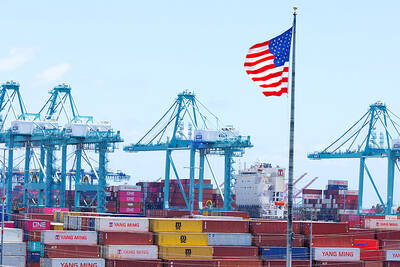
NOT IMMEDIATE: Taiwan has a chance to appeal the proposed 10 percent tariff before it starts, while other countries face a 12.5 percent tariff from the trade office Taiwan is among 60 economies determined by the US to have failed to impose or enforce a ban on the importation of goods produced with forced labor, according to a notice released on Tuesday by the Office of the US Trade Representative (USTR), which proposed imposing an additional 10 percent or more tariff on them. The USTR in a statement said that following an investigation, it had determined under Section 301 of the Trade Act of 1974 that the failure of the 60 economies to impose and effectively enforce a prohibition on the importation of goods produced with forced labor is


 RSS
RSS