

President Ma Ying-jeou’s (馬英九) re-election campaign office yesterday questioned the legitimacy of Democratic Progressive Party (DPP) Chairperson Tsai Ing-wen’s (蔡英文) “three little pigs” donation campaign and accused Tsai’s camp of using children as a campaign tool.
Tsai, the DPP’s presidential candidate, and her election team launched the “three little pigs” campaign late last month after the Control Yuan warned the DPP about a possible violation of the Act Governing Political Donations (政治獻金管理條例) when the party accepted piggy banks donated by three-year-old triplets. The act stipulates that only people of voting age who meet other voting eligibility requirements are allowed to make political donations.
The DPP returned the piggy banks to the children, but the incident sparked a fad among Tsai’s supporters to put their donations in piggy banks. The DPP later declared this month “little pigs month” and has used children as campaign spokespeople to call on supporters to fill piggy banks to support Tsai’s campaign.

Photo: Tsai Shu-yuan, Taipei Times
Ma’s campaign spokesperson Lee Chia-fei (李佳霏) yesterday said the DPP should put a stop to the piggy bank drive, as it violates the law by seeking political donations from children.
Lee denied that the campaign team or the Chinese Nationalist Party (KMT) reported the piggy bank incident to the Control Yuan and said the DPP’s act of returning the piggy banks to the triplets showed that the party acknowledged its mistakes.
“We are not against the participation of children in campaign activities, but it is illegal to solicit political donations from children ... If such an incident happened in our camp, would the DPP keep quiet about it?” she said.
Lee said the campaign team had received complaints from parents who said they were saddened to see children appear at DPP fundraisers because they seemed to be used as a campaign ploy.
In Ma’s campaign souvenir shops, she said, campaign staff would remind supporters that only Taiwanese over the age of 20 are qualified to buy campaign products.
“We cautiously follow legal regulations and we urge the DPP to stop flouting the law immediately,” she said.
In response, DPP spokesperson Lin Chun-hsien (林俊憲) hit back at the KMT for “never understanding [the virtue] of engaging in introspection.”
The KMT doesn’t understand that it [the three little pigs campaign] reflects people’s grievances about the current situation and their desire for change,” Lin said, adding that “the more the KMT oppresses [the three little pigs campaign], the stronger the support from the people [for the campaign.]”
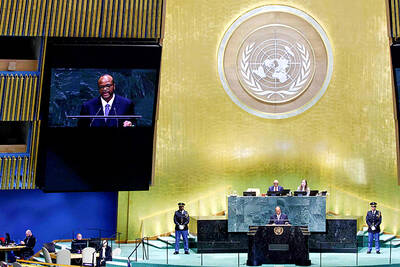
UNITY: Lai thanked the nations who spoke up for Taiwan, saying that democracies must stand together to face global authoritarian expansion Taiwan yesterday thanked eight European and Indo-Pacific countries for opposing unilateral changes to the “status quo” in the Taiwan Strait in a joint statement earlier this week, as well as three of Taiwan’s allies for speaking up for the nation’s participation in the UN at the body’s General Assembly in New York. Minister of Foreign Affairs Lin Chia-lung (林佳龍) welcomed the support and expressed his appreciation for the countries’ stance, the Ministry of Foreign Affairs said in a statement. Foreign ministers and senior representatives of Australia, France, Germany, Japan, New Zealand, Poland, South Korea and the UK issued a statement on Tuesday
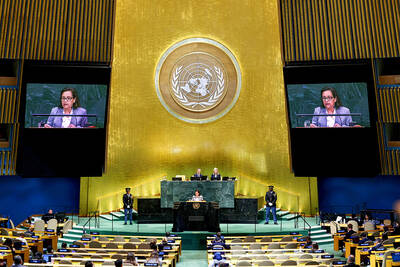
PLEA: How the UN addresses Taiwan’s security issue would be a test of its strength and relevance, Marshall Islands President Hilda Heine told the UN General Assembly Only Taiwan’s elected government can represent the people of Taiwan, Marshall Islands President Hilda Heine said on Friday at the UN General Assembly, calling for the nation’s inclusion in the UN. Taiwan and its 23 million people are a reality, and only its democratically elected government can represent it, Heine said when addressing the 81st session of the UN General Assembly General Debate. Appropriate ways must be found for Taiwan’s substantive participation in UN meetings if the UN is to be truly inclusive and effective in years to come, she said. UN member states would experience pressure to accept a
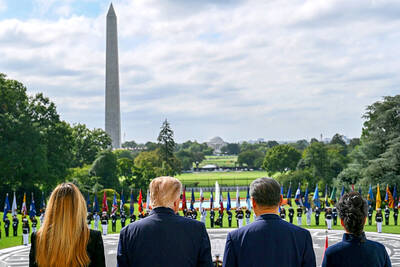
FACTS DISTORTION: The MAC rejected Xi’s remarks that the US and ‘China’ fought side-by-side during WWII, saying the ROC was Washington’s true ally during the war Taiwan yesterday denounced Chinese President Xi Jinping’s (習近平) comments to US President Donald Trump on the nation’s future, after Xi appeared to push Trump for a subtle change in stance that could erode US support for Taiwan. Xi told Trump in Washington on Thursday that he hoped the US would adhere to the “correct position” of opposing Taiwanese independence, according to a Chinese readout of the talks. That would be a tougher version of Washington’s long-standing formulation that it does not “support” independence. There was no immediate White House readout of the exchange. Xi’s remarks represent “the consistent Chinese approach of distorting facts
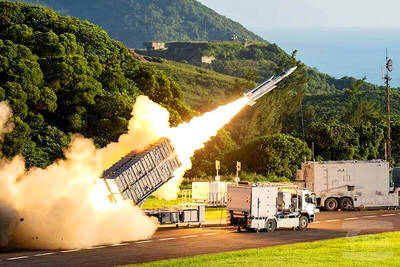
RESILIENCE: Keeping the defense industry’s assembly lines open would prove essential should the nation be involved in a prolonged conflict, a source said The Ministry of National Defense has prepared a NT$22 billion (US$692.3 million) program to acquire about 200 improved Hsiung Feng anti-ship missiles from next year to 2035, a source said. Commenting on condition of anonymity, a high-ranking defense official said the ministry’s plan for enhanced-capability Hsiung Feng II and Hsiung Feng III missiles would be funded as part of the regular defense budget. The 200 missiles would be added on top of the 1,400 missiles being funded via the Sea-Air Combat Power Improvement Plan, they said. The program is not about padding missile numbers, but expanding the capability to defeat


 RSS
RSS