


Scuffles broke out between “Occupy Taipei” demonstrators, the police and Taipei 101 security staff when hundreds of demonstrators rushed into the Taipei 101 shopping mall chanting anti-capitalist slogans, as part of a globally coordinated movement against capitalism inspired by the “Occupy Wall Street” demonstration that started in New York City last month.
“No to capitalism! We are the 99 percent,” demonstrators chanted, while also singing the Workers’ Fight Song as they marched through the ground floor of the shopping mall in the country’s tallest building.
Before entering the building, demonstrators circled it, sparking minor physical and verbal clashes with security staff and the police who tried — unsuccessfully — to stop the protesters from entering.
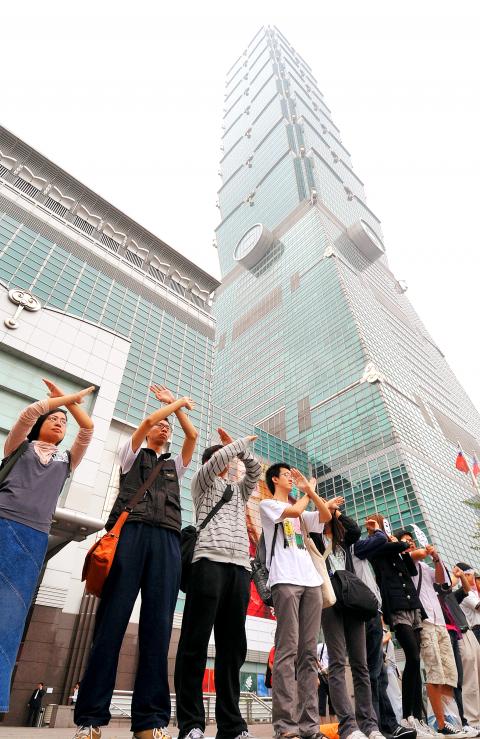
Photo: Chien Jung-fong, Taipei Times
After their brief “march” inside the building, the demonstrators lay down and blocked the entrance of the building. Initiated by Internet users on Facebook, several hundred people showed up at the “Occupy Taipei” demonstration.
The protesters said Taipei 101 was chosen as the target because it is a landmark symbol of capitalism in Taiwan. Participants were mostly students, but also included office workers and unemployed and retired people.
National Taiwan University student Ho Shiang-kai (何翔凱) and friends edited and printed their own magazine, titled Socialist, that they sold during the demonstration, saying they hoped to spread different views.
“I’m glad to see a demonstration in Taipei that has no specific goals, but is directly targeting -capitalism and the financial system in the country,” he said, adding that the capitalist system is making the poor — especially young college graduates — work hard, while they don’t get much in return, and the wealthy make more money through investment activities.
“There are too many problems with capitalism, but I think, at least, the first step to creating a fairer society is to tax peoples’ income through investment activities,” he said. “It’s not fair that workers have to pay taxes on their hard-earned money, but the wealthy are exempt from taxation on whatever they earn from the money game.”
Liang Sheng-yueh (梁聖岳), a high school student from Hsinchu City who traveled to Taipei to take part in the demonstration, was also concerned about the widening wealth gap.
“The economic growth figures may look good on paper, but we are not feeling it because all the money is going into the hands of capitalists,” Liang said. “I don’t expect instant change to happen, but I hope that this demonstration can at least be a start for change in the future.”
A 63-year-old owner of a home design firm surnamed Shen (沈) said he was happy to see so many young people standing up against social inequality. However, he said he had expected that more people would have attended the protest.
A young woman, who only wished to be known as Zoe and was among the first group of people to initiate the event, said she was surprised to see so many people coming out yesterday.
“This shows that a lot of people are dissatisfied with current social conditions,” she said. “I wouldn’t say whether today’s [yesterday’s] action was a success or a failure, because this is only the start.”

‘NO SECURITY RISK’: The Railway Bureau reassured the public that the technicians’ activities were limited to technical guidance and did not involve sensitive systems The Railway Bureau yesterday said it had invited eight Chinese technicians to assist with an airport MRT construction project. The bureau issued the confirmation after an Internet user said Chinese nationals had entered the construction zone of Taiwan Taoyuan International Airport’s Terminal 3 project. They asked why “individuals from an enemy state” were allowed access to such a major national infrastructure project, which raised serious concerns over Taiwan’s industrial safety, sensitive systems and information security. The bureau’s Northern Region Engineering Branch Office said subcontractor Taiwan Handle Industrial Co (台灣手把工業) of the Taoyuan airport MRT’s “Contract No. CU05 Project A14 Station Civil, MEP &

A signaling system malfunction disrupted high-speed rail (HSR) services beginning at 8am today, with trains temporarily reduced to three northbound and three southbound trains per hour as authorities conduct inspections. The malfunction occurred on a section of track in Miaoli County during pre-operation checks early this morning, forcing northbound and southbound trains to use a single track, the HSR operator said. The regular schedule has been replaced with three hourly trains offering only nonreserved seating in each direction, stopping at every station, it said, adding that business class cars would still have reserved seating. Departures from terminal stations are scheduled at the top
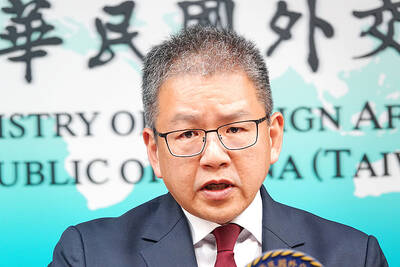
Taiwan is still in the process of assessing the possibility of recruiting workers from Eswatini, the Ministry of Foreign Affairs said yesterday, adding that its goal is to help Eswatini upgrade its vocational training centers. If there are plans to recruit workers from Eswatini, safeguarding national security, protecting public health and ensuring the employment rights of Taiwanese would be prerequisites, Department of West Asian and African Affairs Director-General Yen Chia-liang (顏嘉良) told a news conference. Key considerations would also include filling labor shortages in specific industries, and fostering bilateral professional and technical exchanges, he said. Yen was asked about the progress of labor

A US uncrewed surface vessel (USV) encountered multiple Chinese warships during an autonomous transit of the Taiwan Strait, US defense company Seasats said in a statement on Wednesday. Seasats announced that a Lightfish USV had completed the first autonomous transit of the Taiwan Strait. Over five days, the USV traversed the entire length of the Strait while constantly monitoring surface vessel traffic, the company said. The Lightfish encountered multiple Chinese warships, one of which was a Chinese People’s Liberation Army Navy (PLAN) Type 056 corvette, it said. The Chinese vessels were operating “well within Taiwan’s exclusive economic zone without transmitting their identity via the


 RSS
RSS