


The central bank is expected to hold the nation’s policy rate at 1.875 percent at its board meeting on Thursday, given that Taiwan’s downside risks on economic growth led by recent global uncertainties have outweighed inflationary pressures, economists said.
This would be the first time that the bank has held the policy rate in more than a year after increasing it for the past five straight quarters, bringing Taiwan’s discount rate from 1.25 percent to 1.875 percent.
“It is less likely that the central bank will raise the rates for now, as relatively mild inflation and rising economic uncertainties have lowered the necessity of a rate hike,” National Taiwan University finance professor Shen Chung-hua (沈中華) said by telephone yesterday.
Although a low interest rate may hurt local banks’ profits by squeezing the spread between their lending rates and the central bank’s benchmark rates, the debt crisis in the US and Europe may make the central bank suspend the pace of rate increases, Shen added.
Wu Chung-shu (吳中書), president of the Chung-Hua Institution for Economic Research (中華經濟研究院), shared Shen’s view.
“I see no need for the central bank to raise the policy rates again amid the nation’s slowing economic growth and lowering inflationary pressure,” Wu said at a conference on Friday.
Economists at Standard Chartered Bank and Citigroup also expected the central bank to keep policy rates unchanged.
Tony Phoo (符銘財), a Taipei-based economist at Standard Chartered Bank, said the weaker-than-expected industrial output data, alongside poor export orders and rising concerns about the global economic outlook, have intensified because recent market turmoil may have undermined market confidence.
“These add to further support that the central bank will consider putting on hold its modest tightening stance when it meets next week,” Phoo said in a note on Friday.
Cheng Cheng-mount (鄭貞茂), chief economist at Citigroup in Taipei, reiterated that an interest rate cut for Taiwan would be too early to call, because economic growth only appears to be shifting gear from an above-trend to a trend growth, and not to recession status yet.
However, Barclays Capital maintained its forecast that the central bank would raise the policy rate by 12.5 basis points, saying the impending launch of Apple Inc’s newest iPhone, coupled with the emergence of the seasonal pre-Christmas sales lift, could boost orders down the electronics value chain.
However, the brokerage house revised downward its forecast for the central bank’s increase on rates of 90-day negotiable certificates of deposit (NCD) amid the recent re-appraisal of economic growth.
“We look for a smaller 3 to 4 basis points pass-through into 90-day NCD rates, from 8 to 9 basis points estimated before,” Barclays said.

SILENCING CRITICS: In addition to blocking Taiwan, China aimed to prevent rights activists from speaking out against authoritarian states, a Cabinet department said The Ministry of Foreign Affairs (MOFA) yesterday condemned transnational repression by Beijing after RightsCon, a major digital human rights conference scheduled to be held in Zambia this week, was abruptly canceled due to Chinese pressure over Taiwanese participation. This year’s RightsCon, the world’s largest conference discussing issues “at the intersection of human rights and technology,” was scheduled to take place from tomorrow to Friday in Lusaka, and expected to draw 2,600 in-person attendees from 150 countries, along with 1,100 online participants. However, organizers were forced to cancel the event due to behind-the-scenes pressure from China, the ministry said, expressing its “strongest condemnation”
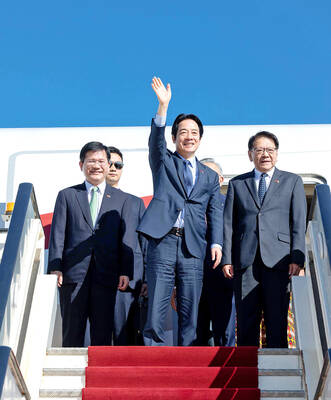
DELAYED BUT DETERMINED: The president’s visit highlights Taiwan’s right to international engagement amid regional pressure from China President Willaim Lai (賴清德) yesterday arrived in Eswatini, more than a week after his planned visit to Taiwan’s sole African ally was suspended because of revoked overflight permits. “The visit, originally scheduled for April 22, was postponed due to unforeseen external factors,” Lai wrote on social media. “After several days of careful arrangements by our diplomatic and national security teams, we successfully arrived today.” Lai said he looked forward to further deepening Taiwan-Eswatini relations through closer cooperation in the economy, agriculture, culture and education, as well as advancing the nation’s international partnerships. The president was initially scheduled to arrive in time to celebrate
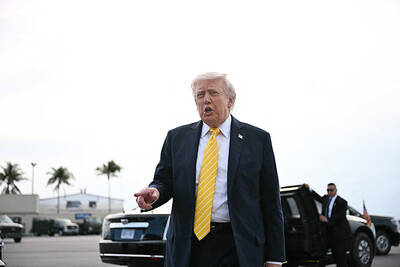
Iran’s Islamic Revolutionary Guard Corp (IRGC) yesterday said the US faced a choice between an “impossible” military operation or a “bad deal” with Tehran, after US President Donald Trump disparaged Iran’s latest peace proposal. Negotiations between the two countries have been deadlocked since a ceasefire came into effect on April 8, with only one round of direct peace talks held so far. Iran’s Tasnim and Fars news agencies reported that Tehran had submitted a 14-point proposal to mediator Pakistan, but Trump was quick to cast doubt on it. “I will soon be reviewing the plan that Iran has just sent to us, but

A group affiliated with indicted Chinese immigrant Xu Chunying (徐春鶯) is to be dissolved for monitoring Chinese immigrants in Taiwan, a source said yesterday. Xu, the secretary-general of the Cross-Strait Marriage and Family Service Alliance, was indicted on March 24 on charges of violating the Anti-Infiltration Act (反滲透法). The alliance “illegally monitored" Chinese immigrants living in Taiwan on behalf of the Chinese Communist Party (CCP) and the Ministry of the Interior is expected to dissolve the organization in the coming days under provisions of the Civil Associations Act (人民團體法), the source said. Xu, who married a Taiwanese in 1993 and became a Republic


 RSS
RSS