


A Taiwanese captain who was killed during a NATO anti-piracy operation off the coast of Somalia earlier this year “was killed inadvertently by ordnance” by the US Navy, a long-awaited US report on the investigation into the incident said yesterday.
Wu Lai-yu (吳來于), skipper of the long-line fishing vessel Jih Chun Tsai No. 68 (JCT 68), which was hijacked by Somali pirates off the eastern coast of Africa on March 30 last year and used as a pirate mothership, died on May 10 when a US frigate, the USS Stephen W. Groves (SWG), operating under NATO-led counter-piracy Combined Task Force 508, engaged the pirates.
Initially expected by July 15, the report providing an account of the incident was delivered to Minister of Foreign Affairs Timothy Yang (楊進添) by American Institute in Taiwan (AIT) Director William Stanton on Saturday.
According to the report, which was conducted by US Naval Forces Central Command (NAVCENT), NATO Task Force 508 directed the SWG to shadow and then disrupt the pirate mothership and “authorized the use of force” to compel the JCT 68 to stop and surrender.
“On the morning of May 10, 2011, SWG executed a graduated use of force: issued verbal warnings; fired warning shots; and then employed 25mm, 7.62mm, and 20mm ordnance to destroy/disable the skiffs on JCT 68 and force the vessel to stop, release hostages, and surrender weapons,” the report says.
After the SWG fired on the skiffs, the pirates returned fire with AK-47 rifles and then subsequently surrendered, it says.
NATO Task Force 508 authorized the SWG to conduct a complete boarding of the fishing vessel to seize suspected pirate weapons and other equipment, which including several rocket-propelled grenades launchers, heavy machine guns, ammunition and about 15 AK-47 assault rifles, the report says.
An SWG boarding team found Wu dead in his sleeping quarters just aft of the wheel house on the forward starboard side of the superstructure, it says.
“As a result of its investigation, NAVCENT concluded that the Master [Wu] had been killed inadvertently by ammunition fired from the SWG,” it says.
Wu’s body was moved to the SWG and prepared for burial at sea without an autopsy because the SWG had neither medical personnel trained to conduct autopsies nor forensic capabilities. On May 11, four US sailors conducted a respectful burial-at-sea ceremony for Wu, who was laid to rest in his ship, which was then sunk, the report says.
In a statement, the AIT said the US “regrets that Master Wu was lost in the NATO effort to repress piracy off the Horn of Africa.”
The ship was sunk “to prevent it from becoming a hazard to navigation,” because the JCH 68 was determined to be unseaworthy after the shelling, the statement said.
“We again express our condolences to the family of Master Wu Lai-yu. On June 8 and again on July 23, AIT provided MOFA [the Ministry of Foreign Affairs] with information on seeking compensation from NATO and the US Navy, respectively,” AIT said.
AIT spokesperson Christopher Kavanagh said Washington was actively considering offering an ex gratia payment to Wu’s family and that Wu’s family could also claim compensation from NATO and the US Navy.
Speaking to the Taipei Times, Wu Hui-hwa (吳惠華), the daughter of the deceased skipper, said her family “did not find the report acceptable” because many questions regarding the cause of her father’s death had yet to be answered.
“They did not apologize for my father’s death,” Wu Hui-hwa said.
Wu Hui-hwa said her family would join a planned protest organized by Tsai Pao-shing (蔡寶興), director of Pingtung County’s Liouciou Township (琉球) fisheries association, in front of the AIT tomorrow.

‘NO SECURITY RISK’: The Railway Bureau reassured the public that the technicians’ activities were limited to technical guidance and did not involve sensitive systems The Railway Bureau yesterday said it had invited eight Chinese technicians to assist with an airport MRT construction project. The bureau issued the confirmation after an Internet user said Chinese nationals had entered the construction zone of Taiwan Taoyuan International Airport’s Terminal 3 project. They asked why “individuals from an enemy state” were allowed access to such a major national infrastructure project, which raised serious concerns over Taiwan’s industrial safety, sensitive systems and information security. The bureau’s Northern Region Engineering Branch Office said subcontractor Taiwan Handle Industrial Co (台灣手把工業) of the Taoyuan airport MRT’s “Contract No. CU05 Project A14 Station Civil, MEP &

A US uncrewed surface vessel (USV) encountered multiple Chinese warships during an autonomous transit of the Taiwan Strait, US defense company Seasats said in a statement on Wednesday. Seasats announced that a Lightfish USV had completed the first autonomous transit of the Taiwan Strait. Over five days, the USV traversed the entire length of the Strait while constantly monitoring surface vessel traffic, the company said. The Lightfish encountered multiple Chinese warships, one of which was a Chinese People’s Liberation Army Navy (PLAN) Type 056 corvette, it said. The Chinese vessels were operating “well within Taiwan’s exclusive economic zone without transmitting their identity via the

‘BOOMING’: ’ The number of partners we have here is incredible. You can see from their stock prices. They’re doing so well, they’re so happy,’ Jensen Huang said Nvidia Corp’s spending in Taiwan has ballooned to about US$150 billion a year, 10 times the US$10 billion to US$15 billion the company spent five years ago, Nvidia chief executive officer Jensen Huang (黃仁勳) said yesterday, suggesting Taiwan’s strategic importance in the global artificial intelligence (AI) supply chain. “Taiwan is the epicenter of the AI revolution. This is where the chips come, packaging comes. This is where the systems are made. This is where AI supercomputers were created,” Huang said at a meeting for the company’s employees in Beitou-Shilin Technology Park (北投士林科技園區) in Taipei, the planned site of Nvidia’s Taipei headquarters. “Taiwan
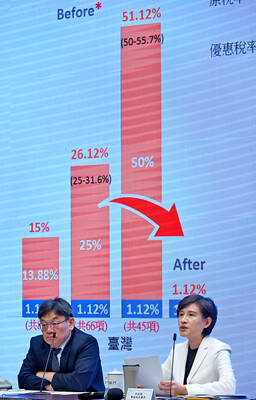
GREATER REACH? Auto parts and wood products would face tariffs of up to 15%, matching those targeting the EU, Japan and South Korea, Vice Premier said The US has announced that preferential tariff treatment for Taiwan’s non-semiconductor Section 232 goods would take effect retroactively from May 1, the Executive Yuan said yesterday. The US government yesterday posted a notice on the Federal Register’s public inspection Web site previewing tariff concessions for Taiwan under a memorandum of understanding (MOU) on Taiwan-US investment after two months of negotiations. The MOU signed on Jan. 15 stipulated three major preferential tariff arrangements: a 15 percent “reciprocal” tariff rate for Taiwan without stacking most-favored nation (MFN) rates; preferential Section 232 treatment for semiconductors and related products; and preferential Section 232 treatment for non-semiconductor


 RSS
RSS