


The legislature yesterday voted down a set of anti-nuclear motions proposed by the Democratic Progressive Party (DPP).
Holding just one-third of the legislative seats, the DPP failed in 11 attempts to block the use of nuclear power, despite support from anti-nuclear activists who have staged a protest outside the legislature since Sunday night.
A motion to reject the request for a supplementary NT$14 billion (US$485.74 million) in funding from state-owned Taiwan Power Co (Taipower) for continued construction work at the Fourth Nuclear Power Plant in Gongliao (貢寮) District, New Taipei City (新北市), was defeated.
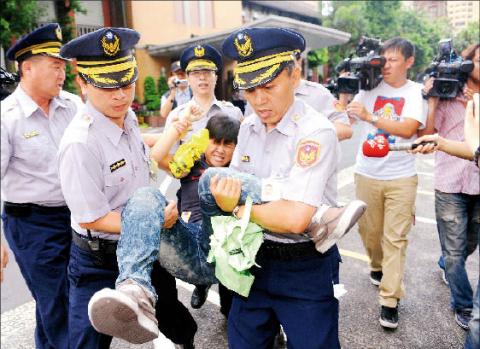
Photo: Chang Chia-ming, Taipei Times
Others motions that failed to pass during the session included one that called for construction of the plant to be suspended and a referendum held on whether the project should continue; another that the plant not be allowed to start trial operations using nuclear fuel before its ability to withstand earthquakes and tsunamis is enhanced, and a third calling on the government to promise not to extend the life of the three operating nuclear power plants.
The DPP also failed in an attempt to remove Daren (達仁), Taitung County, from a list of sites selected for nuclear waste disposal, as it is near active fault lines.
A request that the government re-evaluate the cost of electricity from nuclear power by factoring in the expense of dismantling nuclear power plants and -decontamination of polluted areas was also shot down.
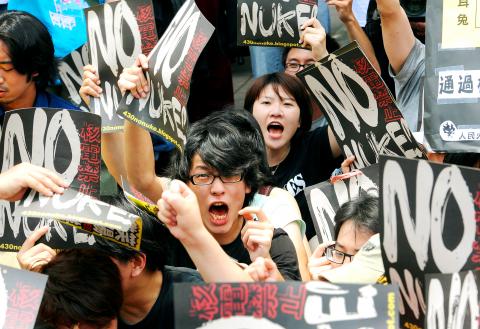
Photo: Chang Chia-ming, Taipei Times
All 33 DPP lawmakers present chanted “Nuclear-free homeland; a sustainable Taiwan,” while one motion after another was voted down.
The Chinese Nationalist Party (KMT) presented counterproposals that demanded the nuclear power plants be subject to thorough safety inspections and new security measures be introduced at the plants. All the KMT proposals passed in the form of resolutions attached to the state-owned enterprises budget for this year.
After the vote, DPP lawmakers accused President Ma Ying-jeou (馬英九) of lacking the determination needed to achieve a nuclear-free homeland, an ideal clearly stipulated in the Environmental Basic Law (環境基本法) promulgated in 2002.
KMT Legislator Hsieh Kuo-liang (謝國樑) said the proposals made by his party would ensure the nuclear power plants met safety requirements, while ensuring the reduction of carbon dioxide emissions and guaranteeing a secure electricity supply.
With the passage of the additional NT$14 billion funding, the total now spent on the construction of the Fourth Nuclear Power Plant, which began in 1997, is NT$264.4 billion.
While the political drama unfolded inside the legislature, anti-nuclear protesters blocked the gates and the street in front of the building.
About 200 protesters had gathered in the morning to protest the government’s plan to continue construction work at the plant.
The protests were organized by Sunflower No Nuke Action, an anti-nuclear alliance made up of more than 40 civic groups, and joined by residents who live near the site of the plant.
Green Citizen Action Alliance secretary-general Tsuei Su-hsin (崔愫欣) said it was undemocratic for legislators to arbitrarily pass the huge budget when many of the details are kept secret from the public, not to mention barring citizens from observing the voting process from inside the legislature.
Green Party Taiwan spokesperson Pan Han-shen (潘翰聲) said that continuing construction at the plant was like throwing good money after bad, adding that the Control Yuan had already -condemned Taipower for more than 1,000 alterations it has made to the original plant design.
Pani (拔耐), an Aboriginal woman and cofounder of Raging Citizens Act Now, provided a clear picture of the implications of nuclear energy for ordinary citizens.
“I come from Taitung County, where nuclear waste is disposed and now live in Keelung, where I am surrounded by three nuclear power plants,” Pani said, adding that it was unfair for Aborigines, who usually consume less energy than other people in Taiwan, to be exposed to the dangers of coal mines in the past, and now nuclear waste.After casting divination moon blocks to determine the will of the Goddess Matsu, goddess of the sea, on Sunday, Gongliao residents brought a statue of Matsu from the main temple in Aodi Village (澳底) to the gates of the legislature.
“We asked if she was willing to come with us to Taipei to protest, and she told us she approved through the divination moon blocks,” Gongliao Anti-nuclear Self-Help Association chairman Wu Wen-chang (吳文樟) said.
“We have about 28 percent surplus electricity now and electricity generated by nuclear power only accounts for about 16 percent [of the nation’s output]. If nuclear power plants were shut down now, we would still have more than enough surplus electricity,” he said.
“So [Taipower], don’t lie to us. We have enough electricity,” he said.
During the nearly four-hour protest in soaring summer temperatures, tension rose when protestors tried to pull open and then climb over the gates to the legislature as they shouted their demands.
Skirmishes and calls of injustice erupted as protesters and police clashed, as those protesters who had been allowed to enter the legislature earlier in the morning to file a petition were escorted out by police officers.
“They kept us waiting in a small room and refused to tell us what was happening inside or allow us to meet legislators,” said Liu Nien-Yun (劉念雲), an organizer at the Taiwan Association for Victims of Occupational Injuries.
“We held up a banner at the doors of the legislative chamber, but were immediately dragged out by police,” Liu said.
When the result of the votes were announced to the crowd at midday, protesters obstructed traffic by lying in the road, claiming their actions simulated what would happen during a nuclear incident.
The groups said that although the budget had passed, their fight against nuclear power would continue.
SECURITY: Taipei presses the US for arms supplies, saying the arms sales are not only a reflection of the US security commitment to Taiwan but also serve as a mutual deterrent against regional threats Taiwan is committed to preserving the cross-strait “status quo” and contributing to regional peace and stability, the Presidential Office said yesterday. “It is an undeniable fact that the Republic of China is a sovereign and independent democratic nation,” Presidential Office spokeswoman Karen Kuo (郭雅慧) reiterated, adding that Beijing has no right to claim sovereignty over Taiwan. The statements came after US President Donald Trump warned against Taiwanese independence. Trump wrapped up a state visit to Beijing on Friday, during which Chinese President Xi Jinping (習近平) had pressed him not to support Taiwan. Taiwan depends heavily on US security backing to deter China from carrying
The subsidiary of Taiwan Semiconductor Manufacturing Co (TSMC, 台積電) in Kumamoto, Japan, turned a profit in the first quarter of this year, marking the first time the first fab of the unit has become profitable since mass production started at the end of 2024. According to the contract chipmaker’s financial statement released on Friday, Japan Advanced Semiconductor Manufacturing Inc (JASM), a joint venture running the fab in Kumamoto, posted NT$951 million (US$30.19 million) in profit in the January-to-March period, compared with a loss of NT$1.39 billion in the previous quarter, and a loss of NT$3.25 billion in the first quarter of
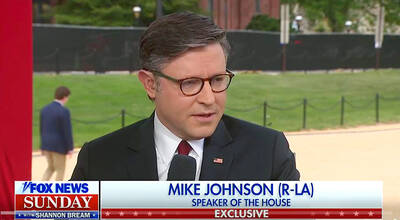
RESOLUTE BACKING: Two Republican senators are planning to introduce legislation that would impose immediate sanctions on China if it attempts to invade Taiwan US House of Representatives Speaker Mike Johnson on Sunday reaffirmed US congressional support for Taiwan, saying the US and “all freedom-loving people” have a stake in preventing China from seizing Taiwan by force. Johnson made the remarks in an interview with Fox News Sunday on US President Donald Trump’s summit with Chinese President Xi Jinping (習近平) last week. In an interview that aired on Friday on Fox News, just as Trump wrapped up a high-stakes visit to China, he said he has yet to green-light a new US$14 billion arms package to Taiwan and that it “depends on China.” “It’s a very good
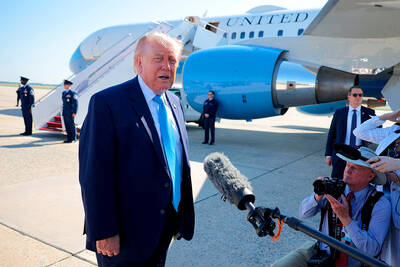
US President Donald Trump yesterday said he would speak to President William Lai (賴清德) as his administration considers whether to move ahead with a US$14 billion weapons sale to Taiwan — a potential arms deal that has drawn criticism from China. “Well, I’ll speak to him. I speak to everybody,” Trump told reporters yesterday when asked if he had any plans to call his counterpart, although he did not offer a time frame for when such a conversation could take place. Trump previously said he would speak to the person “that’s running Taiwan,” without specifying who he meant. “We have that situation very


 RSS
RSS