


Consumers should avoid bread and other baked goods that maintain their fresh smell despite sitting on shelves for a long time, as this could indicate the presence of plasticizer chemicals in the artificial flavoring, experts said over the weekend as the tainted food scare spread to a wider range of products.
Last week, Yu Shen Chemical Co (昱伸香料有限公司), which is under investigation for allegedly using the industrial-use chemical di(2-ethylhexyl) phthalate, or DEHP, in food additives, said pastry shops were among its customers.
Prosecutors have said that Yu Shen purchased about 5 tonnes of DEHP every month to make flavor and food coloring agents and sold the products not just to chemical companies, but also domestic makers of jam and baked goods, as well as pastry shops.
This revelation led to the widespread investigation of seven of the country’s popular jam, bread and pastry businesses, which were alleged to have bought plasticizer-tainted food additives.
Lin Ja-liang (林杰樑), a clinical toxicology specialist at Chang Gung Memorial Hospital in New Taipei City (新北市), said plasticizer chemicals could be used as fixative agents, which can help make baked goods smell fresh longer.
While it is normal for freshly baked bread and cookies to smell good, if the pastry continues to smell the same even after being left out for some time, it is possible that plasticizer chemicals were added to artificially maintain the smell, Lin said.
Even though the Department of Health has required manufacturers of five categories of foods and beverages — sports drinks, juices, tea drinks, fruit jams or syrups, and tablets and powders — to provide certification showing that their products are free of DEHP and other potentially harmful plasticizer chemicals, Lin said that contaminated consumer goods could also include products beyond these categories.
This could include consumer goods such as cookies and cosmetics, he said, which might use such chemicals to keep goods smelling fresh.
He also urged health authorities and prosecutors to find the source of di-n-butyl phthalate (DBP) as soon as possible, as DBP can be more hazardous than DEHP.
Last week, authorities discovered DBP in a health supplement under the brand name Zoeyen, which is distributed by CPC Biotechnology (中油生技). As this was the first discovery of DBP since the tainted food scare began, it is believed that a third company may have been involved in manufacturing tainted food additives.
In response, Food and Drug Administration Director-General Kang Jaw-jou (康照洲) said the department was doing everything in its power to track down the source of the tainted food additives as soon as possible.
As the department found that the tainted bread used jam containing plasticizer chemicals, the problem most likely originated with jam manufacturers rather than bakeries, he said.
The department said eating bread without jam, such as toast, was safe, as it is highly unlikely such goods would be made with clouding agents.
Turning to penalties for offenders, Lin said the fines stipulated under current regulations were not severe enough and should be revised.
Under current regulations, violators are subject to a maximum fine of NT$900,000 (US$31,331) and a prison sentence of up to three years.
Wu Chia-cheng (吳家誠), a -chemistry professor at National Taiwan Normal University and -secretary-general of the Consumers’ Foundation, said the government should require large food companies to establish their own laboratories to inspect their food.
The laboratories should be managed by the department and the laboratories should follow international standards to ensure that Taiwan’s food inspections are more transparent and advanced, Wu said.
Wu described the industrial chain as a bundle of zongzi (粽子), or bamboo leaf-wrapped rice dumplings tied together with string.
“Once you pull on one, all of them will be affected,” he said.
ADDITIONAL REPORTING BY CNA

‘NO SECURITY RISK’: The Railway Bureau reassured the public that the technicians’ activities were limited to technical guidance and did not involve sensitive systems The Railway Bureau yesterday said it had invited eight Chinese technicians to assist with an airport MRT construction project. The bureau issued the confirmation after an Internet user said Chinese nationals had entered the construction zone of Taiwan Taoyuan International Airport’s Terminal 3 project. They asked why “individuals from an enemy state” were allowed access to such a major national infrastructure project, which raised serious concerns over Taiwan’s industrial safety, sensitive systems and information security. The bureau’s Northern Region Engineering Branch Office said subcontractor Taiwan Handle Industrial Co (台灣手把工業) of the Taoyuan airport MRT’s “Contract No. CU05 Project A14 Station Civil, MEP &

A signaling system malfunction disrupted high-speed rail (HSR) services beginning at 8am today, with trains temporarily reduced to three northbound and three southbound trains per hour as authorities conduct inspections. The malfunction occurred on a section of track in Miaoli County during pre-operation checks early this morning, forcing northbound and southbound trains to use a single track, the HSR operator said. The regular schedule has been replaced with three hourly trains offering only nonreserved seating in each direction, stopping at every station, it said, adding that business class cars would still have reserved seating. Departures from terminal stations are scheduled at the top
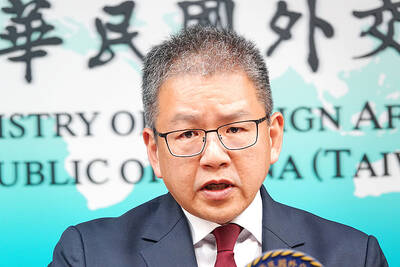
Taiwan is still in the process of assessing the possibility of recruiting workers from Eswatini, the Ministry of Foreign Affairs said yesterday, adding that its goal is to help Eswatini upgrade its vocational training centers. If there are plans to recruit workers from Eswatini, safeguarding national security, protecting public health and ensuring the employment rights of Taiwanese would be prerequisites, Department of West Asian and African Affairs Director-General Yen Chia-liang (顏嘉良) told a news conference. Key considerations would also include filling labor shortages in specific industries, and fostering bilateral professional and technical exchanges, he said. Yen was asked about the progress of labor

A US uncrewed surface vessel (USV) encountered multiple Chinese warships during an autonomous transit of the Taiwan Strait, US defense company Seasats said in a statement on Wednesday. Seasats announced that a Lightfish USV had completed the first autonomous transit of the Taiwan Strait. Over five days, the USV traversed the entire length of the Strait while constantly monitoring surface vessel traffic, the company said. The Lightfish encountered multiple Chinese warships, one of which was a Chinese People’s Liberation Army Navy (PLAN) Type 056 corvette, it said. The Chinese vessels were operating “well within Taiwan’s exclusive economic zone without transmitting their identity via the


 RSS
RSS