


South Korea has confirmed that a 40-year-old military officer exchange program with the Republic of China (ROC) would end soon because it will launch a similar program with China, a Taiwanese government official said yesterday.
“We are in the middle of negotiating with the Ministry of National Defense of South Korea before this plan is finalized [later] this month,” the official told the Taipei Times.
Taiwan was able to authenticate the information, first disclosed by Japan’s Asahi Shimbun on April 21, after the Taipei Mission in Korea talked to South Korea’s Ministry of Foreign Affairs and Trade, said the official, who was not authorized to speak on the record.
Although the Korean Mission in Taipei declined to confirm the report when approached for comment, the Korea JoongAng Daily, an English-language publication under the JoongAng Ilbo, reported yesterday in Seoul that the South Korean government had decided to end the personnel exchange program with Taiwan.
The Korea JoongAng Daily said a South Korean military official told the JoongAng Ilbo that military authorities in Seoul and Beijing had agreed to start an exchange program for major-level officers to study at their respective army, navy or air force academies for one year.
The official was quoted as saying that the agreement with China came after South Korea promised to stop its program with Taiwan.
Beijing had strongly insisted that Seoul stop the exchange program with Taiwan, the reports said.
South Korean Minister of National Defense Kim Kwan-jin and his Chinese counterpart, General Liang Guanglie (梁光烈), will confirm the exchange program in Beijing at the end of this month, as well as the establishment of a military hotline, along with other measures to strengthen military cooperation between the two countries, the newspapers said.
One ROC officer is currently studying in South Korea, while two South Korean officers are in Taiwan, a diplomatic source said.
Sha Tsan-son (沙春生), a retired military attache who had served in Seoul, said ending the ROC-South Korea program was aimed at breaking the “brotherhood that has existed between the Republic of China military and the Gwangbokgun,” the armed forces of the Provisional Government of the Republic of Korea (the 1919 to 1948 government-in-exile in China), since it was established in 1941.
In an interview with the Taipei Times on Tuesday, the retired officer, who took part in the exchange program in the late 1970s, lamented the changes in relations between Taipei and Seoul and those between Beijing and Seoul over the decades.
One main reason Taiwan was able to maintain the program — even after Seoul abruptly broke diplomatic ties with Taipei in 1992, in what was widely regarded in Taiwan as an insulting way — was “the profound relationship between the ROC military and the Gwangbokgun” that dated back to a time when both countries were facing hard times, said the former officer, who retired about 10 years ago.
As China’s clout grew in terms of its economic relationship with South Korea and its influence with North Korea, Taiwan had to reduce the number of officers it sent to Seoul from three when the program began in 1974 to one, said the retiree, who is now president of Taiwan Education Center in South Korea.
“I cannot remember the exact year, but at one point South Korea barred Taiwanese exchange officers from wearing their military uniforms,” he said.
What Taiwan gained from the program was not what its officers learned of military techniques, but “the strong bonds it built between the two countries,” he said.
In the early 2000s, several requests by Beijing that Seoul end the exchange program with Taipei were bluntly turned down by South Korean military leaders, who themselves had studied in Taiwan as part of the program, he said.
A paper published in October by Hwang Jaeho, a professor of international studies at Hankuk University of Foreign Studies in Seoul, said the exchange program had been an impediment for South Korea in achieving a strategic cooperative partnership with China, a goal his country has been pursuing since South Korean President Lee Myung-bak visited Chinese President Hu Jintao (胡錦濤) in 2008.

‘NO SECURITY RISK’: The Railway Bureau reassured the public that the technicians’ activities were limited to technical guidance and did not involve sensitive systems The Railway Bureau yesterday said it had invited eight Chinese technicians to assist with an airport MRT construction project. The bureau issued the confirmation after an Internet user said Chinese nationals had entered the construction zone of Taiwan Taoyuan International Airport’s Terminal 3 project. They asked why “individuals from an enemy state” were allowed access to such a major national infrastructure project, which raised serious concerns over Taiwan’s industrial safety, sensitive systems and information security. The bureau’s Northern Region Engineering Branch Office said subcontractor Taiwan Handle Industrial Co (台灣手把工業) of the Taoyuan airport MRT’s “Contract No. CU05 Project A14 Station Civil, MEP &

A US uncrewed surface vessel (USV) encountered multiple Chinese warships during an autonomous transit of the Taiwan Strait, US defense company Seasats said in a statement on Wednesday. Seasats announced that a Lightfish USV had completed the first autonomous transit of the Taiwan Strait. Over five days, the USV traversed the entire length of the Strait while constantly monitoring surface vessel traffic, the company said. The Lightfish encountered multiple Chinese warships, one of which was a Chinese People’s Liberation Army Navy (PLAN) Type 056 corvette, it said. The Chinese vessels were operating “well within Taiwan’s exclusive economic zone without transmitting their identity via the

Taiwan is still in the process of assessing the possibility of recruiting workers from Eswatini, the Ministry of Foreign Affairs said yesterday, adding that its goal is to help Eswatini upgrade its vocational training centers. If there are plans to recruit workers from Eswatini, safeguarding national security, protecting public health and ensuring the employment rights of Taiwanese would be prerequisites, Department of West Asian and African Affairs Director-General Yen Chia-liang (顏嘉良) told a news conference. Key considerations would also include filling labor shortages in specific industries, and fostering bilateral professional and technical exchanges, he said. Yen was asked about the progress of labor
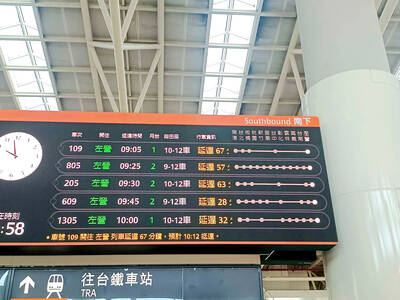
The nation’s usually punctual high-speed rail system yesterday was hit by major disruptions after all scheduled services were canceled and replaced with three hourly trains offering only non-reserved seating, affecting more than 200,000 passengers. Preliminary findings indicate the disruption was caused by a faulty power module in a track switch control cabinet, Taiwan High-Speed Rail Corp (THSRC) said, adding that as a full system inspection could only be conducted after operations end for the day, a decision on whether normal service would resume today would be announced before the first train departs. During a routine inspection early yesterday, a switch signal abnormality


 RSS
RSS