


Japan yesterday put its nuclear calamity on a par with the world’s worst nuclear disaster, Chernobyl, after new data showed that more radiation leaked from its earthquake-crippled power plant in the early days of the crisis than first thought.
Japanese officials said it had taken time to measure radiation from the plant after it was smashed by March 11’s massive earthquake and tsunami, and the upgrade in its severity rating to the highest level on a globally recognized scale did not mean the situation had suddenly become more critical.
“The situation at the Fukushima Dai-ichi plant is slowly stabilizing, step by step, and the emission of radioactive substances is on a declining trend,” Japanese Prime Minister Naoto Kan told a press briefing.
Kan said he wanted to move from emergency response to long-term rebuilding.
“A month has passed. We need to take steps towards restoration and reconstruction,” he said.
He also called on opposition parties, whose help he needs to pass bills in a divided parliament, to take part in drafting reconstruction plans from an early stage.
The operator of the stricken facility appears to be no closer to restoring cooling systems at the reactors, critical to lowering the temperature of overheated nuclear fuel rods. Late yesterday, Japan’s science ministry said small amounts of strontium, one of the most harmful and long-lasting radioactive elements, had been found in soil near Fukushima Dai-ichi.
Hidehiko Nishiyama, a deputy director-general of the Nuclear and Industrial Safety Agency (NISA), said the decision to raise the severity of the incident from level 5 to 7 — the same as the Chernobyl disaster in Ukraine in 1986 — was based on cumulative quantities of radiation released.
No radiation-linked deaths have been reported since the earthquake struck, and only 21 plant workers have been affected by minor radiation sickness, Chief Cabinet Secretary Yukio Edano said.
“Although the level has been raised to 7 today, it doesn’t mean the situation today is worse than it was yesterday. It means the event as a whole is worse than previously thought,” said nuclear expert John Price, a former member of the Safety Policy Unit at the UK’s National Nuclear Corp.
A level 7 incident means a major release of radiation with a widespread health and environmental impact, while a level 5 is a limited release of radioactive material, with several deaths, according to the International Atomic Energy Agency.
Several experts said the new rating exaggerated the severity of the crisis.
“It’s nowhere near that level. Chernobyl was terrible — it blew and they had no containment, and they were stuck,” said nuclear industry specialist Murray Jennex, an associate professor at San Diego State University in California. “Their containment has been holding, the only thing that hasn’t is the fuel pool that caught fire.”
The blast at Chernobyl blew the roof off a reactor and sent large amounts of radiation wafting across Europe. The accident contaminated vast areas and led to the evacuation of more than 100,000 people.
Nevertheless, the increase in the severity level heightens the risk of diplomatic tension with Japan’s neighbors over radioactive fallout. China has so far been sympathetic rather than angry, though it and South Korea have criticized the plant operator’s decision to pump radioactive water into the sea, a process it has now stopped.
NISA said the amount of radiation released into the atmosphere from the plant was about 10 percent that of Chernobyl.
“Radiation released into the atmosphere peaked from March 15 to 16. Radiation is still being released, but the amount now has fallen considerably,” Nishiyama said.
Lam Ching-wan, a chemical pathologist at the University of Hong Kong and member of the American Board of Toxicology, said this level of radiation was harmful.
“It means there is damage to soil, ecosystem, water, food and people. People receive this radiation. You can’t escape it by just shutting the window,” Lam said.

The nation’s fastest supercomputer, Nano 4 (晶創26), is scheduled to be launched in the third quarter, and would be used to train large language models in finance and national defense sectors, the National Center for High-Performance Computing (NCHC) said. The supercomputer, which would operate at about 86.05 petaflops, is being tested at a new cloud computing center in the Southern Taiwan Science Park in Tainan. The exterior of the server cabinet features chip circuitry patterns overlaid with a map of Taiwan, highlighting the nation’s central position in the semiconductor industry. The center also houses Taiwania 2, Taiwania 3, Forerunner 1 and
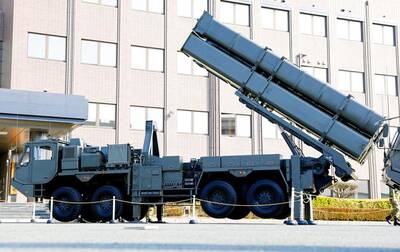
Japan has deployed long-range missiles in a southwestern region near China, the Japanese defense minister said yesterday, at a time when ties with Beijing are at their lowest in recent years. The missiles were installed in Kumamoto in the southern region of Kyushu, as Japan is attempting to shore up its military capacity as China steps up naval activity in the East China Sea. “Standoff defense capabilities enable us to counter the threat of enemy forces attempting to invade our country ... while ensuring the safety of our personnel,” Japanese Minister of Defense Shinjiro Koizumi said. “This is an extremely important initiative for
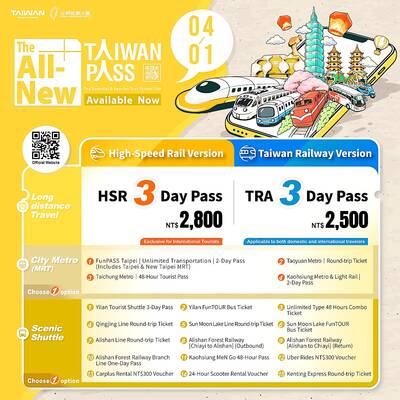
MORE POPULAR: Taiwan Pass sales increased by 59 percent during the first quarter compared with the same period last year, the Tourism Administration said The Tourism Administration yesterday said that it has streamlined the Taiwan Pass, with two versions available for purchase beginning today. The tourism agency has made the pass available to international tourists since 2024, allowing them to access the high-speed rail, Taiwan Railway Corp services, four MRT systems and four Taiwan Tourist Shuttles. Previously, five types of Taiwan Pass were available, but some tourists have said that the offerings were too complicated. The agency said only two types of Taiwan Pass would be available, starting from a three-day pass with the high-speed rail and a three-day pass with Taiwan Railway Corp. The former costs NT$2,800
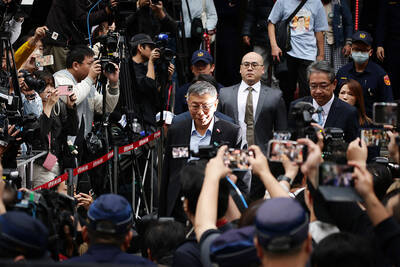
FIRST TRIAL: Ko’s lawyers sought reduced bail and other concessions, as did other defendants, but the bail judge denied their requests, citing the severity of the sentences Former Taipei mayor Ko Wen-je (柯文哲) was yesterday sentenced to 17 years in prison and had his civil rights suspended for six years over corruption, embezzlement and other charges. Taipei prosecutors in December last year asked the Taipei District Court for a combined 28-year, six-month sentence for the four cases against Ko, who founded the Taiwan People’s Party (TPP). The cases were linked to the Core Pacific City (京華城購物中心) redevelopment project and the mismanagement of political donations. Other defendants convicted on separate charges included Chinese Nationalist Party (KMT) Taipei City Councilor Angela Ying (應曉薇), who was handed a 15-year, six-month sentence; Core Pacific


 RSS
RSS