


Workers were close to restoring power to a nuclear plant’s overheating reactors yesterday as the toll of dead or missing from Japan’s worst natural disaster in nearly a century neared 21,000.
Amid the devastation on the northeast coast left by the March 11 earthquake and tsunami, police reported an astonishing tale of survival with the discovery of an 80-year-old woman and her 16-year-old grandson alive under the rubble.
“Their temperatures were quite low, but they were conscious. Details of their condition are not immediately known. They have been already rescued and sent to hospital,” a spokesman for the Ishinomaki Police Department said.
They were in the kitchen when their house collapsed, but the teenager was able to reach food from the refrigerator, helping them survive for nine days, broadcaster NHK quoted rescuers as saying.
However, with half a million tsunami survivors huddled in threadbare, chilly shelters and the threat of disaster at the Fukushima Dai-ichi nuclear plant stretching frayed nerves, the mood in the world’s third-biggest economy remained grim.
The discovery of traces of radioactive iodine in Tokyo tap water, well to the southwest of the crippled atomic power plant on the Pacific coast, compounded public anxiety, but authorities said there was no danger to health.
The Fukushima Dai-ichi plant was struck on March 11 by a massive earthquake and tsunami which, with 8,199 people confirmed killed, is Japan’s deadliest natural disaster since the Great Kanto quake leveled much of Tokyo in 1923.
Another 12,722 are missing, feared swept out to sea by the 10m tsunami or buried in the wreckage of buildings. In Miyagi Prefecture on the northeast coast, where the tsunami reduced entire towns to splintered matchwood, the official death toll stood at 4,882.
However, Miyagi police chief Naoto Takeuchi told a task force meeting that his prefecture alone “will need to secure facilities to keep the bodies of more than 15,000 people,” Jiji Press reported.
Cooling systems that are meant to protect the Fukushima Dai-ichi plant’s six reactors from a potentially disastrous meltdown were knocked out by the tsunami, and engineers have since been battling to control rising temperatures.
The radiation-suited crews were striving to restore electricity to the aging facility 250km northeast of Tokyo, after extending a high-voltage cable into the site from the national grid.
A spokesman for Japan’s nuclear safety agency said electricity had apparently reached the power distributor at reactor 2, which in turn would feed power to reactor 1.
Plant operator Tokyo Electric Power Co (TEPCO) confirmed an electricity supply had been restored to the distributor, but said power at the reactor unit was not back on yet.
Engineers were checking the cooling and other systems at the reactor, aiming to restore power soon, TEPCO said late yesterday.
“It will take more time. It’s not clear when we can try to restore the systems,” spokesman Naohiro Omura said.
Fire engines earlier aimed their water jets at the reactors and fuel rod pools, where overheating is an equal concern, dumping thousands of tonnes of seawater from the Pacific Ocean.
Six workers at the Fukushima Dai-ichi plant have been exposed to high levels of radiation, but are continuing to work and have suffered no health problems, TEPCO said.
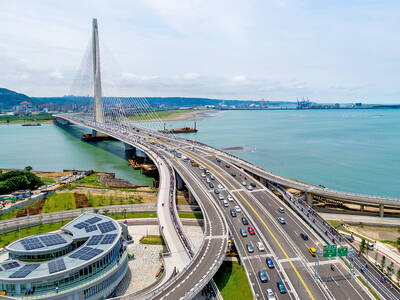
The Ministry of Transportation and Communications yesterday inaugurated the Danjiang Bridge across the Tamsui River in New Taipei City, saying that the structure would be an architectural icon and traffic artery for Taiwan. Feted as a major engineering achievement, the Danjiang Bridge is 920m long, 211m tall at the top of its pylon, and is the longest single-pylon asymmetric cable-stayed bridge in the world, the government’s Web site for the structure said. It was designed by late Iraqi-British architect Zaha Hadid. The structure, with a maximum deck of 70m, accommodates road and light rail traffic, and affords a 200m navigation channel for boats,
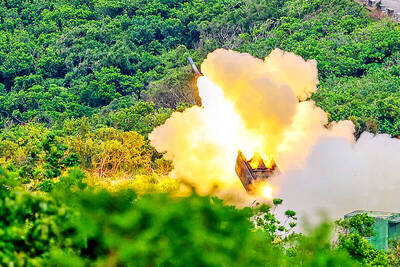
PRECISION STRIKES: The most significant reason to deploy HIMARS to outlying islands is to establish a ‘dead zone’ that the PLA would not dare enter, a source said A High Mobility Artillery Rocket System (HIMARS) would be deployed to Penghu County and Dongyin Island (東引) in Lienchiang County (Matsu) to force the Chinese military to retreat at least 100km from the coastline, a military source said yesterday. Taiwan has been procuring HIMARS and Army Tactical Missile Systems (ATACMS) from the US in batches. Once all batches have been delivered, Taiwan would possess 111 HIMARS units and 504 ATACMS, which have a range of 300km. Considering that “offense is the best defense,” the military plans to forward-deploy the systems to outlying islands such as Penghu and Dongyin so that
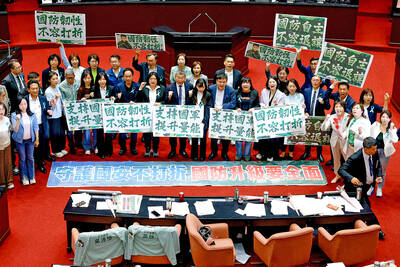
WHAT WAS ALL THAT FOR? Jaw Shaw-kong said that Cheng Li-wen had pushed for more drastic cuts and attacked him, just for the outcome to be nearly identical to his bill The legislature yesterday passed a supplementary budget bill to fund the purchase of separate packages of US military equipment, with the combined amount of spending capped at NT$780 billion (US$24.8 billion). The Chinese Nationalist Party (KMT) and Taiwan People’s Party (TPP) used their legislative majority to pass the bill, which runs until 2033 and has two main funding provisions. One was for NT$300 billion of arms sales already approved by the US for Taiwan on Dec. 17 last year, the other was for NT$480 billion for another arms package expected to be announced by Washington. The bill, which fell short of the NT$1.25

‘CLEAR MESSAGE’: The bill would set up an interagency ‘tiger team’ to review sanctions tools and other economic options to help deter any Chinese aggression toward Taiwan US Representative Young Kim has introduced a bill to deter Chinese aggression against Taiwan, calling for an interagency “tiger team” to preplan coordinated sanctions and economic measures in response to possible Chinese military or political action against Taiwan. “[Chinese President] Xi Jinping [習近平] has directed the People’s Liberation Army to be ready to invade Taiwan by 2027. China has a plan. America should have one too,” Kim said in a news release on Thursday last week. She introduced the “Deter PRC [People’s Republic of China] aggression against Taiwan act” to “ensure the US has a coordinated sanctions strategy ready should


 RSS
RSS