


Premier Wu Den-yih (吳敦義) responded to legislators’ concerns over nuclear safety yesterday by saying that nuclear power plants in Taiwan were “much safer” than Japan’s Fukushima Dai-ichi because they used “fourth-generation” reactors.
Telling legislators the government would “humbly” review its disaster plans and make any necessary improvements, Wu said he was confident the geological environment in Taiwan and the structure of its nuclear power plants meant that the country was well prepared to withstand any natural catastrophe.
Regarding the safety of the three nuclear power plants in operation — Jinshan Nuclear Power Plant in Shihmen District (石門), New Taipei City (新北市), Guosheng Nuclear Power Plant in Wanli (萬里), New Taipei City and Ma-anshan Nuclear Power Plant in Ma-anshan (馬鞍山), Pingtung County — Wu said all three were “much safer” than Fukushima Dai-ichi, which is the object of international concern following a series of explosions and a possible meltdown.
Asked by Chinese Nationalist Party (KMT) Legislator John Chiang (蔣孝嚴) whether the three nuclear plants were earthquake--resistant, Wu said: “That is difficult to say because even a country like Japan, which is more advanced than us, failed to avert disaster.”
“However, the Fukushima plant was equipped with a third--generation [reactor], while Taiwan’s nuclear power plants operate fourth-generation [sic] ones,” Wu said.
According to related literature, fourth-generation nuclear reactors are still being researched and will not be commercially operational for another two decades or so.
Contacted by the Taipei Times, Chung Ming-lien (鍾明廉), chief of public relations at Taipower Corp, which operates Taiwan’s nuclear plants, said there was no fourth--generation reactor in the country.
The Atomic Energy Council Web site shows the Jinshan power plant uses a BWR-4 (boiling water, second-generation) reactor; the Guosheng plant a BWR-6 (third-generation) reactor; the Ma-anshan plant a PWR (pressurized water, third-generation) reactor; and the No. 4 (Lungmen) will use an ABWR (advanced boiling water, also third-generation) reactor.
Units 2, 3, 4, and 5 at Fukushima Dai-ichi all have BWR-4 reactors similar to that at the Jinshan plant in Taiwan.
Wu also said the containment shells around reactors in Taiwan’s nuclear power plants were thicker than those used in Japan.
In addition, the three operational nuclear power plants in Taiwan were unlikely to be damaged by a tsunami because they were built at elevations of between 12m and 15m, Wu said.
Despite the fact that the No. 4 plant, which is currently under construction, is not located on elevated ground, the likelihood of a tsunami hitting it is also low because “Taiwan has only an outside chance of being hit by tsunamis,” the result of a deep-sea trench off the east coast, Wu said.
“The largest tsunami to ever hit Taiwan was a wave between 4m and 6m recorded in the Keelung area in 1867, while one in the 1900s caused a wave of less than 1m,” he said.
Wu also rallied behind Atomic Energy Council Deputy Minister Huang Tsing-tung (黃慶東), who came under criticism from anti-nuclear activists for drawing an analogy between nuclear power plants established on a consolidated-rock basin and a Buddhist sitting on a lotus platform on Monday to highlight their safety.
“Do you agree with Huang Tsing-tung? Are the nuclear power plants as safe as a Buddhist?” Democratic Progressive Party (DPP) Legislator Kuo Jung-tsung (郭榮宗) asked.
“This was not a groundless analogy,” Wu said.
Wu also said it would be “inappropriate” to fly the national flag at half-mast in sympathy with Japan, as no other country had done so.
“If everyone wears shorts to the swimming pool, but we chose to wear a suit, it would be extremely strange, wouldn’t it,” he said.
Taiwan would observe international protocol, which the Ministry of Foreign Affairs would look into, he said.
DPP Legislator Hsueh Ling (薛凌) said the country flew the national flag at half-mast following the Sept. 11, 2001, attacks in the US.
Meanwhile, DPP lawmakers demanded that Wu order the suspension of construction at the No. 4 plant, a move Wu rejected.
Wu said that the government would make a thorough safety inspection of the plant before it goes into operation, which will now not be the end of this year as planned.
KMT Legislator Lin Yu-fang (林郁方) said halting construction of the plant was “a stupid idea” as it would cost the country large amounts of money for breach of contract.
Rather than halting construction, the government should support and develop systems off the coast to monitor undersea seismic movements to provide warnings of earthquakes and tsunamis, Lin said.
ADDITIONAL REPORTING BY J. MICHAEL COLE AND VINCENT Y. CHAO

‘NO SECURITY RISK’: The Railway Bureau reassured the public that the technicians’ activities were limited to technical guidance and did not involve sensitive systems The Railway Bureau yesterday said it had invited eight Chinese technicians to assist with an airport MRT construction project. The bureau issued the confirmation after an Internet user said Chinese nationals had entered the construction zone of Taiwan Taoyuan International Airport’s Terminal 3 project. They asked why “individuals from an enemy state” were allowed access to such a major national infrastructure project, which raised serious concerns over Taiwan’s industrial safety, sensitive systems and information security. The bureau’s Northern Region Engineering Branch Office said subcontractor Taiwan Handle Industrial Co (台灣手把工業) of the Taoyuan airport MRT’s “Contract No. CU05 Project A14 Station Civil, MEP &

A US uncrewed surface vessel (USV) encountered multiple Chinese warships during an autonomous transit of the Taiwan Strait, US defense company Seasats said in a statement on Wednesday. Seasats announced that a Lightfish USV had completed the first autonomous transit of the Taiwan Strait. Over five days, the USV traversed the entire length of the Strait while constantly monitoring surface vessel traffic, the company said. The Lightfish encountered multiple Chinese warships, one of which was a Chinese People’s Liberation Army Navy (PLAN) Type 056 corvette, it said. The Chinese vessels were operating “well within Taiwan’s exclusive economic zone without transmitting their identity via the
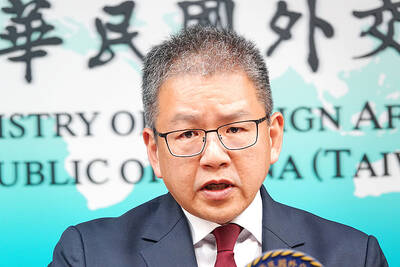
Taiwan is still in the process of assessing the possibility of recruiting workers from Eswatini, the Ministry of Foreign Affairs said yesterday, adding that its goal is to help Eswatini upgrade its vocational training centers. If there are plans to recruit workers from Eswatini, safeguarding national security, protecting public health and ensuring the employment rights of Taiwanese would be prerequisites, Department of West Asian and African Affairs Director-General Yen Chia-liang (顏嘉良) told a news conference. Key considerations would also include filling labor shortages in specific industries, and fostering bilateral professional and technical exchanges, he said. Yen was asked about the progress of labor
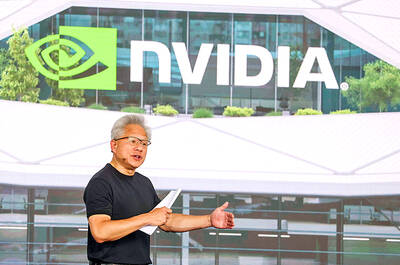
‘BOOMING’: ’ The number of partners we have here is incredible. You can see from their stock prices. They’re doing so well, they’re so happy,’ Jensen Huang said Nvidia Corp’s spending in Taiwan has ballooned to about US$150 billion a year, 10 times the US$10 billion to US$15 billion the company spent five years ago, Nvidia chief executive officer Jensen Huang (黃仁勳) said yesterday, suggesting Taiwan’s strategic importance in the global artificial intelligence (AI) supply chain. “Taiwan is the epicenter of the AI revolution. This is where the chips come, packaging comes. This is where the systems are made. This is where AI supercomputers were created,” Huang said at a meeting for the company’s employees in Beitou-Shilin Technology Park (北投士林科技園區) in Taipei, the planned site of Nvidia’s Taipei headquarters. “Taiwan


 RSS
RSS