


Environmental activists yesterday vowed to stage a large-scale protest if the government does not immediately suspend the construction of the Fourth Nuclear Power Plant, as well as re-examine the nation’s three operational nuclear power plants.
Saying that Taiwan would be hopeless if the incident at Japan’s Fukushima Dai-ichi nuclear power plant happened here, Green Party Taiwan spokesperson Pan Han-shen (潘翰聲) said the residents of Gongliao District (貢寮), New Taipei City (新北市), where the Fourth Nuclear Power Plant is located, would hold a demonstration in front of the Executive Yuan tomorrow morning, demanding an immediate suspension to the power plant’s construction.
Those planning to join election primaries for legislators representing Taipei City and New Taipei City should tell the voters where they stand on this issue, he added.
Pan’s avowal was made at a press conference held by Democratic Progressive Party (DPP) legislators Tien Chiu-chin (田秋堇), Lin Shu-fen (林淑芬) and Huang Sue-ying (黃淑英).
At the press conference, Tien played what she said was a recorded conversation between an engineer of the state-run Taiwan Power Co (Taipower, 台電) and his supervisor. According to the tape, the engineer was pressured by his supervisor to pay the contractor, who only partially followed the original design of the protective facilities at the Fourth Nuclear Power Plant — also known as the Longmen Nuclear Power Plant — laid out by General Electric Co.
Gloria Hsu (徐光蓉), a professor at National Taiwan University (NTU), accused Taipower of changing the original design at its discretion and even skimping on construction materials. For example, Hsu said, the company replaced the heat-resistant gaskets with plastic ones.
“After what happened at Fukushima, many countries around the world are re-examining the soundness of their nuclear power plants,” she said. “Only the Taiwanese government acts like this is no big deal.”
Referring to remarks made by Atomic Energy Council Deputy Minister Huang Tsing-tung (黃慶東) during a legislative session on Monday that the nation’s nuclear power plants were built on stable bedrock, making them as solid as the “lotus-shaped pedestal supporting the goddess Guanyin,” Hsu questioned why the government officials could be so confident to say that the nation would not see a nuclear power crisis similar to that of Fukushima.
“Japan, Russia and the US have all seen nuclear power accidents happen in their own countries. We purchased the power plant facilities from the US and we ended up having more faith in these facilities. This is ridiculous,” Hsu said.
Hsu also said the nation’s operational plants — Jinshan, -Guosheng and Ma-anshan nuclear power plants — were built to withstand a peak ground acceleration (PGA) of 0.3G. However, the government raised the PGA to 0.33G after the 921 earthquake in 1999. The facilities do not follow this updated regulation, she said.
Shih Shin-min (施信民), also of NTU, stressed the importance of raising the fourth plant’s ability to cope with the impact of earthquakes. Instead of a magnitude 7 quake, the power plant must be able to withstand a magnitude 9 earthquake, he said.

The National Chungshan Institute of Science and Technology yesterday showcased its locally developed variants of the Vision 60 robotic patrol dog, which it plans to deploy on the nation’s outlying territories in the South China Sea. The variants were produced under the Joint Lab project — created by the institute and domestic companies — and assembled with domestically produced motors, lenses and artificial intelligence (AI) systems alongside licensed tech from the US, Missile and Rocket Systems Research Division deputy director Jen Kuo-kang (任國光) told the media event at a military base in Taipei’s Dazhi (大直) area. Taiwan has built up its strengths

RIGHT DIRECTION: Taiwan’s efforts to prevent forced labor include a proposal to ‘fully prohibit’ employers from withholding workers’ documents, an official said Taiwan is to establish a mechanism to restrict imports of goods linked to forced labor, the Executive Yuan said yesterday, after the US proposed imposing additional tariffs on Taiwanese goods over labor concerns. “The Ministry of Labor and the Ministry of Economic Affairs are to establish an interministerial review procedure,” Executive Yuan spokesperson Michelle Lee (李慧芝) said at a news briefing in Taipei. “The government is to use the Foreign Trade Act [貿易法] as the legal basis to restrict imports of goods produced with forced labor” and bring its supply chain governance more in line with international standards on human rights, resilience
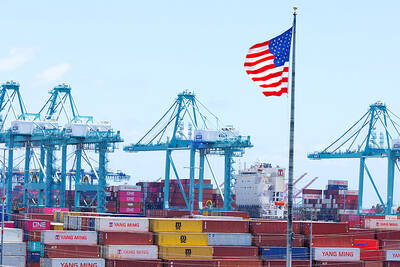
NOT IMMEDIATE: Taiwan has a chance to appeal the proposed 10 percent tariff before it starts, while other countries face a 12.5 percent tariff from the trade office Taiwan is among 60 economies determined by the US to have failed to impose or enforce a ban on the importation of goods produced with forced labor, according to a notice released on Tuesday by the Office of the US Trade Representative (USTR), which proposed imposing an additional 10 percent or more tariff on them. The USTR in a statement said that following an investigation, it had determined under Section 301 of the Trade Act of 1974 that the failure of the 60 economies to impose and effectively enforce a prohibition on the importation of goods produced with forced labor is
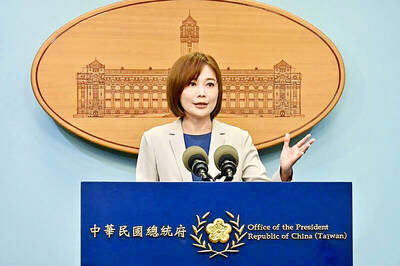
TIT-FOR-TAT: The US allegedly revoked the visa of a Chinese national working at Xinhua News Agency in the US in response to Beijing’s expulsion of Vivian Wang The Presidential Office yesterday condemned China for expelling a New York Times correspondent from Beijing following the newspaper’s interview with President William Lai (賴清德), saying the move highlighted Beijing’s suppression of press freedom and its threat to international news media. Taiwan has noted a series of recent incidents in which Beijing used similar tactics to “threaten and pressure international media outlets and journalists,” Presidential Office spokeswoman Karen Kuo (郭雅慧) said in a statement. “This concerns not only press freedom and freedom of expression, but also the safety of journalists, and Taiwan and relevant partners are paying close attention to the situation,” she


 RSS
RSS