


Democratic Progressive Party (DPP) candidates for legislative by-elections in Greater Tainan and Greater Kaohsiung both defeated their Chinese Nationalist Party (KMT) counterparts yesterday, increasing the party’s number of seats in the Legislative Yuan to 33, compared to the KMT’s 73 seats.
According to a statement from the Kaohsiung City Election Commission, vote counting for the legislative by-election was completed at 5:25pm, with a voter turnout of 33.97 percent.”
“The [KMT] candidate Hsu --Ching-huang [徐慶煌] has garnered 23,409 votes, while the [DPP] candidate Lin Tai-hua [林岱樺] has received 53,833 votes,” the statement said. “The official result will be released by March 11, after a review by the commission.”
Meanwhile, information from the Tainan City Election Commission showed that the DPP candidate for the city’s Fourth Electoral District, Hsu Tain-tsair (許添財), garnered 49,002 votes compared with his KMT rival Chen Shu-huei’s (陳淑慧) 30,504 votes.
The electoral results yesterday marked another setback for the KMT after it lost legislative by-elections in Yunlin in 2009, and in Taoyuan, Hsinchu and Chiayi last year. In the five municipality elections last year, the KMT took three of five cities, but received fewer overall votes than the DPP.
DPP Chairperson Tsai Ing-wen (蔡英文) told a post-election press conference at the party’s headquarters in Taipei: “wining the by-elections gives us more confidence in our ability to face future challenges.”
“After its defeat in the 2008 presidential election, the DPP has humbly reflected on its failings and the party has now stood up again,” she added, taking a bow to thank voters for their support.
The KMT’s losses of yesterday’s by-elections and previous elections sent a message from the people to the KMT government, “which is that the people want change,” Tsai said.
“The DPP’s goal in the next round is to regain power and win a majority in the legislature,” she said.
At a separate setting, KMT -Secretary-General Liao Liou -yi (廖了以) apologized to supporters for the party’s defeat in the two by-elections and said the KMT would work harder to expand its support base in Greater Tainan and Kao-hsiung areas that have long been pan-green strongholds.
“I want to express my -deepest apologies to supporters as the election result failed to meet their expectations.
Although the two districts were challenging areas for the KMT, there should be no excuses for our defeat,” Liao said in a post-election press conference held at the KMT headquarters.
He described the two by--elections as “tough battles with high thresholds” for the KMT, defending both the party and the candidates’ efforts throughout the election campaign.
“There are significant elections waiting for us and I urge our supporters not to be discouraged by the result this time around. We will work harder to consolidate our support base in the South and seek to work more closely with local factions,” he added.
While acknowledging its defeat in the by-elections, the KMT blamed the disappointing number of votes cast for its candidates on the low turnout.
“The turnout was less than 30 percent, and many supporters did not leave home to cast their vote. We put in a lot of effort to encourage voters to turn out, but clearly we need to work harder,” Liao said.
He declined to comment on the DPP’s interpretation of the by-elections as a dry run for the presidential election next year, and said President Ma Ying-jeou (馬英九), who also doubles as the KMT chairman, has instructed the party to work harder at developing support in southern Taiwan.

PROVOCATIVE: Chinese Deputy Ambassador to the UN Sun Lei accused Japan of sending military vessels to deliberately provoke tensions in the Taiwan Strait China denounced remarks by Japan and the EU about the South China Sea at a UN Security Council meeting on Monday, and accused Tokyo of provocative behavior in the Taiwan Strait and planning military expansion. Ayano Kunimitsu, a Japanese vice foreign minister, told the Council meeting on maritime security that Tokyo was seriously concerned about the situation in the East China and South China seas, and reiterated Japan’s opposition to any attempt to change the “status quo” by force, and obstruction of freedom of navigation and overflight. Stavros Lambrinidis, head of the EU delegation to the UN, also highlighted South China Sea
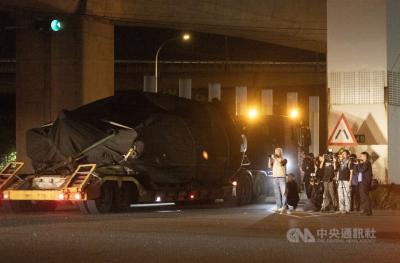
The final batch of 28 M1A2T Abrams tanks purchased from the US arrived at Taipei Port last night and were transported to the Armor Training Command in Hsinchu County’s Hukou Township (湖口), completing the military’s multi-year procurement of 108 of the tanks. Starting at 12:10am today, reporters observed more than a dozen civilian flatbed trailers departing from Taipei Port, each carrying an M1A2T tank covered with black waterproof tarps. Escorted by military vehicles, the convoy traveled via the West Coast Expressway to the Armor Training Command, with police implementing traffic control. The army operates about 1,000 tanks, including CM-11 Brave Tiger
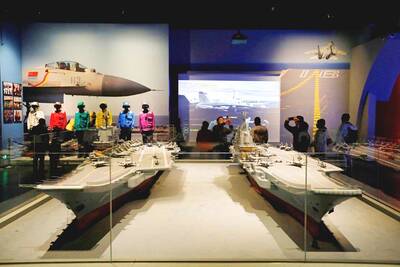
China on Wednesday teased in a video an aircraft carrier that could be its fourth, and the first using nuclear power, while making an allusion to Taiwan and vowing to further build up its islands, as it looks to boost maritime power, secure resources and bolster territorial claims. The video, issued on the eve of the 77th founding anniversary of the Chinese People’s Liberation Army Navy, featured fictional officers with names that are homophones of three commissioned aircraft carriers, the Liaoning (遼寧), Shandong (山東) and Fujian (福建). Titled Into the Deep, it showed a 19-year-old named “Hejian” (何劍) joining the group, sparking
Taiwan Semiconductor Manufacturing Co (TSMC, 台積電), the world’s largest contract chipmaker, said it expects its 2-nanometer (2nm) chip capacity to grow at a compound annual rate of 70 percent from this year to 2028. The projection comes as five fabs begin volume production of 2-nanometer chips this year — two in Hsinchu and three in Kaohsiung — TSMC senior vice president and deputy cochief operating officer Cliff Hou (侯永清) said at the company’s annual technology symposium in Silicon Valley, California, last week. Output in the first year of 2-nanometer production, which began in the fourth quarter of last year, is expected to


 RSS
RSS