


US policy on Taiwan under US President Barack Obama has taken a “hazardous” turn that appears to be moving toward support for Beijing’s interpretation of its core interests, the US-Taiwan Business Council said in a special commentary released on Monday.
The Obama administration appears to be “telegraphing its willingness to moderate legacy Taiwan support and cede more control to China in the dynamics and direction of cross-strait affairs,” said the report, titled The American Defense Commitment to Taiwan Continues to Deteriorate.
For the first time in about a decade, the US has the opportunity to reassess Taiwan’s defense requirements and future US security support for its longtime ally, the commentary said.
Although last year “started off strong on Taiwan defense issues,” with the Jan. 29 notification to Congress of five separate arms sales programs worth US$6.4 billion, the programs “were not intrinsically controversial,” since the great bulk of the money involved UH-60 Black Hawk utility helicopters and PAC-III missile defense batteries. Those items were leftovers from former US president George W. Bush’s April 2001 arms package, it said.
Another notification in August involved a small US$250 million package to upgrade radars on Taiwan’s Indigenous Defense Fighter — again a non-controversial program.
“On both occasions the arms sales notified were originally intended to address the military threat posed by China dating back before April 2001,” the report said.
As a result, the arms sold to Taiwan are “a solid decade out of date,” it said. “China rolls out its J-20 [stealth aircraft] prototype, and America enters the 6th year of deliberation over whether to provide Taiwan with additional F-16s — a platform already in its inventory.”
Although the Obama administration has been right to encourage cross-strait economic liberalization and support President Ma Ying-jeou (馬英九) in signing the Economic Cooperation Framework Agreement (ECFA), China’s military posture has failed to dovetail with those developments, the report said.
“It is not acceptable to point to the ECFA as the only dynamic aspect of today’s cross-strait development,” it said. “China’s military investments are having a huge impact on the cross-strait status quo.”
“China is playing relentless offense on Taiwan, and at some point the US has to step up and make it pay for its actions,” the commentary said, adding that Washington “must be as outspoken in [its] opposition to China’s strategy of military coercion as [it is] in [its] support of the ECFA and other positive trends.”
However, such a response has yet to materialize, it said.
“Two years into Mr Obama’s term in office, we have yet to see a single material action that suggests US willingness to make China pay a real cost for its aggressive cross-strait posture,” the chamber report said.
In addition to giving Taiwan and China the impression that it doesn’t care enough to act, US inaction will likely have an impact on the calculations of South Koreans and Japanese, who risk seeing this as “a drawn-out withdrawal of US interests in North Asia.”
The report called for the de-politicization of the process of arms sales to Taiwan, saying that indecision on the US side had forced Taiwan’s Ministry of National Defense (MND) to return more than US$1.4 billion in unused budget to state coffers since 2007.
The council’s criticism was not only focused on Washington, however, pointing to Ma’s failure to meet his campaign promise on national defense.
“As the US shows increasing angst over selling arms to Taiwan, President Ma and his colleagues have determined that they no longer need stand by their ‘defense spending at 3% of GDP’ commitment, as there is little demand from Washington that they do so,” the report said.
“The overall consensus is that Taiwan isn’t spending enough on national security,” it said, adding that forecasts for this year put direct defense expenditure at 2.16 percent of GDP, a figure that would rise to about 2.73 percent of GDP if non-direct expenditures were factored in.
If Taiwan’s economic -expansion continues apace, the share of defense spending to GDP could fall below 2 percent, it said.
The Ma administration’s failure to substantially increase direct and non-direct spending is taking place during a period when Taiwan has to take on “significant new commitments,” it said.
This “budget squeeze” has “tipped the scales so that the MND is laboring under tremendous budget shortages.”
A likely consequence is that Taiwan will almost certainly have to “refocus its force modernization plans” over the next half-decade and look for lower acquisition cost solutions and the prioritization of mid-life upgrades rather than the acquisition of new, more modern platforms.
Looking to the future, the council said a classified assessment of Taiwan’s air power capabilities to Congress — scheduled for release last year, but likely delayed until the second quarter this year — would hopefully provide a blueprint for US security cooperation with Taiwan.
However, the council said it feared the report “will have been written from the perspective of what the administration is and is not prepared to do when it comes to supporting Taiwan defense, rather than being based on the actual threat facing Taiwan.”

‘NO SECURITY RISK’: The Railway Bureau reassured the public that the technicians’ activities were limited to technical guidance and did not involve sensitive systems The Railway Bureau yesterday said it had invited eight Chinese technicians to assist with an airport MRT construction project. The bureau issued the confirmation after an Internet user said Chinese nationals had entered the construction zone of Taiwan Taoyuan International Airport’s Terminal 3 project. They asked why “individuals from an enemy state” were allowed access to such a major national infrastructure project, which raised serious concerns over Taiwan’s industrial safety, sensitive systems and information security. The bureau’s Northern Region Engineering Branch Office said subcontractor Taiwan Handle Industrial Co (台灣手把工業) of the Taoyuan airport MRT’s “Contract No. CU05 Project A14 Station Civil, MEP &

A US uncrewed surface vessel (USV) encountered multiple Chinese warships during an autonomous transit of the Taiwan Strait, US defense company Seasats said in a statement on Wednesday. Seasats announced that a Lightfish USV had completed the first autonomous transit of the Taiwan Strait. Over five days, the USV traversed the entire length of the Strait while constantly monitoring surface vessel traffic, the company said. The Lightfish encountered multiple Chinese warships, one of which was a Chinese People’s Liberation Army Navy (PLAN) Type 056 corvette, it said. The Chinese vessels were operating “well within Taiwan’s exclusive economic zone without transmitting their identity via the
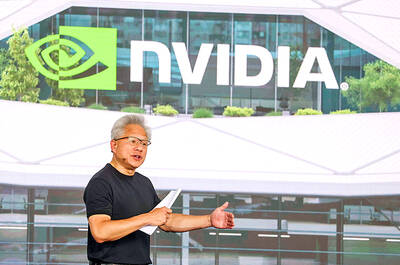
‘BOOMING’: ’ The number of partners we have here is incredible. You can see from their stock prices. They’re doing so well, they’re so happy,’ Jensen Huang said Nvidia Corp’s spending in Taiwan has ballooned to about US$150 billion a year, 10 times the US$10 billion to US$15 billion the company spent five years ago, Nvidia chief executive officer Jensen Huang (黃仁勳) said yesterday, suggesting Taiwan’s strategic importance in the global artificial intelligence (AI) supply chain. “Taiwan is the epicenter of the AI revolution. This is where the chips come, packaging comes. This is where the systems are made. This is where AI supercomputers were created,” Huang said at a meeting for the company’s employees in Beitou-Shilin Technology Park (北投士林科技園區) in Taipei, the planned site of Nvidia’s Taipei headquarters. “Taiwan
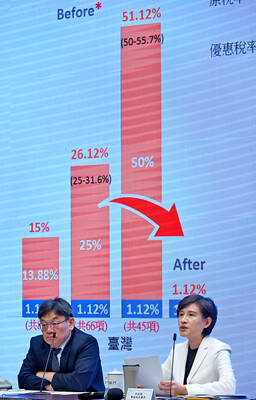
GREATER REACH? Auto parts and wood products would face tariffs of up to 15%, matching those targeting the EU, Japan and South Korea, Vice Premier said The US has announced that preferential tariff treatment for Taiwan’s non-semiconductor Section 232 goods would take effect retroactively from May 1, the Executive Yuan said yesterday. The US government yesterday posted a notice on the Federal Register’s public inspection Web site previewing tariff concessions for Taiwan under a memorandum of understanding (MOU) on Taiwan-US investment after two months of negotiations. The MOU signed on Jan. 15 stipulated three major preferential tariff arrangements: a 15 percent “reciprocal” tariff rate for Taiwan without stacking most-favored nation (MFN) rates; preferential Section 232 treatment for semiconductors and related products; and preferential Section 232 treatment for non-semiconductor


 RSS
RSS