


US President Barack Obama voiced hope on Wednesday for a further easing of tensions across the Taiwan Strait as he reaffirmed his commitment to the “one China” policy and to the Taiwan Relations Act (TRA), a law passed by the US Congress in 1979 that requires the US to provide Taiwan with the means to defend itself.
Welcoming Chinese President Hu Jintao (胡錦濤) for a state visit, Obama praised a major trade pact sealed last year between China and Taiwan.
“I welcome the progress that’s been made on both sides of the Taiwan Strait in reducing tensions and building economic ties,” Obama told a joint press conference. “We hope this progress continues, because it’s in the interests of both sides, the region and the United States. Indeed, I reaffirmed our commitment to a ‘one China’ policy based on the three US-China communiques and the Taiwan Relations Act.”
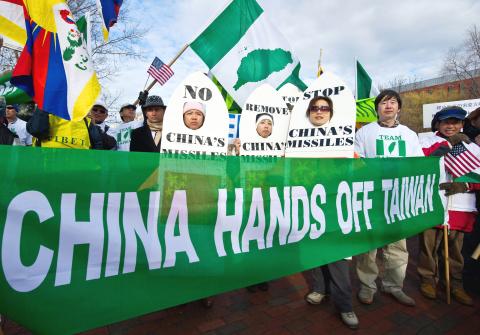
Photo: AFP
In a joint statement, Hu said that Taiwan “concerns China’s sovereignty and territorial integrity” and hoped the US would “honor its relevant commitments and appreciate and support the Chinese side’s position on this issue.”
During the press conference, which was disrupted by technical and translation problems, Obama touched on some of the other topics dealt with during the White House talks.
He said that the yuan was undervalued, that the two countries were expanding and deepening dialogue and cooperation between their militaries, and added that the US had a fundamental interest in regional stability, maintaining freedom of navigation and unimpeded commerce.
The two leaders agreed that North Korea must avoid further provocations.
On the delicate issue of human rights, Obama seemed to deliberately avoid being over-critical.
Although he said he was “candid” on the subject, Obama seems to have ignored congressional wishes that he bring up specific cases of abuse, such as that of jailed Nobel Peace Prize winner Liu Xiaobo (劉曉波).
Hu ignored a question from a US reporter on human rights, but when prodded with a follow-up, said: “China is always committed to the protection and promotion of human rights and, in the course of human rights, China has also made enormous progress, recognized widely in the world.”
However, he also acknowledged that “a lot still needs to be done.”
There is little doubt that Obama’s critics will be disappointed in the president’s failure to be more outspoken on the human rights issue.
Most of the closed-door White House talks appear to have been centered on trade, commerce and economics.
US officials said Beijing had agreed to buy 200 Boeing aircraft for US$19 billion as part of a US$45 billion export deal that is expected to create 200,000 new jobs in the US.
“We welcome China’s rise,” Obama said. “I absolutely believe that China’s peaceful rise is good for the world and it’s good for America. We just want to make sure that that rise occurs in a way that reinforces international norms and international rules, and enhances security and peace, as opposed to it being a source of conflict, either in the region or around the world.”
A lavish state dinner on Wednesday night was “quintessentially American” and included among the 225 guests stars such as Barbra Streisand, her husband James Brolin and action movie star Jackie Chan (成龍).
From big business there was Microsoft’s Steven Ballmer, from fashion there was Vera Wang and Vogue’s Anna Wintour. Artist Maya Lin, Olympic figure skater Michelle Kwan and Supreme Court Justice Stephen Breyer also attended.
Michelle Obama wore what one of the TV networks described as a dramatic red, off-one-shoulder, floor-length gown designed by Alexander McQueen, the British designer who committed suicide last year.
The White House served d’anjou pear salad with goat cheese, poached Maine lobster, orange glazed carrots and black trumpet mushrooms, dry aged rib eye steak with buttermilk crisp onions, double-stuffed potatoes and creamed spinach. Dessert was apple pie and vanilla ice cream.
After-dinner entertainment was provided by an all-star jazz lineup.
Three top US congressional leaders — House Speaker John Boehner, an Ohio Republican; Senate Majority Leader Harry Reid, a Nevada Democrat; and Senator Mitch McConnell of Kentucky, the Republican leader — turned down their invitations as part of a thinly veiled snub to protest Hu’s human rights record.
Obama and Hu also held private Oval Office talks on Taiwan on Wednesday, but later refused to divulge details.
While Taipei and senior US officials are certain to have been given a full briefing, there were no leaks of the details in Washington on Wednesday night.
Analysts speculate that Obama may have told Hu that the US intends to continue selling arms to Taiwan and that Hu would have registered a strong objection, leaving both sides to simply agree to disagree.
At this early stage, there are no indications that a breakthrough — or progress of any kind — was made.
Hu was scheduled to make a public speech later yesterday before he traveled to Chicago and the end of his three-day state visit to the US.
ADDITIONAL REPORTING BY AFP

‘NO SECURITY RISK’: The Railway Bureau reassured the public that the technicians’ activities were limited to technical guidance and did not involve sensitive systems The Railway Bureau yesterday said it had invited eight Chinese technicians to assist with an airport MRT construction project. The bureau issued the confirmation after an Internet user said Chinese nationals had entered the construction zone of Taiwan Taoyuan International Airport’s Terminal 3 project. They asked why “individuals from an enemy state” were allowed access to such a major national infrastructure project, which raised serious concerns over Taiwan’s industrial safety, sensitive systems and information security. The bureau’s Northern Region Engineering Branch Office said subcontractor Taiwan Handle Industrial Co (台灣手把工業) of the Taoyuan airport MRT’s “Contract No. CU05 Project A14 Station Civil, MEP &

A US uncrewed surface vessel (USV) encountered multiple Chinese warships during an autonomous transit of the Taiwan Strait, US defense company Seasats said in a statement on Wednesday. Seasats announced that a Lightfish USV had completed the first autonomous transit of the Taiwan Strait. Over five days, the USV traversed the entire length of the Strait while constantly monitoring surface vessel traffic, the company said. The Lightfish encountered multiple Chinese warships, one of which was a Chinese People’s Liberation Army Navy (PLAN) Type 056 corvette, it said. The Chinese vessels were operating “well within Taiwan’s exclusive economic zone without transmitting their identity via the
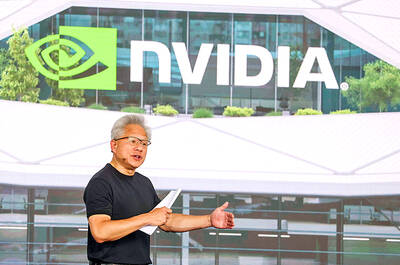
‘BOOMING’: ’ The number of partners we have here is incredible. You can see from their stock prices. They’re doing so well, they’re so happy,’ Jensen Huang said Nvidia Corp’s spending in Taiwan has ballooned to about US$150 billion a year, 10 times the US$10 billion to US$15 billion the company spent five years ago, Nvidia chief executive officer Jensen Huang (黃仁勳) said yesterday, suggesting Taiwan’s strategic importance in the global artificial intelligence (AI) supply chain. “Taiwan is the epicenter of the AI revolution. This is where the chips come, packaging comes. This is where the systems are made. This is where AI supercomputers were created,” Huang said at a meeting for the company’s employees in Beitou-Shilin Technology Park (北投士林科技園區) in Taipei, the planned site of Nvidia’s Taipei headquarters. “Taiwan
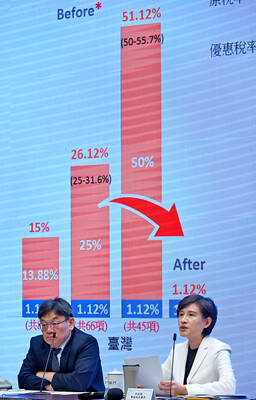
GREATER REACH? Auto parts and wood products would face tariffs of up to 15%, matching those targeting the EU, Japan and South Korea, Vice Premier said The US has announced that preferential tariff treatment for Taiwan’s non-semiconductor Section 232 goods would take effect retroactively from May 1, the Executive Yuan said yesterday. The US government yesterday posted a notice on the Federal Register’s public inspection Web site previewing tariff concessions for Taiwan under a memorandum of understanding (MOU) on Taiwan-US investment after two months of negotiations. The MOU signed on Jan. 15 stipulated three major preferential tariff arrangements: a 15 percent “reciprocal” tariff rate for Taiwan without stacking most-favored nation (MFN) rates; preferential Section 232 treatment for semiconductors and related products; and preferential Section 232 treatment for non-semiconductor


 RSS
RSS