


The Centers for Disease Control (CDC) yesterday defended its decision not to publicize a case of suspected death from mad cow disease by saying that the cause of death had not been confirmed.
Late on Wednesday, the CDC responded to media reports that a 36-year-old Taiwanese man who spent eight years in the UK died in May from what appeared to be mad cow disease.
The man was in the UK from 1978 to 1986. In 2008, he began to develop symptoms resembling that of Creutzfeldt-Jacob disease (CJD) such as memory loss and hypersomnia, and was reported as a suspected CJD case in March last year, the CDC said. However, the man’s family refused to provide tissue for testing or to give permission for an autopsy, making it difficult to confirm the cause of death.
Based on his symptoms and his MRI and EEG records, a medical team has determined this was “extremely likely” to be a CJD case.
However, the announcement came only after media outlets had already broken the news. The health authorities were heavily criticized for delaying reporting a serious infectious disease.
The Consumers’ Foundation, which has opposed imports of US beef parts that are at risk of spreading mad cow disease, criticized the CDC, saying it told bold-faced lies by saying there had been no cases of CJD from 1997 to May 29.
The foundation accused the CDC of covering up the information even though it was fully aware of the case to prevent hindrances to importing US beef, which the foundation called “malfeasance to an extreme.”
A trade agreement on US beef imports signed in October last year was widely criticized by health professionals and consumer groups, who said at the time that Taiwan had no facilities to deal with a possible outbreak of the disease. The legislature in January barred US ground beef, beef offal and other beef parts such as skulls, eyes and intestines from entering the market.
“The toxin has an incubation period of as long as seven years, so without symptoms or signs of the disease, it is very difficult to prevent and there is no cure for the disease,” Chen Sheng-shun (陳勝順), vice president of the Chang Gung Memorial Hospital Kaohsiung Branch, said yesterday.
Democratic Progressive Party (DPP) lawmakers also accused the Department of Health of failing to make public the case despite reportedly having known of it since last year.
Citing information apparently acquired from the government, DPP Legislator Kuan Bi-ling (管碧玲) said the victim began receiving treatment at a hospital during the second half of 2008. By March last year, she said, it was almost certain that the victim had acquired some form of mad cow disease.
“The hospital alerted the CDC shortly after, but the government still made no effort to tell the public,” Kuan said.
She suggested the lack of disclosure was because of sensitive talks over the importation of certain kinds of US beef more susceptible to carrying the disease at the time, alleging then-National Security Council secretary-general Su Chi (蘇起) signed the beef-import deal with the US despite the case.
CDC Director-General Chang Feng-yee (張峰義) denied covering up the incident and said that because the family of the victim refused to allow an autopsy, there is no way to confirm that the man died of mad cow disease.
Chang said it was standard protocol in Taiwan and many other countries to publicize only confirmed cases and not suspected cases.
Chinese Nationalist Party (KMT) Legislator Kuo Su-chun (郭素春) also shrugged off the DPP’s criticism of the government’s beef import policy, saying the DPP was simply taking every opportunity to attack the KMT.
At a separate setting yesterday, Department of Health Minister Yaung Chih-liang (楊志良) said “the person then in charge of [the DOH]” was the one who decided not to disclose the case, referring to Yeh Ching-chuan (葉金川), who resigned in August last year to run for Hualien county commissioner.
Yeh probably decided not to make the case known to the public because he thought the case was not of domestic origin, the minister said.
“I respected the decision, but personally I have different opinions,” Yaung said, adding that he was not aware of the case until Wednesday.
The government might have been concerned that a mad cow case at that time might lead to greater opposition to relaxing restrictions on imports of US beef, but the government was duty bound to disclose information on diseases, Yaung said.
When asked why the case was not passed on to him when he succeeded Yeh, Yaung said that Yeh did not have enough time during the transition because he “left in a hurry for the election.”
ADDITIONAL REPORTING BY FLORA WANG

‘NO SECURITY RISK’: The Railway Bureau reassured the public that the technicians’ activities were limited to technical guidance and did not involve sensitive systems The Railway Bureau yesterday said it had invited eight Chinese technicians to assist with an airport MRT construction project. The bureau issued the confirmation after an Internet user said Chinese nationals had entered the construction zone of Taiwan Taoyuan International Airport’s Terminal 3 project. They asked why “individuals from an enemy state” were allowed access to such a major national infrastructure project, which raised serious concerns over Taiwan’s industrial safety, sensitive systems and information security. The bureau’s Northern Region Engineering Branch Office said subcontractor Taiwan Handle Industrial Co (台灣手把工業) of the Taoyuan airport MRT’s “Contract No. CU05 Project A14 Station Civil, MEP &

A US uncrewed surface vessel (USV) encountered multiple Chinese warships during an autonomous transit of the Taiwan Strait, US defense company Seasats said in a statement on Wednesday. Seasats announced that a Lightfish USV had completed the first autonomous transit of the Taiwan Strait. Over five days, the USV traversed the entire length of the Strait while constantly monitoring surface vessel traffic, the company said. The Lightfish encountered multiple Chinese warships, one of which was a Chinese People’s Liberation Army Navy (PLAN) Type 056 corvette, it said. The Chinese vessels were operating “well within Taiwan’s exclusive economic zone without transmitting their identity via the
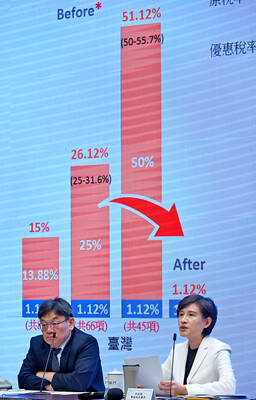
GREATER REACH? Auto parts and wood products would face tariffs of up to 15%, matching those targeting the EU, Japan and South Korea, Vice Premier said The US has announced that preferential tariff treatment for Taiwan’s non-semiconductor Section 232 goods would take effect retroactively from May 1, the Executive Yuan said yesterday. The US government yesterday posted a notice on the Federal Register’s public inspection Web site previewing tariff concessions for Taiwan under a memorandum of understanding (MOU) on Taiwan-US investment after two months of negotiations. The MOU signed on Jan. 15 stipulated three major preferential tariff arrangements: a 15 percent “reciprocal” tariff rate for Taiwan without stacking most-favored nation (MFN) rates; preferential Section 232 treatment for semiconductors and related products; and preferential Section 232 treatment for non-semiconductor
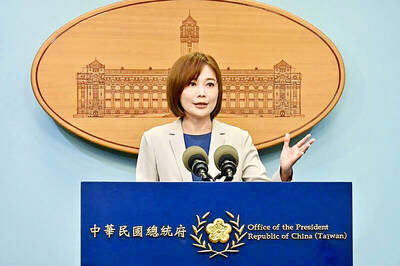
TIT-FOR-TAT: The US allegedly revoked the visa of a Chinese national working at Xinhua News Agency in the US in response to Beijing’s expulsion of Vivian Wang The Presidential Office yesterday condemned China for expelling a New York Times correspondent from Beijing following the newspaper’s interview with President William Lai (賴清德), saying the move highlighted Beijing’s suppression of press freedom and its threat to international news media. Taiwan has noted a series of recent incidents in which Beijing used similar tactics to “threaten and pressure international media outlets and journalists,” Presidential Office spokeswoman Karen Kuo (郭雅慧) said in a statement. “This concerns not only press freedom and freedom of expression, but also the safety of journalists, and Taiwan and relevant partners are paying close attention to the situation,” she


 RSS
RSS