


AP, YEONPYEONG ISLAND, South Korea
North Korea yesterday warned that US-South Korean plans for military maneuvers put the peninsula on the brink of war, and appeared to launch its own artillery drills within sight of an island it showered with a deadly barrage this week.
The fresh artillery blasts were especially defiant because they came as the US commander in South Korea, General Walter Sharp, toured Yeonpyeong Island to survey damage from Tuesday’s hail of North Korean artillery fire that killed four people.
None of the latest rounds hit the South’s territory, and US military officials said Sharp did not even hear the concussions, though residents on other parts of the island panicked and ran back to the air raid shelters where they huddled earlier in the week as white smoke rose from North Korean territory.
Tuesday’s attack — eight months after a torpedo sank a South Korean warship, killing 46 sailors — has also laid bare weaknesses in the South’s defense 60 years after the Korean War.
South Korean President Lee Myung-bak yesterday named a former chairman of the Joint Chiefs of Staff to replace Kim Tae-young, who was sacked as defense minister on Thursday.
US-South Korean military drills in the Yellow Sea are scheduled to start tomorrow, and will include a US nuclear-powered aircraft carrier. The North unleashed its anger over the planned exercises in a dispatch yesterday.
“The situation on the Korean Peninsula is inching closer to the brink of war,” the report in the North’s Korean Central News Agency (KNCA) said.
A North Korean official boasted that Pyongyang’s military “precisely aimed and hit the enemy artillery base” as punishment for South Korean military drills — a reference to Tuesday’s attack — and warned of another “shower of dreadful fire,” KCNA reported in a separate dispatch.
China also expressed concern over any war games in waters within its exclusive economic zone, though the statement on the Ministry of Foreign Affairs Web site didn’t mention the latest drills.
That zone extends 370km from China’s coastline and includes areas south of Yeonpyeong cited for possible maneuvers, though the exact location of the drills is not known.
Sharp said Tuesday’s attack was a clear violation of the 1953 Korean War armistice.
“We at United Nations Command will investigate this completely and call on North Korea to stop any future attacks,” he said.
Dressed in a heavy camouflage jacket, army fatigues and a black beret, Sharp walked down a heavily damaged street strewn with debris from buildings. Around him were charred bicycles and shattered bottles of soju, Korean rice liquor.
Many houses were blackened, half-collapsed or flattened, the streets littered with shattered windows, bent metal and other charred wreckage. Several stray dogs barked as they sat near destroyed houses.
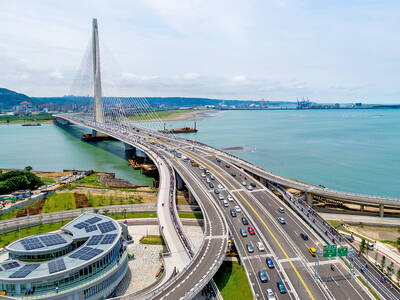
The Ministry of Transportation and Communications yesterday inaugurated the Danjiang Bridge across the Tamsui River in New Taipei City, saying that the structure would be an architectural icon and traffic artery for Taiwan. Feted as a major engineering achievement, the Danjiang Bridge is 920m long, 211m tall at the top of its pylon, and is the longest single-pylon asymmetric cable-stayed bridge in the world, the government’s Web site for the structure said. It was designed by late Iraqi-British architect Zaha Hadid. The structure, with a maximum deck of 70m, accommodates road and light rail traffic, and affords a 200m navigation channel for boats,
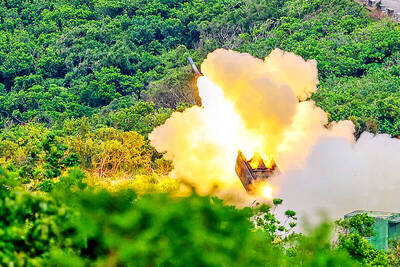
PRECISION STRIKES: The most significant reason to deploy HIMARS to outlying islands is to establish a ‘dead zone’ that the PLA would not dare enter, a source said A High Mobility Artillery Rocket System (HIMARS) would be deployed to Penghu County and Dongyin Island (東引) in Lienchiang County (Matsu) to force the Chinese military to retreat at least 100km from the coastline, a military source said yesterday. Taiwan has been procuring HIMARS and Army Tactical Missile Systems (ATACMS) from the US in batches. Once all batches have been delivered, Taiwan would possess 111 HIMARS units and 504 ATACMS, which have a range of 300km. Considering that “offense is the best defense,” the military plans to forward-deploy the systems to outlying islands such as Penghu and Dongyin so that

WHAT WAS ALL THAT FOR? Jaw Shaw-kong said that Cheng Li-wen had pushed for more drastic cuts and attacked him, just for the outcome to be nearly identical to his bill The legislature yesterday passed a supplementary budget bill to fund the purchase of separate packages of US military equipment, with the combined amount of spending capped at NT$780 billion (US$24.8 billion). The Chinese Nationalist Party (KMT) and Taiwan People’s Party (TPP) used their legislative majority to pass the bill, which runs until 2033 and has two main funding provisions. One was for NT$300 billion of arms sales already approved by the US for Taiwan on Dec. 17 last year, the other was for NT$480 billion for another arms package expected to be announced by Washington. The bill, which fell short of the NT$1.25

‘CLEAR MESSAGE’: The bill would set up an interagency ‘tiger team’ to review sanctions tools and other economic options to help deter any Chinese aggression toward Taiwan US Representative Young Kim has introduced a bill to deter Chinese aggression against Taiwan, calling for an interagency “tiger team” to preplan coordinated sanctions and economic measures in response to possible Chinese military or political action against Taiwan. “[Chinese President] Xi Jinping [習近平] has directed the People’s Liberation Army to be ready to invade Taiwan by 2027. China has a plan. America should have one too,” Kim said in a news release on Thursday last week. She introduced the “Deter PRC [People’s Republic of China] aggression against Taiwan act” to “ensure the US has a coordinated sanctions strategy ready should


 RSS
RSS