


The Environmental Protection Administration (EPA) yesterday filed lawsuits against Democratic Progressive Party (DPP) spokesperson Tsai Chi-chang (蔡其昌) and former Government Information Office chief Cheng Wen-tsang (鄭文燦) for allegedly ignoring the EPA’s request to correct what it deemed “untruthful statements” about a controversy surrounding air pollution fees levied by Taiwan’s two oil refiners.
In February, the government had announced that CPC Corp, Taiwan (台灣中油) and Formosa Petrochemical Corp (台塑石化) had overcharged consumers by about NT$1.37 billion (US$42.6 million) last year in the name of air pollution fees — which worked out to be NT$240 per motorist.
Environmental Protection Administration Minister Stephen Shen (沈世宏) was quoted by the Chinese-language United Evening News on Feb. 25 as saying that the controversy over the air pollution fee stemmed from an error in the formula used to calculate changing oil prices, adding that the formula was created when Su Tseng-chang (蘇貞昌) was premier.
Su is now the DPP candidate for Taipei mayor.
The EPA said Tsai and Cheng’s reactions to Shen’s statement — published in the United Daily News and Apply Daily on Feb. 26 — had been inaccurate and defamatory.
“Freedom of speech is protected under the Constitution and the administration respects criticism and comments on government policies,” the EPA said in a statement. “However, their remarks should not contradict actual facts, nor should they use insulting remarks to defame government departments and civil servants. Politicians or political parties ... should be last to do so.”
Tsai was quoted as saying that Su had decided to freeze oil prices when global prices for crude were rising and he accused President Ma Ying-jeou’s (馬英九) administration of robbing people in the guise of air pollution fees. Tsai was also quoted as questioning why Shen had not changed the calculation formula if it was wrong.
“Was he sleeping the whole time?” the United Daily News quoted Tsai as asking before adding: “Shen passed the buck whenever he dealt with a problem. Such an irresponsible person should not be the EPA minister.”
The Apply Daily cited Cheng as saying the Chinese Nationalist Party (KMT) had been in power for two years, so it should bear responsibility for the problem and not blame the former DPP administration.
The EPA said the Control Yuan had investigated the pollution fee controversy and found that the EPA had respected the law. The Control Yuan report also said the Ministry of Economic Affairs had not informed the EPA of how oil prices were set.
The EPA notified Tsai and Cheng on May 6 of the results of the Control Yuan’s investigation, after the watchdog body had made its report public. On July 22, the EPA sent a request to both by registered mail, asking that they correct their statements. Neither responded to the request, the EPA said.
Its lawsuit only focuses on Tsai and Cheng’s “untrue” statements, the EPA said. Su and DPP Chairperson Tsai Ing-wen (蔡英文) should not let their party members off the hook if they do not admit they are wrong, the EPA said.
Tsai Chi-chang and Cheng -responded to news of the lawsuit by questioning its timing, given the nearness of the Nov. 27 special municipality elections.
Tsai Chi-chang said his February comments should be protected under freedom of speech, but added that Taiwan has descended into a state of “martial law” under Ma.
He said he would file a countersuit against Shen for “making false accusations.”
“My concerns ... at the time were supported by evidence,” he said. “Even KMT lawmakers raised questions about whether the EPA had enough checks in place.”
Cheng, who is working on Tsai Ing-wen’s campaign for Sinbei City mayor, said he did not see what the problem was with his February comments.
ADDITIONAL REPORTING BY VINCENT Y. CHAO AND STAFF WRITER
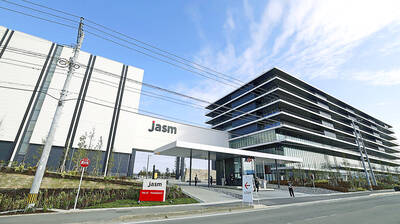
The subsidiary of Taiwan Semiconductor Manufacturing Co (TSMC, 台積電) in Kumamoto, Japan, turned a profit in the first quarter of this year, marking the first time the first fab of the unit has become profitable since mass production started at the end of 2024. According to the contract chipmaker’s financial statement released on Friday, Japan Advanced Semiconductor Manufacturing Inc (JASM), a joint venture running the fab in Kumamoto, posted NT$951 million (US$30.19 million) in profit in the January-to-March period, compared with a loss of NT$1.39 billion in the previous quarter, and a loss of NT$3.25 billion in the first quarter of
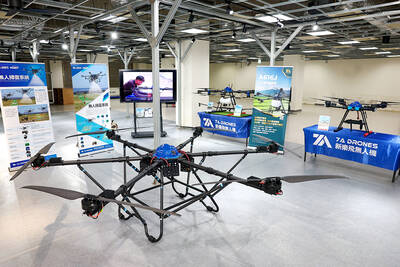
DRONE CENTRAL: Taiwan aims to become Asia’s democratic hub for drones, with most exports focused on high-quality military-grade models, an official said Taiwan’s drone industry is expected to expand significantly by 2030, producing 100,000 units per month and exporting half of them, the Ministry of Economic Affairs said yesterday. Current drone production capacity is about 15,000 units per month, but the industry can quickly scale up as demand increases, Industrial Development Administration Director-General Chiou Chyou-huey (邱求慧) told a news conference in Taipei. Taiwan’s drone output grew 2.5-fold last year to NT$12.9 billion (US$408.3 million) under a government program to develop the uncrewed vehicle sector, he said. The Executive Yuan in October last year approved plans to invest NT$44.2 billion into domestic production of uncrewed aerial
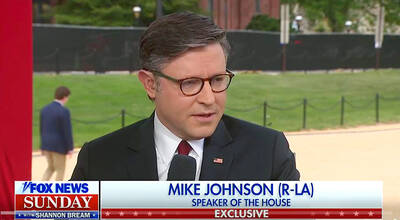
RESOLUTE BACKING: Two Republican senators are planning to introduce legislation that would impose immediate sanctions on China if it attempts to invade Taiwan US House of Representatives Speaker Mike Johnson on Sunday reaffirmed US congressional support for Taiwan, saying the US and “all freedom-loving people” have a stake in preventing China from seizing Taiwan by force. Johnson made the remarks in an interview with Fox News Sunday on US President Donald Trump’s summit with Chinese President Xi Jinping (習近平) last week. In an interview that aired on Friday on Fox News, just as Trump wrapped up a high-stakes visit to China, he said he has yet to green-light a new US$14 billion arms package to Taiwan and that it “depends on China.” “It’s a very good
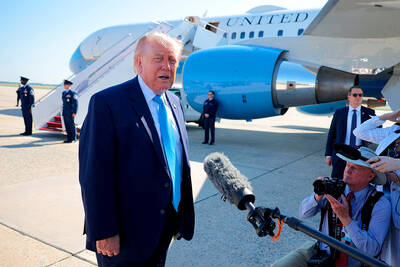
US President Donald Trump yesterday said he would speak to President William Lai (賴清德) as his administration considers whether to move ahead with a US$14 billion weapons sale to Taiwan — a potential arms deal that has drawn criticism from China. “Well, I’ll speak to him. I speak to everybody,” Trump told reporters yesterday when asked if he had any plans to call his counterpart, although he did not offer a time frame for when such a conversation could take place. Trump previously said he would speak to the person “that’s running Taiwan,” without specifying who he meant. “We have that situation very


 RSS
RSS