


Both sides of the Taiwan Strait should communicate and negotiate on issues pertaining to the participation of Taiwan, including Taiwanese non-governmental organizations (NGOs), in international NGOs and occasions so that unnecessary confrontations and unpleasant incidents can be avoided, Chinese President Hu Jintao (胡錦濤) said yesterday.
Hu made the remarks in a closed-door meeting with President Ma Ying-jeou’s (馬英九) APEC envoy Lien Chan (連戰), who visited Hu at the latter’s hotel in Yokohama, Japan, on the sidelines of the APEC leaders’ summit.
“During the meeting, I mentioned to Hu that since cross-strait relations have improved, we could now work together in many more ways, such as in [cross-strait] economic and trade cooperation and in regional economic integration,” Lien told a news conference yesterday evening after meeting Hu in the morning and taking part in the APEC economic leaders’ summit in the afternoon.
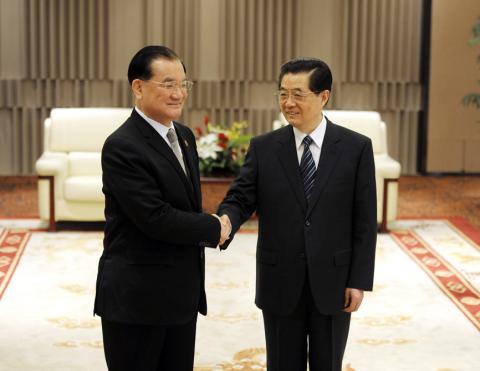
Photo: CNA
“I also told [Hu] that Taiwan-based NGOs have participated in international events for many years — and I think Taiwan’s NGOs have far more experiences in international organizations and events than those based in China,” Lien said. “Taiwan should not miss out.”
In response to Lien’s remarks, Hu said that such issues should be resolved through further cross-strait negotiations “to avoid unnecessary internal friction and unpleasant events in the future.”
Asked by the press whether Hu was referring to the feud between the Taiwanese and Chinese delegations at the Tokyo International Film Festival last month, Lien said no particular event was mentioned.
On the opening night of the film festival on Oct. 23, the head of the Chinese delegation demanded that the Taiwanese delegation use the word “China” as part of its name, a request which was rejected by the Taiwanese delegation that was led by Chen Chih-kuan (陳志寬), director of the Government Information Office’s Department of Motion Pictures Affairs. The argument lasted more than 90 minutes, causing both delegations to miss their grand entrances.
At the meeting, Lien and Hu addressed each other by party titles instead of official titles: Lien addressed Hu as “General Secretary Hu” — referring to his title as the general secretary of the Chinese Communist Party, while Hu addressed Lien as “Chairman Lien” — referring to Lien’s title as honorary chairman of the Chinese Nationalist Party (KMT).
Before Hu was to deliver a speech at 11am yesterday, he only received two guests at his hotel. The first guest was Lien, who was then followed by Hong Kong Chief Executive Donal Tsang (曾蔭權).
Later yesterday, Lien took part in the leaders’ summit, during which he said he had “talked with every one of the leaders from all 21 APEC member economies. No one was missed.”
Lien reaffirmed Taiwan’s willingness to work in collaboration with Indonesia to develop Morotai Island with Indonesian President Susilo Bambang Yudhoyono, and added that the two countries can use the Morotai project as a platform to develop further joint ventures.
Lien also declared Taiwan’s willingness to host an APEC leaders’ summit.
APEC economic leaders are scheduled to hold a second closed-door summit meeting today to produce a “Leaders’ Declaration” to conclude this year’s APEC meeting.
Commenting on Hu’s remarks that both sides should negotiate on Taiwan’s international participation in Taipei, Democratic Progressive Party spokesperson Tsai Chi-chang (蔡其昌) called on China to respect Taiwan’s international presence and participation, adding that as a sovereign nation Taiwan was entitled to enjoy sovereign authority.
“Taiwanese people will never accept [China’s] attitude if it habitually attempts to ‘domesticize’ Taiwan and refuses to treat Taiwan with equal respect and on an equal footing,” Tsai said.
ADDITIONAL REPORTING BY SU YUNG-YAO

‘NO SECURITY RISK’: The Railway Bureau reassured the public that the technicians’ activities were limited to technical guidance and did not involve sensitive systems The Railway Bureau yesterday said it had invited eight Chinese technicians to assist with an airport MRT construction project. The bureau issued the confirmation after an Internet user said Chinese nationals had entered the construction zone of Taiwan Taoyuan International Airport’s Terminal 3 project. They asked why “individuals from an enemy state” were allowed access to such a major national infrastructure project, which raised serious concerns over Taiwan’s industrial safety, sensitive systems and information security. The bureau’s Northern Region Engineering Branch Office said subcontractor Taiwan Handle Industrial Co (台灣手把工業) of the Taoyuan airport MRT’s “Contract No. CU05 Project A14 Station Civil, MEP &

A US uncrewed surface vessel (USV) encountered multiple Chinese warships during an autonomous transit of the Taiwan Strait, US defense company Seasats said in a statement on Wednesday. Seasats announced that a Lightfish USV had completed the first autonomous transit of the Taiwan Strait. Over five days, the USV traversed the entire length of the Strait while constantly monitoring surface vessel traffic, the company said. The Lightfish encountered multiple Chinese warships, one of which was a Chinese People’s Liberation Army Navy (PLAN) Type 056 corvette, it said. The Chinese vessels were operating “well within Taiwan’s exclusive economic zone without transmitting their identity via the
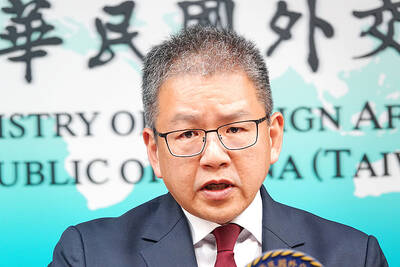
Taiwan is still in the process of assessing the possibility of recruiting workers from Eswatini, the Ministry of Foreign Affairs said yesterday, adding that its goal is to help Eswatini upgrade its vocational training centers. If there are plans to recruit workers from Eswatini, safeguarding national security, protecting public health and ensuring the employment rights of Taiwanese would be prerequisites, Department of West Asian and African Affairs Director-General Yen Chia-liang (顏嘉良) told a news conference. Key considerations would also include filling labor shortages in specific industries, and fostering bilateral professional and technical exchanges, he said. Yen was asked about the progress of labor
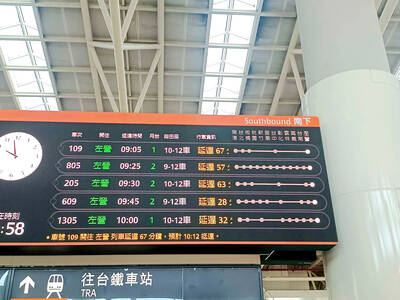
The nation’s usually punctual high-speed rail system yesterday was hit by major disruptions after all scheduled services were canceled and replaced with three hourly trains offering only non-reserved seating, affecting more than 200,000 passengers. Preliminary findings indicate the disruption was caused by a faulty power module in a track switch control cabinet, Taiwan High-Speed Rail Corp (THSRC) said, adding that as a full system inspection could only be conducted after operations end for the day, a decision on whether normal service would resume today would be announced before the first train departs. During a routine inspection early yesterday, a switch signal abnormality


 RSS
RSS