


Deputy Minister of National Defense Andrew Yang (楊念祖) warned the US at a defense conference earlier this week that the Chinese threat against Taiwan “has never diminished.”
In a speech with far more hawkish undertones than are normally heard from members of President Ma Ying-jeou’s (馬英九) administration, Yang said China was continuing its preparations for “contingency operations” to respond to any change in relations across the Taiwan Strait.
Addressing the closed-door US-Taiwan Defense Industry -Conference in Cambridge, Maryland, Yang said that to suppress independence and promote unification, Beijing was combining “carrots and sticks.”
Beijing was sweetening the carrots and hardening the sticks, he said.
“China has attempted to instigate differences between the Taiwanese people and the government and even tried to dominate Taiwan’s public opinion and manipulate it in cross-strait relations,” Yang said.
Beijing’s military preparations against Taiwan were at least partly based on the principle that there would be no compromise on Taiwanese independence.
The very same month that -Taiwan and China signed the Economic Cooperation Framework Agreement (ECFA), Yang said, at a time when relations between the two countries were at a high point, Chinese Minister of National Defense Liang Guanglie (梁光烈) told a delegation from the Japanese Self--Defense Forces that Taiwan was “the focus” of China’s military buildup.
Yang said there was a sharp contrast between the ECFA and Liang’s comments about the military buildup and that he could only conclude that Taiwan continued to face the same or an “increasing intensity” of threat.
Yang said a historic examination of China’s military strategy showed that the emphasis had always been less on defense and more on an active approach.
He said this could mean that China would be capable of launching a pre-emptive strike.
In this context, Yang urged the US to sell Taiwan the 66 advanced F-16C/D fighter aircraft and diesel-electric submarines it has requested.
A copy of Yang’s remarks was made available to the media.
At a press conference later, Yang said China had not been testing Taiwan’s defenses by sending military units close to its waters, but that Taipei could not count on China’s intentions because its military capability was steadily increasing and Beijing had not promised to refrain from using force.
He said the US was ready to upgrade Taiwan’s existing fleet of older F-16A/B aircraft, that there had been a warm response to a request to buy more recent models of the plane and that the request was being given serious consideration.
Hsiao Bi-khim (蕭美琴), director of the Democratic Progressive Party’s department of international affairs, later said she was happy to see a Ma official willing to face up to the challenge.
More than 140 government officials, academics, experts and representatives from defense companies attended the three-day annual conference, which concluded yesterday.
US-Taiwan Business Council president Rupert Hammond--Chambers said the closed sessions at the conference were being used to examine the future of cross-strait threats and Taiwan’s security needs.
He said the Taiwanese military’s new focus on disaster rescue, recovery and relief and asymmetric options for the armed forces would also be addressed.
“The Defense Industry Conference is the most important private event reviewing US-Taiwan defense and security issues each year,” he said.
Other keynote speakers included Wallace Gregson, assistant secretary for Asian and Pacific security affairs at the US Department of Defense and Andrew Shapiro, assistant secretary for political--military affairs at the US Department of State.

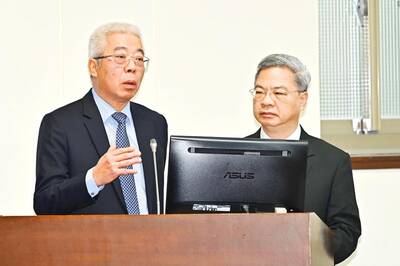
Taiwan has arranged for about 8 million barrels of crude oil, or about one-third of its monthly needs, to be shipped from the Red Sea this month to bypass the Strait of Hormuz and ease domestic supply pressures, CPC Corp, Taiwan (CPC, 台灣中油) said yesterday. The state-run oil company has worked with Middle Eastern suppliers to secure routes other than the Strait of Hormuz, through which about 20 percent of the world’s oil and liquefied natural gas typically passes, CPC chairman Fang Jeng-zen (方振仁) said at a meeting of the legislature’s Economics Committee in Taipei. Suppliers in Saudi Arabia have indicated they
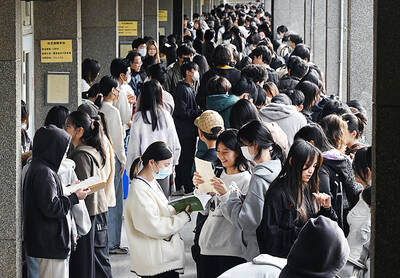
A global survey showed that 60 percent of Taiwanese had attained higher education, second only to Canada, the Ministry of the Interior said. Taiwan easily surpassed the global average of 43 percent and ranked ahead of major economies, including Japan, South Korea and the US, data from the Organisation for Economic Co-operation and Development (OECD) for 2024 showed. Taiwan has a high literacy rate, data released by the ministry showed. As of the end of last year, Taiwan had 20.617 million people aged 15 or older, accounting for 88.5 percent of the total population, with a literacy rate of 99.4 percent, the data
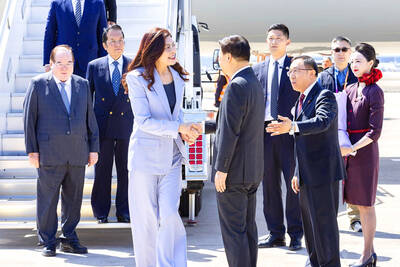
CCP ‘PAWN’? Beijing could use the KMT chairwoman’s visit to signal to the world that many people in Taiwan support the ‘one China’ principle, an academic said Chinese Nationalist Party (KMT) Chairwoman Cheng Li-wun (鄭麗文) yesterday arrived in China for a “peace” mission and potential meeting with Chinese President Xi Jinping (習近平), while a Taiwanese minister detailed the number of Chinese warships currently deployed around the nation. Cheng is visiting at a time of increased Chinese military pressure on Taiwan, as the opposition-dominated Legislative Yuan stalls a government plan for US$40 billion in extra defense spending. Speaking to reporters before going to the airport, Cheng said she was going on a “historic journey for peace,” but added that some people felt uneasy about her trip. “If you truly love Taiwan,

NEW LOW: The council in 2024 based predictions on a pessimistic estimate for the nation’s total fertility rate of 0.84, but last year that rate was 0.69, 17 percent lower An expected National Development Council (NDC) report expects the nation’s population to drop below 12 million by 2065, with the old-age dependency ratio to top 100 percent sooner than 2070, sources said yesterday. The council is slated to release its latest population projections in August, using an ultra-low fertility model, the sources said. The previous report projected that Taiwan’s population would fall to 14.37 million by 2070, but based on a new estimate of the total fertility rate (TFR) — the average number of children born to a woman over her lifetime — the population is expected to reach 12 million by


 RSS
RSS