


Taiwan was pounded by winds of more than 200kph yesterday as Typhoon Fanapi crippled transportation nationwide and prompted the evacuation of thousands of residents from mountainous areas prone to devastating landslides.
While Fanapi made landfall in Hualien County’s Fengbin Township (豐濱) at 8:40am, severe flooding was reported in southern Taiwan. Statistics from the Central Weather Bureau showed that between 12am and 7:10pm, Majia (瑪家), Pingtung County, topped other areas with the highest accumulation of rainfall at 890mm. It was followed by the county’s Shangdewen (上德文) and Weiliaoshan (尾寮山), with accumulated rainfall of 835.5mm and 781.5mm. Kaohsiung County’s Gangshan (岡山) and Fongsyong (鳳雄) recorded accumulated rainfalls of 656.5mm and 622mm respectively.
Flooding also occurred in Pingtung County’s Linbian (林邊), Ciangyuan (羌園) and Jiadong (佳冬) townships, Kaohsiung County’s Dashu (大樹), Renwu (仁武), Dashe (大社) and Niaosong (鳥松) townships, as well as four of Kaohsiung City’s nine administrative districts.

PHOTO: NICKY LOH, REUTERS
At 7pm, the bureau raised the rainfall estimates in Kaohsiung’s plains to 1,000mm and to 1,200mm in the mountainous areas. The estimated rainfall in the Pingtung plains was elevated to 700mm and to 1,400mm in the mountainous areas.
At press time, Taitung, Kaohsiung city and county, Nantou County’s Renai (仁愛) and Sinyi (信義) townships and Chiayi County’s Alishan Township (阿里山) have declared today a typhoon day, canceling both work and classes.
Kinmen County announced work and class cancellations before noon today while Penghu County announced all classes were canceled today but it would remain a working day.

PHOTO: WANG HAN-PING,TAIPEI TIMES
The Central Emergency Operation Center reported that 10,000 residents from remote areas vulnerable to landslides, mostly in Chiayi, Nantou and Pingtung counties, have been evacuated to temporary shelters set up by the military.
CWB forecaster Hsieh Ming-chang (謝明昌) said the nation’s heavy rain belt had switched to the southern region because of the air stream from the south.
“Heavy rain from the storm’s outer layers could still affect Taiwan’s southern regions and that’s something we need to pay attention to,” a Central Emergency Operation Center official added, advising the public to take precautions against possible flash flooding.

PHOTO: WU CHUN-FENG, TAIPEI TIMES
Typhoon Fanapi also disrupted transportation nationwide.
All domestic air services were suspended yesterday. China Airlines suspended all international departures from Kaohsiung City, while other carriers, including Hong Kong’s Dragonair and China Eastern Airlines, also canceled flights to regional destinations departing from Taipei.
Several provincial and county highways — notably Provincial Highway No. 18 leading to the Alishan area — in Taoyuan, Nantou, Yunlin, Chiayi, Kaohsiung, Pingtung and Taitung counties were also blocked either because the roads had collapsed or because bridges were closed off where the water level underneath was too high.

PHOTO: CNA
The Taiwan Railway Administration and the Taiwan High Rail System managed to resume partial operations by 6pm yesterday.
TV footage from Hualien showed lines of fallen trees, several houses with their roofs ripped off and an upturned truck. TV footage also showed several parked cars crushed by fallen trees in Taipei City and floods partially submerging a bridge in Kaohsiung County.
As of press time, the Central Emergency Operation Center reported two people missing and a total of 75 people across the country had been reported to be lightly injured — mostly in Hualien County and a few in Tainan City and Kaohsiung City — because of accidents caused by winds, in which they were either knocked off their motorcycles or injured by flying debris and fallen trees.
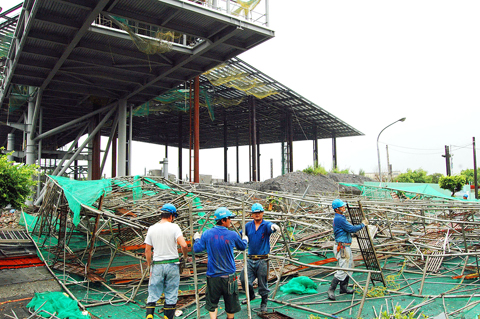
PHOTO: CNA
Electricity maintenance workers, meanwhile, had their hands full, as power was cut off to about 314,000 households nationwide. Power had been restored to 140,000 of those households by noon, and was expected to be restored to normal for the rest by today, according to Taiwan Power Company.
The bureau’s observation stations in Suao (蘇澳) in Yilan County and Hualien also reported gusts that reached Level 16 and Level 17 on the Beaufort scale, respectively.
According to the bureau’s definition, Level 16 refers to wind speed that falls between 184kph and 202kph, while Level 17 refers to wind speeds falling between 202kph and 220kph.
Memories are still raw over the onslaught of Typhoon Morakot in August last year, which left more than 700 people dead or missing in one of the nation’s worst natural disasters. President Ma Ying-jeou (馬英九) and his administration came under criticism following Morakot for reacting too late.
Authorities appeared determined to take a more proactive approach this time, as Ma paid visits to the Central Emergency Operation Center on Saturday night and early yesterday and held teleconferences with mayors and commissioners of the four cities and counties that were hardest-hit by Fanapi.
Although the eye of Fanapi left Taiwan and churned westward for China at about 6pm at a speed of 20kph, weather forecasters said its outer periphery was not expected to clear Taiwan until early today.
In southeastern China, authorities were on high alert after its meteorological center warned that Fanapi was expected to hit its coastal areas of Guangdong and Fujian provinces today.
Also See: CPC suspends price hikes amid typhoon
Also See: Yeangder cut to 54 holes by Fanapi

PROVOCATIVE: Chinese Deputy Ambassador to the UN Sun Lei accused Japan of sending military vessels to deliberately provoke tensions in the Taiwan Strait China denounced remarks by Japan and the EU about the South China Sea at a UN Security Council meeting on Monday, and accused Tokyo of provocative behavior in the Taiwan Strait and planning military expansion. Ayano Kunimitsu, a Japanese vice foreign minister, told the Council meeting on maritime security that Tokyo was seriously concerned about the situation in the East China and South China seas, and reiterated Japan’s opposition to any attempt to change the “status quo” by force, and obstruction of freedom of navigation and overflight. Stavros Lambrinidis, head of the EU delegation to the UN, also highlighted South China Sea

The final batch of 28 M1A2T Abrams tanks purchased from the US arrived at Taipei Port last night and were transported to the Armor Training Command in Hsinchu County’s Hukou Township (湖口), completing the military’s multi-year procurement of 108 of the tanks. Starting at 12:10am today, reporters observed more than a dozen civilian flatbed trailers departing from Taipei Port, each carrying an M1A2T tank covered with black waterproof tarps. Escorted by military vehicles, the convoy traveled via the West Coast Expressway to the Armor Training Command, with police implementing traffic control. The army operates about 1,000 tanks, including CM-11 Brave Tiger
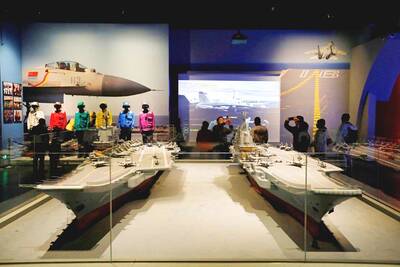
China on Wednesday teased in a video an aircraft carrier that could be its fourth, and the first using nuclear power, while making an allusion to Taiwan and vowing to further build up its islands, as it looks to boost maritime power, secure resources and bolster territorial claims. The video, issued on the eve of the 77th founding anniversary of the Chinese People’s Liberation Army Navy, featured fictional officers with names that are homophones of three commissioned aircraft carriers, the Liaoning (遼寧), Shandong (山東) and Fujian (福建). Titled Into the Deep, it showed a 19-year-old named “Hejian” (何劍) joining the group, sparking

Taiwan Semiconductor Manufacturing Co (TSMC, 台積電), the world’s largest contract chipmaker, said it expects its 2-nanometer (2nm) chip capacity to grow at a compound annual rate of 70 percent from this year to 2028. The projection comes as five fabs begin volume production of 2-nanometer chips this year — two in Hsinchu and three in Kaohsiung — TSMC senior vice president and deputy cochief operating officer Cliff Hou (侯永清) said at the company’s annual technology symposium in Silicon Valley, California, last week. Output in the first year of 2-nanometer production, which began in the fourth quarter of last year, is expected to


 RSS
RSS