


Taipei and Beijing will hold a preparatory meeting in Taipei tomorrow to iron out final differences on an economic cooperation framework agreement (ECFA) before top negotiators from both sides meet next week to sign the deal.
In a statement, the Straits Exchange Foundation (SEF) said Zheng Lizhong (鄭立中), executive deputy director of China’s Taiwan Affairs Office, and his delegation would arrive in Taipei today and hold talks with the foundation’s vice chairman, Kao Koong-liang (高孔廉), tomorrow. It did not say where the meeting would be held.
The statement said Kao and Zheng would conduct a final round of confirmations on the text of the accord and negotiations on the “early harvest” lists.
The early harvest lists refer to goods and services that will be subject to immediate tariff concessions or exemptions, which are expected to form the backbone of the proposed deal.
The two sides will also finalize an agreement on intellectual property rights (IPR) protection and the time and place of the meeting between Straits Exchange Foundation Chairman Chiang Pin-kung (江丙坤) and his Chinese counterpart, Association for Relations Across the Taiwan Strait (ARATS) Chairman Chen Yunling (陳雲林).
While unconfirmed reports say the Chiang-Chen meeting could take place in Chongqing, China, next Wednesday, Mainland Affairs Council (MAC) Deputy Minister Liu Te-shun (劉德勳) declined to confirm the location, but said it would be announced tomorrow.
However, he said the talks would not last as long as previous rounds because there would be no sightseeing involved.
As soon as the preparatory meeting concludes, Liu said the negotiation team would brief Legislative Speaker Wang Jin-pyng (王金平).
The foundation would also make Taiwan’s early harvest list public tomorrow, Liu said, but the content of the agreement would not be fully disclosed until after it is signed. Liu said most of the text of the ECFA was already public and that it would not set a timeframe for opening the Taiwanese market.
The legislature intends to call a provisional session to review the pact next month. Liu yesterday said both an ECFA and agreement on IPR protection would need legislative examination rather than mere ratification because they concern legal revisions of current laws.
Wu Mei-hung (吳美紅), director of the council’s Legal Affairs Department, said that if any proposed amendment pertaining to the accord failed to pass the legislature, that particular article in the IPR agreement would not be implemented.
She said the IPR accord would cover the cultural industry and plant varieties. The purpose is to establish a communication platform for both sides to jointly combat IPR violations.

The subsidiary of Taiwan Semiconductor Manufacturing Co (TSMC, 台積電) in Kumamoto, Japan, turned a profit in the first quarter of this year, marking the first time the first fab of the unit has become profitable since mass production started at the end of 2024. According to the contract chipmaker’s financial statement released on Friday, Japan Advanced Semiconductor Manufacturing Inc (JASM), a joint venture running the fab in Kumamoto, posted NT$951 million (US$30.19 million) in profit in the January-to-March period, compared with a loss of NT$1.39 billion in the previous quarter, and a loss of NT$3.25 billion in the first quarter of

DRONE CENTRAL: Taiwan aims to become Asia’s democratic hub for drones, with most exports focused on high-quality military-grade models, an official said Taiwan’s drone industry is expected to expand significantly by 2030, producing 100,000 units per month and exporting half of them, the Ministry of Economic Affairs said yesterday. Current drone production capacity is about 15,000 units per month, but the industry can quickly scale up as demand increases, Industrial Development Administration Director-General Chiou Chyou-huey (邱求慧) told a news conference in Taipei. Taiwan’s drone output grew 2.5-fold last year to NT$12.9 billion (US$408.3 million) under a government program to develop the uncrewed vehicle sector, he said. The Executive Yuan in October last year approved plans to invest NT$44.2 billion into domestic production of uncrewed aerial
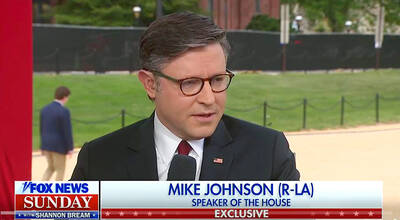
RESOLUTE BACKING: Two Republican senators are planning to introduce legislation that would impose immediate sanctions on China if it attempts to invade Taiwan US House of Representatives Speaker Mike Johnson on Sunday reaffirmed US congressional support for Taiwan, saying the US and “all freedom-loving people” have a stake in preventing China from seizing Taiwan by force. Johnson made the remarks in an interview with Fox News Sunday on US President Donald Trump’s summit with Chinese President Xi Jinping (習近平) last week. In an interview that aired on Friday on Fox News, just as Trump wrapped up a high-stakes visit to China, he said he has yet to green-light a new US$14 billion arms package to Taiwan and that it “depends on China.” “It’s a very good
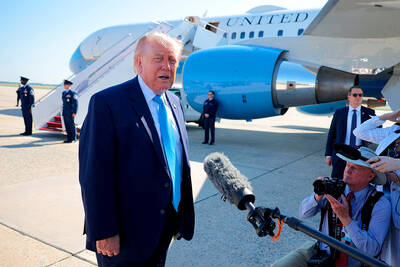
US President Donald Trump yesterday said he would speak to President William Lai (賴清德) as his administration considers whether to move ahead with a US$14 billion weapons sale to Taiwan — a potential arms deal that has drawn criticism from China. “Well, I’ll speak to him. I speak to everybody,” Trump told reporters yesterday when asked if he had any plans to call his counterpart, although he did not offer a time frame for when such a conversation could take place. Trump previously said he would speak to the person “that’s running Taiwan,” without specifying who he meant. “We have that situation very


 RSS
RSS