


The car bomb was a crude concoction of ordinary items — fireworks, fuel and fertilizer — that authorities suspect was meant to cause maximum mayhem in the heart of Times Square.
In the end, the device fizzled and the city and its residents counted themselves lucky once again: lucky that a vendor saw smoke creeping out of the car parked in one of the busiest streets in the US; lucky that authorities responded quickly; and lucky that the would-be terrorists were clumsy enough to assemble a bomb that wasn’t capable of exploding.
It was a close enough call, however, to fray nerves and set off a frenzied probe in what New York Police Department (NYPD) officials called the most serious car bomb plot in the city since the first attack on the World Trade Center in 1993.
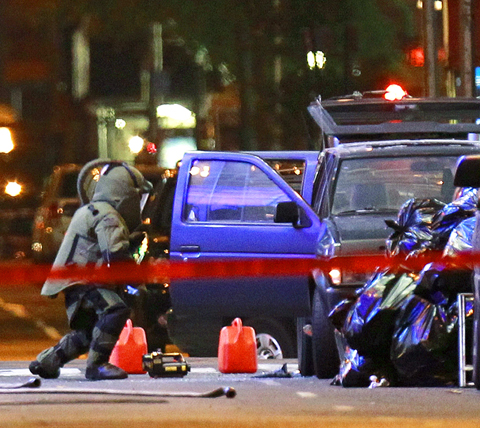
PHOTO: REUTERS
“Clearly it was the intent of whoever did this to cause mayhem, to create casualties,” Police Commissioner Raymond Kelly said.
The hunt was on Monday for a middle-aged man who was videotaped shedding his shirt near the sport utility vehicle where the bomb was found. They also wanted to talk to the owner of the 1993 Nissan Pathfinder.
The gasoline-and-propane bomb could have cut the sport utility vehicle in half, produced “a significant fireball” and sprayed shrapnel and metal parts with enough force to kill pedestrians and knock out windows on one of city’s busiest streets, full of Broadway theaters and restaurants on a Saturday night, Kelly said.
The Pakistani Taliban appeared to claim responsibility for an attempted car bombing in New York in three separate videos that surfaced after the weekend scare, monitoring groups said.
Kelly said police have no evidence to support the claims and noted that the same group had falsely taken credit for previous attacks on US soil.
The New York surveillance video, made public late on Sunday, shows an unidentified white man apparently in his 40s slipping down an alley and taking off his shirt, revealing another underneath. In the same clip, he’s seen looking back in the direction of the smoking vehicle and furtively putting the first shirt in a bag. Police hoped to interview the tourist who took the video.
The NYPD and FBI also were examining “hundreds of hours” of security videotape from around Times Square, Kelly said.
Police had already identified the registered owner of the dark-colored Pathfinder and were looking to interview him. The vehicle didn’t have an easily visible vehicle identification number and had license plates that came from a car found in a repair shop in Connecticut.
Police released a photograph of the SUV as it crossed an intersection at 6:28pm on Saturday. A vendor pointed the SUV out to an officer about two minutes later.
The explosive device in the SUV had cheap-looking alarm clocks connected to a 45g can filled with fireworks, which were apparently intended to detonate the gas cans and set the propane afire in a chain reaction, Kelly said.
Investigators had feared that a final component placed in the cargo area — a metal rifle cabinet packed a fertilizer-like substance and rigged with wires and more fireworks — could have made the device even more devastating.
Test results late on Sunday showed it was indeed fertilizer, but NYPD bomb experts believe it was not a type volatile enough to explode like the ammonium nitrate grade fertilizer used in previous terror attacks, said police spokesman Paul Browne.

‘CROSSING THE LINE’: China’s embassy in Seoul criticized US Forces Korea Commander General Xavier Brunson, asking if his ‘hostile’ remarks were authorized by Washington South Korea and the US are in talks over recent public remarks by the commander of US Forces Korea, Seoul’s presidential office said yesterday, after the comments drew sharp criticism from China. In a recent podcast interview, US Forces Korea Commander General Xavier Brunson described South Korea as “the dagger in the heart of Asia” from China’s east coast, prompting the Chinese embassy in Seoul to say that he had “truly crossed the line.” The interview came amid growing speculation that Washington might seek to expand the role of US Forces Korea in countering the growing regional influence of China, a key

Through the noise of rushing papers and whirring belts at a print factory in Kyoto, two creators watch their photo essay come to life in broadsheet form — part of an effort to win new audiences in the age of artificial intelligence (AI). Despite the decline of the publishing industry, self-publication and handmade “zine” magazines are growing in popularity in Japan, reflecting the nation’s enduring love of paper in the digital era. While speaking to Agence France-Presse at the plant, his hands black with ink, one of the creators, Kazuma Obara, said: “I think [paper] is a medium that engages all five

Australian researchers have trained lab-grown brain cells on a silicon computer chip to play the 1990s shooter game Doom and said they are just scratching the surface of what the neurons could be capable of doing. It is the science-fiction work of biotech boffins at Cortical Labs, who researched and developed the technology that harnesses the workings of the brain’s networking system. Each so-called “biological computer” contains about 200,000 living human brain cells, grown from stem cells that were harvested from blood donations. Having mastered the simple computer game Pong, where a paddle is moved up and down to send a ball

France experienced its hottest spring on record, the French weather service said on Tuesday, after an exceptional early heat wave that also broke highs for the season in England and Wales. Meteo-France said the average nationwide temperature over March to May was 13.8°C — about 1.7°C above the norm, and surpassing records set in 2011 and 2020. “The warmest spring since records began in 1900,” it said in a bulletin. All three months were warmer than average, but the onset of an “unprecedented heatwave” late last month pushed the mercury to highs typically seen at the height of the summer. “Our country had never


 RSS
RSS