


The US Coast Guard now fears the underwater oil well spewing crude into the Gulf of Mexico could become an unchecked gusher shooting millions of liters of oil per day, the Mobile Press-Register reported yesterday, as the oil spill reached precious shoreline habitats and documents emerged showing British Petroleum (BP) downplayed the possibility of a catastrophic accident at the offshore rig that exploded.
Citing a confidential National Oceanic and Atmospheric Administration report on the unfolding spill disaster, the Alabama newspaper said two additional release points had been found in the tangled riser.
“If the riser pipe deteriorates further, the flow could become unchecked resulting in a release volume an order of magnitude higher than previously thought,” the paper quotes the report as saying.
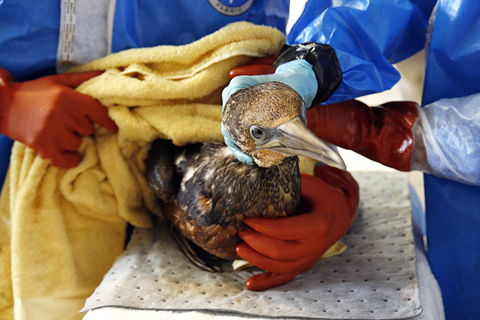
PHOTO: EPA
In this case, it would mean the volume of oil coming from the well could be 10 times higher than the 5,000 barrels a day coming out now, the Press-Register concluded.
That would mean 50,000 barrels, or 7.9 million liters, a day.
The region threatened by the looming oil spill is a prime spawning ground for fish, shrimp and crabs, home to oyster beds and a major stop for migratory birds.
“For birds, the timing could not be worse; they are breeding, nesting and especially vulnerable in many of the places where the oil could come ashore,” said Melanie Driscoll of the Audubon Society, a nature conservancy group.
The first known wildlife casualty of the massive oil spill threatening the US Gulf Coast was a single Northern Gannet seabird, found alive, but coated in the toxic grime creeping ashore along Louisiana’s coast.
That bird, recovered offshore on Friday and taken to an emergency rehabilitation center to be cleaned up and nursed back to health, is only the tip of a potential calamity facing the region’s birds, sea turtles and marine mammals.
Besides the rescued Gannet, several sperm whales have been seen swimming in and around the oil slick.
“We are expecting many more [casualties] in the days to come. We hope that number is not catastrophic. We’re ... hoping for the best but planning for the worst,” said Michael Ziccardi, a veterinarian overseeing some of the wildlife rescue teams in the region, in a telephone interview from Houma, Louisiana.
Meanwhile, documents emerged showing that BP suggested last year in an exploration plan and environmental impact analysis for the well that an accident leading to a giant crude oil spill — and serious damage to beaches, fish and mammals — was unlikely, or virtually impossible.
The Coast Guard estimates now that at least 6 million liters of oil have spilled since the April 20 explosion that killed 11 workers. The amount already threatens to make it the worst US oil disaster since the Exxon Valdez spilled 42 million liters of oil off Alaska’s shores in 1989.
“The sort of occurrence that we’ve seen on the Deepwater Horizon is clearly unprecedented,” BP spokesman David Nicholas said on Friday. “It’s something that we have not experienced before ... a blowout at this depth.”
The plan for the Deepwater Horizon well, filed with the federal Minerals Management Service, said repeatedly that it was “unlikely that an accidental surface or subsurface oil spill would occur from the proposed activities.”
The company conceded a spill would impact beaches, wildlife refuges and wilderness areas, but argued that “due to the distance to shore [77km] and the response capabilities that would be implemented, no significant adverse impacts are expected.”
Robert Wiygul, an Ocean Springs, Mississippi-based environmental lawyer and board member for the Gulf Restoration Network, said he doesn’t see anything in the document suggesting BP addressed the kind of technology needed to control a spill at that depth of water.
“The point is, if you’re going to be drilling in 5,000 feet [1,500m] of water for oil, you should have the ability to control what you’re doing,” he said.
The company has as yet failed to contain the spill.
British energy giant BP said it is “taking full responsibility” for the Gulf of Mexico oil spill and will pay for “legitimate claims” stemming from the disaster.
“It was not our accident, but it is our responsibility to clean it up,” BP chief executive Tony Hayward told the Financial Times. “Where people have legitimate claims for damages, we will absolutely honor them.”
The Pentagon meanwhile authorized the deployment of the Louisiana National Guard, some 6,000 troops, to respond to the crisis.
US President Barack Obama said some 1,900 federal response personnel were in the area with 300 boats and aircraft and the southern states of Alabama and Mississippi yesterday declared a state of emergency because of the imminent threat of the oil slick.

‘NO SECURITY RISK’: The Railway Bureau reassured the public that the technicians’ activities were limited to technical guidance and did not involve sensitive systems The Railway Bureau yesterday said it had invited eight Chinese technicians to assist with an airport MRT construction project. The bureau issued the confirmation after an Internet user said Chinese nationals had entered the construction zone of Taiwan Taoyuan International Airport’s Terminal 3 project. They asked why “individuals from an enemy state” were allowed access to such a major national infrastructure project, which raised serious concerns over Taiwan’s industrial safety, sensitive systems and information security. The bureau’s Northern Region Engineering Branch Office said subcontractor Taiwan Handle Industrial Co (台灣手把工業) of the Taoyuan airport MRT’s “Contract No. CU05 Project A14 Station Civil, MEP &

A US uncrewed surface vessel (USV) encountered multiple Chinese warships during an autonomous transit of the Taiwan Strait, US defense company Seasats said in a statement on Wednesday. Seasats announced that a Lightfish USV had completed the first autonomous transit of the Taiwan Strait. Over five days, the USV traversed the entire length of the Strait while constantly monitoring surface vessel traffic, the company said. The Lightfish encountered multiple Chinese warships, one of which was a Chinese People’s Liberation Army Navy (PLAN) Type 056 corvette, it said. The Chinese vessels were operating “well within Taiwan’s exclusive economic zone without transmitting their identity via the

‘BOOMING’: ’ The number of partners we have here is incredible. You can see from their stock prices. They’re doing so well, they’re so happy,’ Jensen Huang said Nvidia Corp’s spending in Taiwan has ballooned to about US$150 billion a year, 10 times the US$10 billion to US$15 billion the company spent five years ago, Nvidia chief executive officer Jensen Huang (黃仁勳) said yesterday, suggesting Taiwan’s strategic importance in the global artificial intelligence (AI) supply chain. “Taiwan is the epicenter of the AI revolution. This is where the chips come, packaging comes. This is where the systems are made. This is where AI supercomputers were created,” Huang said at a meeting for the company’s employees in Beitou-Shilin Technology Park (北投士林科技園區) in Taipei, the planned site of Nvidia’s Taipei headquarters. “Taiwan
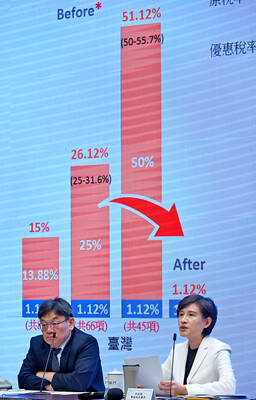
GREATER REACH? Auto parts and wood products would face tariffs of up to 15%, matching those targeting the EU, Japan and South Korea, Vice Premier said The US has announced that preferential tariff treatment for Taiwan’s non-semiconductor Section 232 goods would take effect retroactively from May 1, the Executive Yuan said yesterday. The US government yesterday posted a notice on the Federal Register’s public inspection Web site previewing tariff concessions for Taiwan under a memorandum of understanding (MOU) on Taiwan-US investment after two months of negotiations. The MOU signed on Jan. 15 stipulated three major preferential tariff arrangements: a 15 percent “reciprocal” tariff rate for Taiwan without stacking most-favored nation (MFN) rates; preferential Section 232 treatment for semiconductors and related products; and preferential Section 232 treatment for non-semiconductor


 RSS
RSS