


As China showed off its new J-10 fighter planes this week, Taiwan supporters in the US Congress began pressing the White House once again to sell advanced F-16s to Taipei.
Texas Republican Representative Kay Granger inserted “remarks” into the Congressional Record urging US President Barack Obama to “immediately move ahead with the sale of F-16s to Taiwan.”
And Oklahoma Republican Senator James Inhofe was preparing to introduce a new resolution in the US Senate supporting F-16 sales to Taiwan.
Granger, whose district is home to the Lockheed Martin plant where the F-16s are built, said: “One of the main reasons to move now is that the production of the F-16s is nearing its end as more countries are switching to the advanced F-35 Joint Strike Fighter.”
If Obama agrees to sell the requested 66 advanced F-16C/Ds to Taiwan, it will save about 1,400 Texan jobs.
The potential sale was the subject of new interest among US military circles following an event in Tianjin, China, on Tuesday when the media and more than 50 military attaches from embassies in Beijing were invited to a 15-minute demonstration of the domestically developed J-10.
It was the first time that a foreign audience had been shown the plane — also known as Annihilator 10 — in action.
Four jets from the 24th Fighter Division of the Chinese Air Force flew impressive aerial acrobatics in diamond formation with their wingtips less than 5m apart during multiple rolls and spins.
The London Times said that the J-10 is believed to be “loosely based on the early-generation F-16.”
“Israel helped at the start with aspects of avionics and aerodynamics until it was warned off by Washington,” it said.
If the US does sell advanced F-16s to Taiwan, they would face J-10s in the case of a military conflict with China.
The International Assessment and Strategy Center (IASC) said China is selling the J-10 to Pakistan and other countries for about US$40 million each — roughly half the cost of an F-16.
Richard Fisher, a military expert with the IASC in Washington, has published a paper entitled The Air Balance on the Taiwan Strait in which he says that even if the F-16 sale to Taiwan is approved, “its deterrent effect may be temporary.”
By the time the F-16s were delivered, the People’s Liberation Army Air Force may have about 150 J-10s in service and a more capable variant called the J-10B in development, he said.
“Soon the J-10 could have a capability approaching that of the advanced F-16s Taiwan now is seeking,” Fisher wrote.
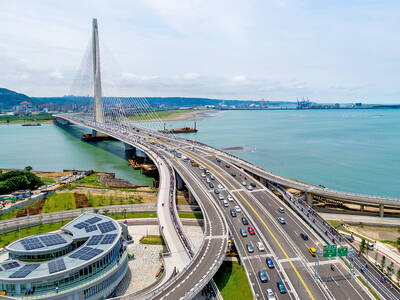
The Ministry of Transportation and Communications yesterday inaugurated the Danjiang Bridge across the Tamsui River in New Taipei City, saying that the structure would be an architectural icon and traffic artery for Taiwan. Feted as a major engineering achievement, the Danjiang Bridge is 920m long, 211m tall at the top of its pylon, and is the longest single-pylon asymmetric cable-stayed bridge in the world, the government’s Web site for the structure said. It was designed by late Iraqi-British architect Zaha Hadid. The structure, with a maximum deck of 70m, accommodates road and light rail traffic, and affords a 200m navigation channel for boats,
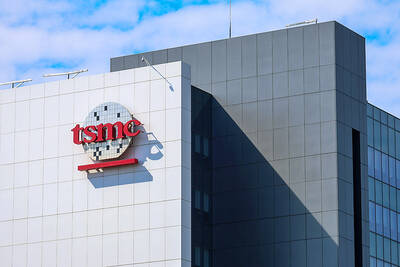
Taiwan Semiconductor Manufacturing Co (TSMC, 台積電), the world’s largest foundry service provider, yesterday said that global semiconductor revenue is projected to hit US$1.5 trillion in 2030, after the figure exceeds US$1 trillion this year, as artificial intelligence (AI) demand boosts consumption of token and compute power. “We are still at the beginning of the AI revolution, but we already see a significant impact across the whole semiconductor ecosystem,” TSMC deputy cochief operating officer Kevin Zhang (張曉強) said at the company’s annual technology symposium in Hsinchu City. “It is fair to say that in the past decade, smartphones and other mobile devices were
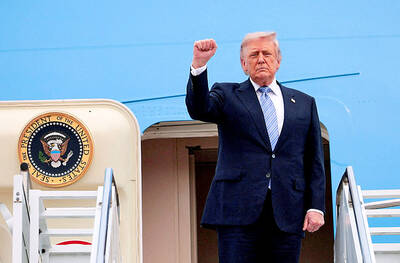
US-CHINA SUMMIT: MOFA welcomed US reassurance of no change in its Taiwan policy; Trump said he did not comment when Xi talked of opposing independence US President Donald Trump yesterday said he has not made a decision on whether to move forward with a major arms package for Taiwan after hearing concerns about it from Chinese President Xi Jinping (習近平). Trump’s comments on Taiwan came as he flew back to Washington after wrapping up critical talks in which both leaders said important progress was made in stabilizing US-China relations even as deep differences persist between the world’s two biggest powers on Iran and Taiwan. “I will make a determination,” Trump said, adding: “I’ll be making decisions. But, you know, I think the last thing we need right
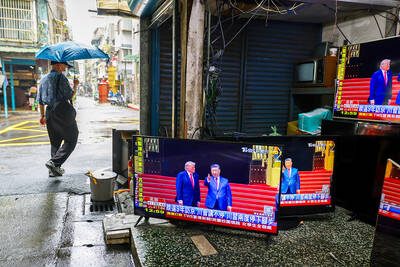
TAIWAN ISSUE: US treasury secretary Scott Bessent said on the first day of meetings that ‘it wouldn’t be a US-China summit without the Taiwan issue coming up’ There were no surprises on the first day of the summit between US President Donald Trump and Chinese President Xi Jinping (習近平), the Mainland Affairs Council (MAC) said yesterday, as the government reiterated that cross-strait stability is crucial to the Asia-Pacific region, as well as the world. As the two presidents met for a highly anticipated summit yesterday, Chinese state media reported that Xi warned Trump that missteps regarding Taiwan could push their two countries into “conflict.” Trump arrived in China with accolades for his host, calling Xi a “great leader” and “friend,” and extending an invitation to visit the White House


 RSS
RSS