


China intensified its clampdown on local and foreign media last year, with reporters facing violence, censorship and arbitrary detention, a report by an international press watchdog said.
Beijing also closed down social networking sites and moved to restrict online news under numerous regulations introduced last year by local censors to control what the media says, the International Federation of Journalists (IFJ) said.
“Banned topics range from events associated with social unrest and public protests against authorities to reports of photos of an actress topless on a Caribbean beach,” the Brussels-based group said.
Signs that China was loosening controls on the media in the run-up to the 2008 Olympics had faded by early last year, according to the report titled China Clings to Control: Press Freedom in 2009 released in Hong Kong on Sunday.
“Authorities sought to re-exert control on the media and information, focusing in particular on the rising power of the Internet as a means for social expression and organizing,” the IFJ said.
The report was issued against the backdrop of a row over US Internet giant Google, which has said it would no longer bow to Chinese censorship and threatened to halt its operations in China in protest over cyber attacks.
“We ... call on the international community to take a principled stand to oppose all forms of restrictions on the rights of journalists to do their work in China,” IFJ general secretary Aiden White said.
These include a “steady stream of official bans, as well as new rules in 2009 which make it virtually impossible for local journalists who work in traditional or online media to receive the accreditation they need in order to conduct their profession,” he said.
The report highlighted a catalogue of restrictions that impeded the work of the media in the world’s most populous nation. They included banning journalists from going to Sichuan Province to report on the massive 2008 earthquake and telling the media to only use Xinhua news agency reports on the tainted milk scandal and US President Barack Obama’s first official visit to China in November.
China also banned reporting on photos of Crouching Tiger, Hidden Dragon actress Zhang Ziyi (章子怡) topless on a Caribbean beach and prohibited entertainment programs from covering celebrity love affairs or scandals, it said.
In the lead-up to National Day on Oct. 1, more than 10 orders were issued to prohibit the media from reporting at Tiananmen Square and other public venues, the report said.
Incidents of violence against foreign media declined last year, which the IFJ attributed to their reduced presence in China after the Olympics.
“Even so, foreign journalists still encountered many obstacles and difficulties through 2009, including acts of violence, destruction of work materials and equipment, prevention of access to public spaces,surveillance and reprimands,” the report said.
Authorities targeted journalists’ sources, assistants and drivers “to obstruct foreign media reporting on events in China.”
Local journalists were forced into self-censorship over concerns they might lose their accreditation, the report said, adding that the “biggest taboo” for Chinese media was the 20th anniversary of the Tiananmen Square massacre.
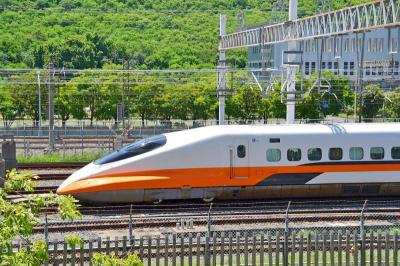
A signaling system malfunction disrupted high-speed rail (HSR) services beginning at 8am today, with trains temporarily reduced to three northbound and three southbound trains per hour as authorities conduct inspections. The malfunction occurred on a section of track in Miaoli County during pre-operation checks early this morning, forcing northbound and southbound trains to use a single track, the HSR operator said. The regular schedule has been replaced with three hourly trains offering only nonreserved seating in each direction, stopping at every station, it said, adding that business class cars would still have reserved seating. Departures from terminal stations are scheduled at the top

‘NO SECURITY RISK’: The Railway Bureau reassured the public that the technicians’ activities were limited to technical guidance and did not involve sensitive systems The Railway Bureau yesterday said it had invited eight Chinese technicians to assist with an airport MRT construction project. The bureau issued the confirmation after an Internet user said Chinese nationals had entered the construction zone of Taiwan Taoyuan International Airport’s Terminal 3 project. They asked why “individuals from an enemy state” were allowed access to such a major national infrastructure project, which raised serious concerns over Taiwan’s industrial safety, sensitive systems and information security. The bureau’s Northern Region Engineering Branch Office said subcontractor Taiwan Handle Industrial Co (台灣手把工業) of the Taoyuan airport MRT’s “Contract No. CU05 Project A14 Station Civil, MEP &

Taiwan is still in the process of assessing the possibility of recruiting workers from Eswatini, the Ministry of Foreign Affairs said yesterday, adding that its goal is to help Eswatini upgrade its vocational training centers. If there are plans to recruit workers from Eswatini, safeguarding national security, protecting public health and ensuring the employment rights of Taiwanese would be prerequisites, Department of West Asian and African Affairs Director-General Yen Chia-liang (顏嘉良) told a news conference. Key considerations would also include filling labor shortages in specific industries, and fostering bilateral professional and technical exchanges, he said. Yen was asked about the progress of labor

A US uncrewed surface vessel (USV) encountered multiple Chinese warships during an autonomous transit of the Taiwan Strait, US defense company Seasats said in a statement on Wednesday. Seasats announced that a Lightfish USV had completed the first autonomous transit of the Taiwan Strait. Over five days, the USV traversed the entire length of the Strait while constantly monitoring surface vessel traffic, the company said. The Lightfish encountered multiple Chinese warships, one of which was a Chinese People’s Liberation Army Navy (PLAN) Type 056 corvette, it said. The Chinese vessels were operating “well within Taiwan’s exclusive economic zone without transmitting their identity via the


 RSS
RSS