


President Ma Ying-jeou (馬英九) brought relief supplies to the Dominican Republic for delivery to Haiti and proposed a long-term reconstruction project to help the country’s earthquake-ravaged ally get back on its feet, hoping to inspire more countries to follow suit.
Ma, who arrived in the Dominican Republic on Thursday morning, delivered 10 tonnes of relief supplies. They were to be transported by land from the Dominican Republic to Haiti.
During his whirlwind visit, Ma held a joint meeting with Dominican President Leonel Fernandez Reyna and Haitian Prime Minister Jean-Max Bellerive at the presidential building.
The trio did not touch on the issue of debt reduction or cancellation for Haiti, Presidential Office Spokesman Wang Yu-chi (王郁琦) said.
The Paris Club, the UK and, most recently, Canada have openly called for two of Haiti’s biggest creditors — Taiwan and Venezuela — to pardon the debt the Caribbean nation owes. Haiti reportedly owes Taiwan US$91 million.
Canadian Finance Minister Jim Flaherty said international lenders should expunge the debt so as not to encumber Haiti in its reconstruction effort.
Wang said they estimated the reconstruction project Ma proposed would cost US$10 million for the first year, including the US$5 million cash donation Taiwan has pledged.
Ma has said the relocation and reconstruction project may take five to 10 years or even longer, Wang said, adding that it was a long process and the administration would implement the projects as planned or adjust them according to the needs of the Haitian people.
“This is a pilot project,” Wang said. “We hope our efforts will encourage more countries to follow suit.”
Wang said Fernandez invited Ma to attend a world leaders’ meeting he has called for April 14 to discuss how to assist Haiti in its reconstruction projects, at which Ma said a representative from Taiwan would be present, but did not commit himself to attend.
Wang said the reconstruction project Ma had proposed would consist of four parts.
The first focus would be public hygiene and medical assistance, Wang said. Taiwan would send medical personnel to help Haiti prevent the spread of diseases. It would also dispatch medical teams to set up checkup points to provide medical services.
The second focus would be tents and prefabricated housing, he said. As the rescue operation draws to an end, Wang said relocation and reconstruction projects would then begin.
Ma said he hoped the Haitian government would find a suitable area with water and electricity to set up tents for refugees before moving them into prefabricated housing units.
Although the number of tents and prefabricated housing units Taiwan will send was unknown at the moment, Wang said Ma proposed that Taiwan fund the establishment of the settlement and name it “Village of Hope.”
Wang said that initially the administration hoped to provide 200 units for 1,000 people, but did not rule out increasing the number to 1,000 units for 5,000 people.
The third focus would be vocational training and employment assistance services for people staying in the village, including farming and factory skills, Wang said.
The Ma administration could ask for help from local agricultural missions or send experts to help them grow rice and chicken, Wang said. If factories are to be set up on the island of Hispaniola, which Haiti and the Dominican Republic share, Wang said the Ma administration hoped they would be built in Haiti, and if they are built in the Dominican Republic, Ma hopes a certain percentage of Haitian workers will be hired.
ADOPTION PROGRAM
Because thousands of children lost their parents in the earthquake, Wang said Ma also proposed an adoption program in which Taiwan’s government could work together with private institutions. Taiwan has adopted nearly 200,000 orphans from around the world, an outstanding record, Wang said.
Ma also met Consul to Haiti Chi Wang-teh (齊王德) at the airport before he and the delegation left for Los Angeles on Thursday. He telephoned Ambassador to Haiti Hsu Mien-sheng (徐勉生), who has been transferred to a hospital in Miami, Florida. Chi and Hsu were sent to Santo Domingo to receive medical attention after being pulled out of debris in Haiti’s capital, Port-au-Prince. They had been trapped for six hours before rescuers found them.
Ma was to leave Los Angeles for Taiwan yesterday morning and is due back in Taipei today.
CONCERN
Meanwhile, in Taipei, lawmakers yesterday voiced concern that Taiwan was being ripped off following reports that Panama’s president used a plane provided by Taipei for rescue missions as his private jet.
Local media have reported that Panamanian President Martin Torrijos took the Legacy 600 for personal use, while Taipei-based TVBS news said he flew it to Honduras for the inauguration of President Porfirio Lobo Sosa this week.
“We have to review our foreign aid policy so that we are not treated as a rich fool,” Chinese Nationalist Party (KMT) Legislator Lo Shu-lei (羅淑蕾) said.
Democratic Progressive Party Legislator Chen Ting-fei (陳亭妃) demanded that the Ma government explain whether it was engaging in “dollar diplomacy” with Panama.
The TVBS said Ma raised the issue during a meeting in Honduras with Torrijos, who replied that the jet had been used on relief missions including to quake-hit Haiti.
ADDITIONAL REPORTING BY AFP
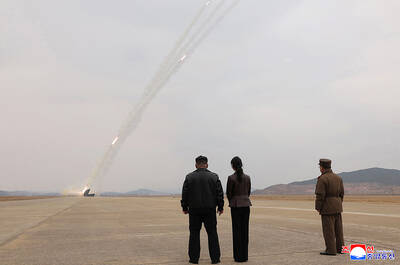
North Korea tested nuclear-capable rocket launchers, state media reported yesterday, a day after Seoul detected the launch of about 10 ballistic missiles. The test comes after South Korean and US forces launched their springtime military drills, due to run until Thursday. North Korean leader Kim Jong-un on Saturday oversaw the testing of the multiple rocket launcher system (MRLS), the Korean Central News Agency (KCNA) said. The test involved 12 600mm-caliber ultra-precision multiple rocket launchers and two artillery companies, it said. Kim said the drill gave Pyongyang’s enemies, within the 420km striking range, a sense of “uneasiness” and “a deep understanding
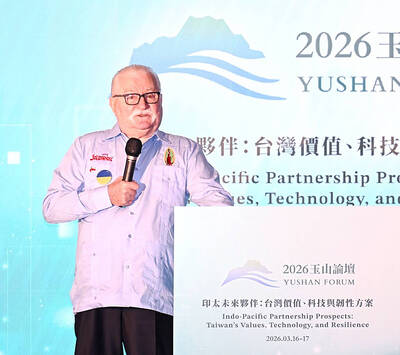
RECOGNITION: Former Fijian prime minister Mahendra Chaudhry said that Taiwan’s New Southbound Policy serves as a stabilizing force in the Indo-Pacific region Taiwan can lead the unification of the Chinese people, Nobel Peace Prize laureate and former Polish president Lech Walesa said in Taipei yesterday, adding that as the world order is changing, peaceful discussion would find good solutions, and that the use of force and coercion would always fail. Walesa made the remarks during his keynote address at a luncheon of the Yushan Forum in Taipei, titled “Indo-Pacific Partnership Prospects: Taiwan’s Values, Technology and Resilience,” organized by the Taiwan-Asia Exchange Foundation with the Ministry of Foreign Affairs. Walesa said that he had been at the forefront of a big peaceful revolution and “if

North Korea yesterday fired about 10 ballistic missiles to the sea toward Japan, the South Korean Joint Chiefs of Staff (JCS) said, days after Pyongyang warned of “terrible consequences” over ongoing South Korea-US military drills. Pyongyang recently dashed hopes of a diplomatic thaw with Seoul, Washington’s security ally, describing its latest peace efforts as a “clumsy, deceptive farce.” Seoul’s military detected “around 10 ballistic missiles launched from the Sunan area in North Korea toward the East Sea [Sea of Japan] at around 1:20pm,” JCS said in a statement, referring to South Korea’s name for the body of water. The missiles

‘UNWAVERING FRIENDSHIP’: A representative of a Japanese group that co-organized a memorial, said he hopes Japanese never forget Taiwan’s kindness President William Lai (賴清德) yesterday marked the 15th anniversary of the Tohoku earthquake and tsunami, urging continued cooperation between Taiwan and Japan on disaster prevention and humanitarian assistance. Lai wrote on social media that Taiwan and Japan have always helped each other in the aftermath of major disasters. The magnitude 9 earthquake struck northeastern Japan on March 11, 2011, triggering a massive tsunami that claimed more than 19,000 lives, according to data from Japanese authorities. Following the disaster, Taiwan donated more than US$240 million in aid, making it one of the largest contributors of financial assistance to Japan. In addition to cash donations and


 RSS
RSS