


China has sentenced a respected Tibetan lama to eight-and-a-half years in jail for illegal land occupation and ammunition possession, possibly the first senior Buddhist leader tried on serious charges linked to riots in 2008 in the Tibetan capital, a lawyer said on Thursday.
A court in Sichuan Province, bordering Tibet, convicted Phurbu Tsering Rinpoche, who headed a convent in Ganzi, a predominantly Tibetan prefecture in the province, Beijing-based attorney Jiang Tianyong (江天勇) said.
Phurbu Tsering Rinpoche is a Buddhist priest, or lama, and is highly respected. He was arrested on May 18, 2008, just days after more than 80 nuns in Ganzi held a demonstration against an official campaign to impose “patriotic re-education” on their convents, in which they were required to denounce Tibet’s spiritual leader, the Dalai Lama.
The International Campaign for Tibet, an activist group, has described Phurbu Tsering Rinpoche as a “deeply respected local figure known for his work in the community” — including the building of a center for the aged and two clinics in Ganzi prefecture — whose detention aroused deep resentment among local Tibetans.
The sentence was handed down on Dec. 23, eight months after the monk first went on trial in April, after authorities said they found a pistol and more than 100 bullets under a bed in his living room.
His lawyers said he was forced into making a confession following a four-day police interrogation and threats to detain his family.
The 53-year-old monk had faced up to 15 years in jail.
Jiang, one of two attorneys who advised the monk from early in the case, said he had pleaded not guilty to the charges. The court did not allow Jiang and Li Fangping (李方平), another well-known activist lawyer, to represent the monk in later trial sessions, Jiang said.
“We don’t believe there was sufficient evidence to convict him on either of the charges,” Jiang said.
Phurbu Tsering Rinpoche was sentenced to more than seven years in jail on the charge of illegal expropriation of land, which was related to the center for the aged he set up. The monk says the land was given to him lawfully.
The court sentenced him to another one-and-a-half years for possession of ammunition.
Jiang said that the lawyers and the monk’s family believed he should appeal for a lighter sentence.
“We don’t know if he will appeal. I think he has lost confidence in China’s courts since this case,” Jiang said.
A rugged, deeply Buddhist region filled with monasteries and nunneries, Ganzi is known for its strong Tibetan identity and has been at the center of dissent for years. It saw some of the most violent protests in spring 2008.
Rioting that broke out in Lhasa on March 14, 2008, led to the most sustained Tibetan uprising against Chinese rule in decades. The violence in the capital killed 22 people, according to Chinese officials.
Beijing says the demonstrations were part of a violent campaign organized by the Dalai Lama and his supporters to throw off Chinese rule in Tibet and sabotage the Beijing Olympics in August 2008.
The Dalai Lama has denied the charge and says he seeks only significant autonomy for Tibet under continued Chinese rule.

‘NO SECURITY RISK’: The Railway Bureau reassured the public that the technicians’ activities were limited to technical guidance and did not involve sensitive systems The Railway Bureau yesterday said it had invited eight Chinese technicians to assist with an airport MRT construction project. The bureau issued the confirmation after an Internet user said Chinese nationals had entered the construction zone of Taiwan Taoyuan International Airport’s Terminal 3 project. They asked why “individuals from an enemy state” were allowed access to such a major national infrastructure project, which raised serious concerns over Taiwan’s industrial safety, sensitive systems and information security. The bureau’s Northern Region Engineering Branch Office said subcontractor Taiwan Handle Industrial Co (台灣手把工業) of the Taoyuan airport MRT’s “Contract No. CU05 Project A14 Station Civil, MEP &

A US uncrewed surface vessel (USV) encountered multiple Chinese warships during an autonomous transit of the Taiwan Strait, US defense company Seasats said in a statement on Wednesday. Seasats announced that a Lightfish USV had completed the first autonomous transit of the Taiwan Strait. Over five days, the USV traversed the entire length of the Strait while constantly monitoring surface vessel traffic, the company said. The Lightfish encountered multiple Chinese warships, one of which was a Chinese People’s Liberation Army Navy (PLAN) Type 056 corvette, it said. The Chinese vessels were operating “well within Taiwan’s exclusive economic zone without transmitting their identity via the
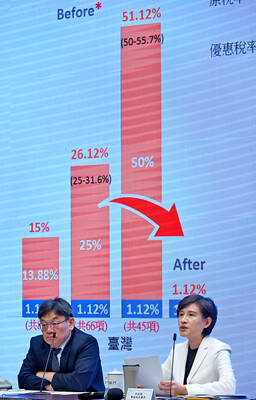
GREATER REACH? Auto parts and wood products would face tariffs of up to 15%, matching those targeting the EU, Japan and South Korea, Vice Premier said The US has announced that preferential tariff treatment for Taiwan’s non-semiconductor Section 232 goods would take effect retroactively from May 1, the Executive Yuan said yesterday. The US government yesterday posted a notice on the Federal Register’s public inspection Web site previewing tariff concessions for Taiwan under a memorandum of understanding (MOU) on Taiwan-US investment after two months of negotiations. The MOU signed on Jan. 15 stipulated three major preferential tariff arrangements: a 15 percent “reciprocal” tariff rate for Taiwan without stacking most-favored nation (MFN) rates; preferential Section 232 treatment for semiconductors and related products; and preferential Section 232 treatment for non-semiconductor

TIT-FOR-TAT: The US allegedly revoked the visa of a Chinese national working at Xinhua News Agency in the US in response to Beijing’s expulsion of Vivian Wang The Presidential Office yesterday condemned China for expelling a New York Times correspondent from Beijing following the newspaper’s interview with President William Lai (賴清德), saying the move highlighted Beijing’s suppression of press freedom and its threat to international news media. Taiwan has noted a series of recent incidents in which Beijing used similar tactics to “threaten and pressure international media outlets and journalists,” Presidential Office spokeswoman Karen Kuo (郭雅慧) said in a statement. “This concerns not only press freedom and freedom of expression, but also the safety of journalists, and Taiwan and relevant partners are paying close attention to the situation,” she


 RSS
RSS