


Yemen confirmed yesterday that Umar Farouk Abdulmutallab, who has been charged with trying to blow up a US-bound airliner, was still in the country earlier this month, after the local al-Qaeda branch claimed the attempted bombing.
“He stayed in Yemen between the beginning of August and the beginning of December, after having received a visa to study Arabic at an institute in Sanaa where he had previously studied,” a Yemeni Foreign Ministry spokesman said in a statement carried by the official Saba news agency.
The spokesman did not provide details on Abdulmutallab’s previous stay in Yemen, saying only that the government gave him a visa after security officials were “reassured that he had been granted visas by friendly countries, and still held a valid visa to the US, where he had visited before.”
Students at the Institute of Languages in Sanaa’s old city said Abdulmutallab studied at the school and lived in student housing. He was in Yemen between August and early this month, they said.
“He was normal and mixed with women and dealt with all people normally,” an American student said, asking not to be identified.
Abdulmutallab, 23, is a Nigerian Muslim and the son of a wealthy banker.
US security officials have saidthat he is suspected of receiving training from al-Qaeda. But the US government has been cautious about linking the failed attack to Osama bin Laden’s network.
Abdulmutallab’s family has said he traveled to Yemen, where he cut ties with them.
The Yemeni spokesman said that security agencies are investigating “the parties with whom the accused Nigerian was in contact during his time in Yemen.”
He said the results will be “sent to US agencies investigating the attempted attack, within the framework of US-Yemeni cooperation on security and fighting terrorism.”
The spokesman condemned the attack, and said his country, “which has suffered much from terrorism,” remains “an active partner in the international community in the war against terrorism.”
“The Yemeni security services continue to track and carry out operations against the terrorists of Al-Qaeda,” he said.
Al-Qaeda in the Arabian Peninsula, which is active in Yemen and Saudi Arabia, said in an Internet posting on Monday that it masterminded the attempted bombing. It said the attack was in response to “unjust American aggression” on the Arabian Peninsula.
The group said a “technical fault” caused the plot’s failure, US monitoring group SITE Intelligence said. The statement was accompanied by a picture of Abdulmutallab, who was described as the “Nigerian brother,” and boasted he “was able to breach all the modern and sophisticated technologies and checkpoints at the airports around the world,” said IntelCenter, another US monitoring group.
“His act has dealt a huge blow to the myth of American and global intelligence services and showed how fragile its structure is,” the statement said.

PARLIAMENT CHAOS: Police forcibly removed Brazilian Deputy Glauber Braga after he called the legislation part of a ‘coup offensive’ and occupied the speaker’s chair Brazil’s lower house of Congress early yesterday approved a bill that could slash former Brazilian president Jair Bolsonaro’s prison sentence for plotting a coup, after efforts by a lawmaker to disrupt the proceedings sparked chaos in parliament. Bolsonaro has been serving a 27-year term since last month after his conviction for a scheme to stop Brazilian President Luiz Inacio Lula da Silva from taking office after the 2022 election. Lawmakers had been discussing a bill that would significantly reduce sentences for several crimes, including attempting a coup d’etat — opening up the prospect that Bolsonaro, 70, could have his sentence cut to
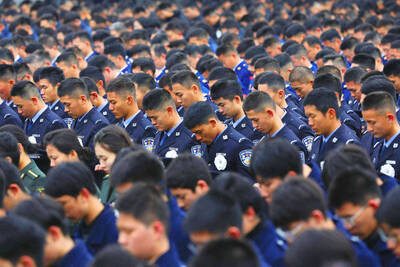
China yesterday held a low-key memorial ceremony for the 1937 Nanjing Massacre, with Chinese President Xi Jinping (習近平) not attending, despite a diplomatic crisis between Beijing and Tokyo over Taiwan. Beijing has raged at Tokyo since Japanese Prime Minister Sanae Takaichi last month said that a hypothetical Chinese attack on Taiwan could trigger a military response from Japan. China and Japan have long sparred over their painful history. China consistently reminds its people of the 1937 Nanjing Massacre, in which it says Japanese troops killed 300,000 people in what was then its capital. A post-World War II Allied tribunal put the death toll

A passerby could hear the cacophony from miles away in the Argentine capital, the unmistakable sound of 2,397 dogs barking — and breaking the unofficial world record for the largest-ever gathering of golden retrievers. Excitement pulsed through Bosques de Palermo, a sprawling park in Buenos Aires, as golden retriever-owners from all over Argentina transformed the park’s grassy expanse into a sea of bright yellow fur. Dog owners of all ages, their clothes covered in dog hair and stained with slobber, plopped down on picnic blankets with their beloved goldens to take in the surreal sight of so many other, exceptionally similar-looking ones.
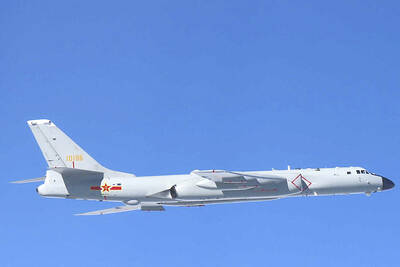
‘UNWAVERING ALLIANCE’: The US Department of State said that China’s actions during military drills with Russia were not conducive to regional peace and stability The US on Tuesday criticized China over alleged radar deployments against Japanese military aircraft during a training exercise last week, while Tokyo and Seoul yesterday scrambled jets after Chinese and Russian military aircraft conducted joint patrols near the two countries. The incidents came after Japanese Prime Minister Sanae Takaichi triggered a dispute with Beijing last month with her remarks on how Tokyo might react to a hypothetical Chinese attack on Taiwan. “China’s actions are not conducive to regional peace and stability,” a US Department of State spokesperson said late on Tuesday, referring to the radar incident. “The US-Japan alliance is stronger and more


 RSS
RSS